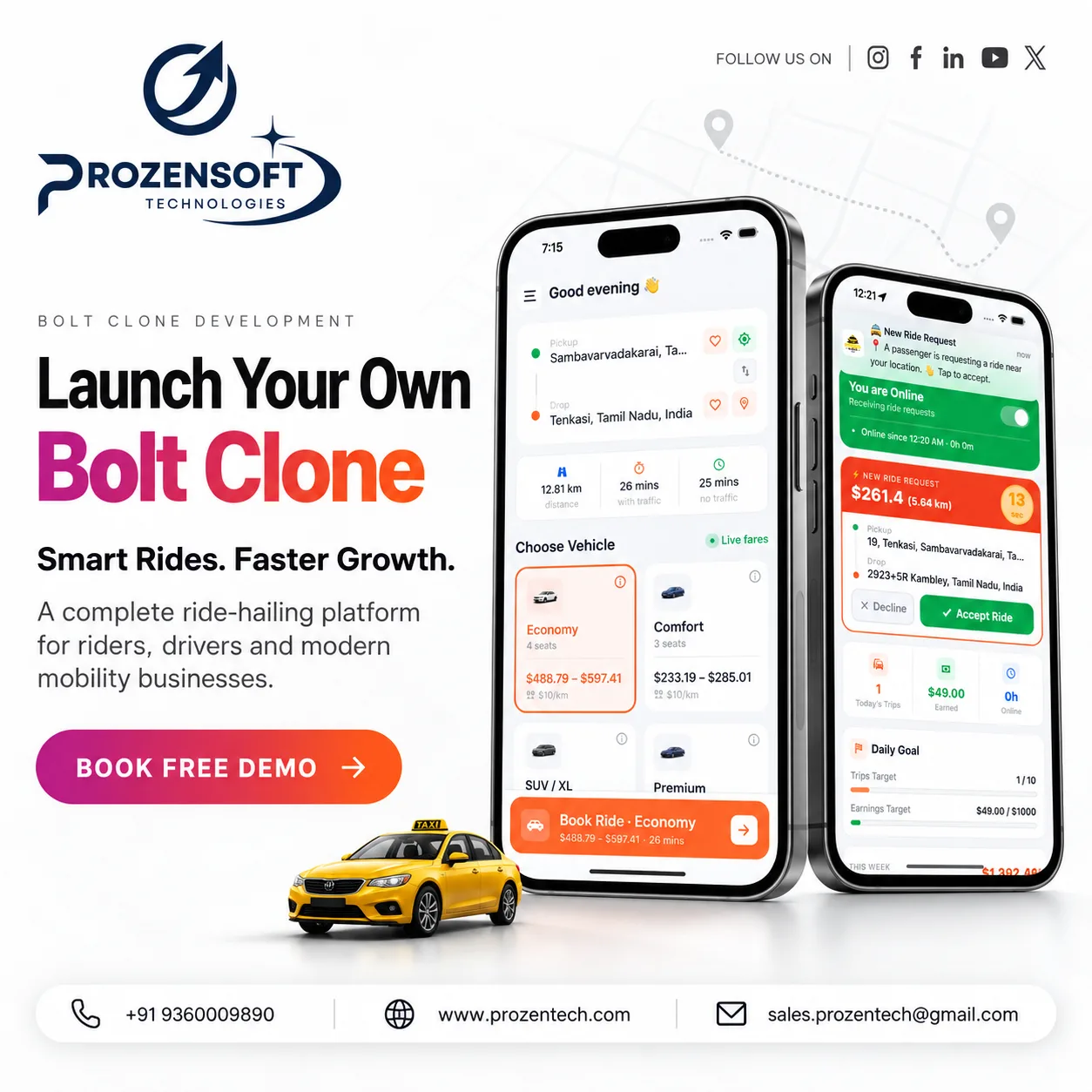
A professional Bolt Clone App Development solution should therefore combine customer experience, driver management, dispatch automation, localized pricing, payments, safety, fleet operations, promotions, and business intelligence into one connected platform. In this article, we explore how a Bolt-like mobility solution can be designed not just for launch, but for retention, reliability, operational efficiency, and sustainable expansion.
Mobility Businesses Win Through Repeat Usage
Ride-hailing is a habit-driven business.
If customers have a reliable experience, they are likely to return.
If they face:
- Long waiting times
- Repeated driver cancellations
- Unclear fares
- Payment failures
- Poor support
they may quickly switch to another platform.
This means customer retention should be considered from the beginning.
A good Bolt-like app should make every trip feel predictable.
The customer opens the app, books quickly, receives a driver, completes the ride, makes payment, and gets the information they need without confusion.
That consistency is what turns occasional users into regular riders.
The Booking Experience Should Feel Almost Instant
A rider should not need to navigate through several screens before booking.
The ideal booking journey can be:
Choose Pickup
Enter Destination
Select Vehicle
View Fare
Confirm Ride
The application can make this even faster using:
- Current location detection
- Saved home and work addresses
- Recent destinations
- Favourite locations
- Suggested pickup points
Small improvements in booking speed can have a major impact on customer experience.
Vehicle Choice Should Be Simple and Relevant
Too many vehicle categories can confuse customers.
The platform should offer categories that match the local market.
For example:
Economy
Affordable everyday transportation.
Comfort
Better vehicle standards and additional convenience.
Premium
Higher-end cars for business or luxury customers.
XL
Larger vehicles for families or groups.
Bike or Auto
Regional low-cost options where appropriate.
Each category should clearly display:
- Estimated fare
- Estimated arrival
- Passenger capacity
- Category name
Customers should understand the difference immediately.
Reliability Starts With Better Driver Availability
A ride-hailing platform is only as useful as its active driver network.
The admin system should provide visibility into:
- Online drivers
- Offline drivers
- Busy drivers
- Drivers by location
- Drivers by vehicle category
This helps the business understand whether enough supply exists in each operating zone.
For example:
Zone A may have strong customer demand but weak driver availability.
Zone B may have many drivers but low booking volume.
The platform can use this information to support operational decisions.
Driver Onboarding Should Be Fast but Controlled
Drivers are one of the most important assets of a mobility marketplace.
The onboarding process should therefore balance convenience with verification.
Drivers can provide:
- Name and contact information
- Driving licence
- Identity proof
- Vehicle registration
- Insurance
- Vehicle photographs
- Required permits
The admin team can review applications and approve eligible drivers.
Statuses may include:
Pending
Under Review
Approved
Rejected
Suspended
This keeps onboarding structured even when hundreds of drivers join.
Fleet Owners Can Become a Growth Channel
Some mobility companies work with individual drivers.
Others may partner with fleet operators.
A fleet owner may manage:
- Multiple vehicles
- Several drivers
- Driver assignments
- Earnings
- Trips
- Vehicle documents
A fleet portal can allow partners to manage their operations without requiring full admin access.
This can help the platform expand driver supply faster.
Automatic Dispatch Can Reduce Manual Work
Manual driver assignment becomes difficult when booking volume grows.
A smart dispatch system can automatically identify eligible drivers based on:
- Pickup distance
- Availability
- Vehicle category
- Service zone
- Driver status
- Estimated arrival time
The platform may use:
Nearest Driver Assignment
Multiple Driver Broadcast
Priority-Based Assignment
Hybrid Dispatch
Automation helps reduce the workload on dispatch teams while improving response time.
Trip Status Should Keep Everyone Synchronized
A ride can move through a structured lifecycle:
Ride Requested
Driver Accepted
Driver On the Way
Driver Arrived
Trip Started
Trip Completed
Cancelled
These statuses keep:
- Rider app
- Driver app
- Admin panel
- Notifications
- Payments
synchronized.
If a customer contacts support, the team can immediately understand what happened during the trip.
OTP Verification Can Improve Trip Accuracy
One useful safety feature is OTP-based trip start.
The rider receives a code.
The driver arrives.
The rider provides the code.
The driver enters it.
The trip starts.
This helps reduce incorrect trip starts and confirms that the right customer has entered the vehicle.
Pricing Should Be Localized
A Bolt-like platform may operate across different cities or zones.
Each market may require its own fare structure.
A fare can include:
Base Fare
- Distance Charge
- Time Charge
- Service Fee
- Taxes
Businesses may also configure:
- Minimum fare
- Waiting fee
- Cancellation charge
- Airport fee
- Night pricing
- Toll charges
Localized pricing makes the platform more adaptable.
Promotions Should Help Build Habits
Discounts can be useful, but they should have a clear purpose.
For example:
First Ride Offer
Encourage new user conversion.
Referral Reward
Bring in new riders.
Weekend Coupon
Increase weekend usage.
Airport Offer
Promote airport transfers.
Returning Customer Discount
Reactivate inactive users.
The admin panel can control eligibility, expiry dates, usage limits, and discount values.
Customer Loyalty Can Go Beyond Discounts
A ride-hailing platform can introduce loyalty programs.
For example:
Complete 10 rides → Receive a reward.
Spend a certain amount → Earn credits.
Refer friends → Receive wallet balance.
Membership tiers can also be introduced.
Examples:
Silver
Gold
Platinum
Higher levels may receive:
- Priority support
- Special discounts
- Reduced booking fees
- Exclusive ride offers
This gives customers additional reasons to stay with the platform.
Wallets Can Improve Repeat Transactions
A customer wallet can support:
- Promotional credits
- Refunds
- Cashback
- Referral rewards
- User top-ups
Driver wallets can separately track:
- Earnings
- Incentives
- Deductions
- Withdrawals
Keeping rider and driver wallets separate helps maintain financial clarity.
Driver Earnings Need Transparency
Drivers should always know how each trip affects their earnings.
The driver app can show:
Trip Fare
Platform Commission
Driver Share
Tips
Incentives
Final Earnings
Additional dashboards can show:
- Daily income
- Weekly income
- Completed trips
- Withdrawals
- Wallet balance
Transparent earnings can improve driver confidence.
Payment Options Should Match Customer Preference
Different markets prefer different payment methods.
A platform may support:
- Cash
- Cards
- UPI
- Wallet
- Local payment gateways
- International gateways
Payment status should stay connected to the trip.
The platform can track:
Paid
Pending
Failed
Refunded
This makes finance and support workflows easier to manage.
Cancellation Rules Should Be Fair and Configurable
Cancellations happen in every ride-hailing business.
The system should identify:
- Who cancelled
- When they cancelled
- Whether the driver had arrived
- How long the driver waited
- Why the trip was cancelled
Businesses can define policies accordingly.
This also allows management to identify repeated cancellation patterns.
Customer Support Needs Complete Ride Context
Support teams should not have to ask customers for basic trip information.
The support panel can display:
- Rider
- Driver
- Vehicle
- Pickup
- Destination
- Trip timeline
- Fare
- Payment
- Cancellation status
This makes problem resolution faster and more professional.
Ratings Can Improve Marketplace Quality
After each ride, riders and drivers can rate each other.
The platform can track:
- Average rating
- Completed trips
- Cancellation history
- Complaints
- Service quality
Drivers with consistently low ratings can be reviewed.
High-performing drivers can receive incentives.
This turns feedback into a quality management tool.
Scheduled Rides Can Create Premium Use Cases
Customers may want to plan rides in advance.
Scheduled booking can support:
- Airport transfers
- Office travel
- Meetings
- Hospital visits
- Events
- Early morning trips
Scheduled demand can also help operations teams prepare driver availability more effectively.
Corporate Mobility Can Create Recurring Revenue
Businesses can use the platform for employee or guest transportation.
A corporate module may include:
- Company profile
- Employee users
- Booking limits
- Approved vehicle categories
- Monthly billing
- Central payment
- Trip reports
This creates a separate B2B revenue stream.
The Admin Dashboard Should Be Action-Oriented
The admin dashboard should immediately highlight important issues.
Examples:
12 Drivers Awaiting Approval
8 Active Trips
5 Unassigned Bookings
3 Failed Payments
High Demand in Zone A
Driver Supply Low in Zone B
Management should not have to search through hundreds of records to identify operational problems.
The dashboard should surface exceptions.
Analytics Can Improve Business Decisions
Useful mobility metrics include:
- Ride completion rate
- Driver acceptance rate
- Average pickup time
- Average trip value
- Driver utilization
- Customer retention
- Cancellation rate
- Platform commission
- Revenue by city
- Revenue by category
These metrics help management understand both operational performance and customer behaviour.
Multi-City Growth Requires Flexible Configuration
When a platform expands, each city can be configured separately.
For example:
City A — Economy + Comfort
City B — Bike + Auto + Economy
City C — Premium + Airport Service
Each city can also have different:
- Pricing
- Drivers
- Promotions
- Payment methods
- Service zones
- Commission rules
Central administrators can still manage everything from one platform.
Technology Behind a Bolt Clone Platform
A complete solution can include:
Rider App
For booking, payments, tracking, promotions, and trip history.
Driver App
For trip requests, navigation, availability, and earnings.
Fleet Portal
For fleet owners where required.
Admin Dashboard
For complete business management.
Backend
Node.js, NestJS, Laravel, Django, Java, or another suitable framework.
Database
PostgreSQL, MongoDB, MySQL, or another scalable database.
Real-Time Technology
WebSockets or Socket.IO for live ride and location updates.
Maps
Google Maps or supported alternatives.
Payments
Regional or international payment providers.
The architecture should be designed to support real-time bookings and future expansion.
What Makes a Bolt-Like Platform Strong?
A strong platform should perform well in five areas.
Reliable Driver Supply
Customers can consistently find rides.
Smooth Booking
The customer journey remains simple.
Transparent Economics
Pricing and driver earnings are clear.
Operational Automation
Dispatch, payments, notifications, and reporting require less manual effort.
Customer Retention
Users have reasons to return.
When these areas work together, the platform becomes more valuable over time.
Final Thoughts
A successful Bolt-like platform should be designed for more than initial launch.
It should support repeat customer usage, reliable driver availability, efficient dispatch, transparent pricing, strong support, and scalable city operations.
A carefully planned Bolt Clone App Development project can connect these elements within one digital mobility ecosystem.
Customers receive a consistent ride experience.
Drivers receive clearer earning opportunities.
Fleet partners gain structured management tools.
Operations teams gain better visibility.
Business owners gain more control over growth.
The strongest ride-hailing platforms do not simply generate bookings.
They build long-term mobility relationships between customers, drivers, and the business.
Frequently Asked Questions
1. What is Bolt clone app development?
Bolt clone app development is the process of building a ride-hailing platform inspired by the Bolt operating model, with rider, driver, admin, dispatch, payment, and business management capabilities.
2. Can the app support different ride categories?
Yes. Economy, Comfort, Premium, SUV, Bike, Auto, XL, and custom categories can be added.
3. Can fleet owners manage multiple vehicles?
Yes. A fleet portal can allow authorized fleet partners to manage vehicles, drivers, trips, and earnings.
4. Can fares differ by city or zone?
Yes. Each city or service area can have separate fare structures and business rules.
5. Can drivers be verified before activation?
Yes. Driver and vehicle documents can be submitted and reviewed through an approval workflow.
6. Can customers schedule rides?
Yes. Both instant and future scheduled rides can be supported.
7. Can the platform provide live driver tracking?
Yes. GPS and map integrations can provide real-time driver location and trip progress.
8. Can customer loyalty programs be added?
Yes. Rewards, referral credits, wallets, membership tiers, and repeat-ride benefits can be included.
9. Can the system manage driver commissions?
Yes. Commission rules can be configured by driver, city, vehicle category, or fleet agreement.
10. Can corporate transportation accounts be included?
Yes. Companies can receive employee booking access, centralized billing, ride limits, and reporting.
11. Can the platform support multiple payment methods?
Yes. Cash, cards, wallets, UPI, and supported regional or international gateways can be integrated.
12. Can the Bolt clone platform expand to multiple cities?
Yes. A scalable architecture can support city-specific drivers, pricing, vehicle categories, promotions, service zones, and operational settings.