There's a habit millions of people have that's slowly eroding their sleep — and almost none of them know it's happening.
It doesn't involve caffeine. It doesn't involve stress. It doesn't even feel like a bad habit. It's simply sitting in a lit room looking at a screen after dark, the same way nearly everyone does, every single night.
The mechanism behind the damage is blue light. And blue light filter glasses are one of the most targeted, practical ways to stop it.
What "Filtering" Actually Means
The word "filter" gets used loosely in this space. It's worth being precise about what's actually happening when a lens filters blue light — because that precision is what separates a product that works from one that just claims to.
Visible light travels in waves. Shorter wavelengths carry more energy. Blue light — sitting between roughly 400 and 500 nanometers on the spectrum — is among the most energetic light your eyes encounter indoors. When a lens filters it, the lens material absorbs those specific wavelengths before they pass through to your retina.
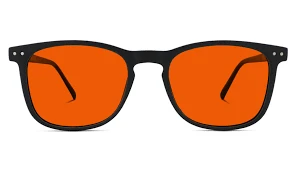
The amount absorbed depends on the lens tint. A clear lens with a surface coating might intercept 10–20% of incoming blue light. A mid-amber lens intercepts 65–80%. A deep amber or orange lens can intercept 90% or more.
Those numbers represent very different physiological outcomes — not minor variations on the same product. The filtering percentage determines whether your brain gets a meaningful "it's getting dark" signal or a mildly edited version of the same "it's daytime" broadcast it's been receiving all day.
The Biology Behind Why It Matters
Your brain doesn't guess when it's time to sleep. It receives a signal — specifically, the gradual disappearance of blue-spectrum light from the environment as the sun sets.
Inside the retina, a specialized population of cells called intrinsically photosensitive retinal ganglion cells (ipRGCs) monitor the light environment continuously. They're most sensitive to wavelengths around 480 nm. When stimulated, they relay a signal to the suprachiasmatic nucleus — the brain's master circadian clock — which keeps melatonin suppressed.
As natural light fades in the evening, that stimulus drops. Melatonin begins rising. Core body temperature falls. Heart rate slows. The body shifts into a physiological state primed for deep, restorative sleep.
Artificial light interrupts that sequence. LED screens, overhead lights, and smart TVs all emit meaningful amounts of blue-range wavelengths. The ipRGCs can't distinguish between sunlight and a phone screen. The circadian clock receives the same signal regardless of the actual time — and melatonin stays suppressed.
Research has shown this delay can range from 30 minutes to over 90 minutes depending on exposure intensity. Over days and weeks, that means consistently less deep sleep, harder mornings, and a creeping fatigue that's difficult to trace back to its source.
Blue light filter glasses reduce the stimulus reaching those retinal cells, allowing the evening melatonin sequence to begin closer to when it should.
Why Most People Buy the Wrong Type
Here's where a lot of purchases go wrong.
The majority of blue light filter glasses sold today have clear or near-clear lenses. They look like regular glasses, they're comfortable for all-day wear, and they're marketed with language about "filtering harmful blue light" and "protecting your eyes."
What they rarely disclose clearly is that their filtering rate is typically between 10% and 25%. That is not enough to meaningfully change the signal your circadian system receives. If the goal is sleep improvement and melatonin protection, a 15% filter leaves 85% of the relevant wavelengths intact — and 85% is more than enough to keep melatonin suppressed.
This doesn't mean clear-lens products are useless. For mild daytime screen comfort — reducing glare, softening harsh display brightness — they serve a role. But they should not be confused with genuine circadian protection. The two are categorically different applications.
For actual sleep benefit, the lens needs to be visibly amber. If the lenses look clear, the filtering is cosmetic-level for circadian purposes.
Choosing Blue Light Filter Glasses That Perform
Cut through the noise with three non-negotiable criteria:
Disclosed filtering percentage. Any product making a circadian health claim should state exactly what percentage of blue light it blocks and across which wavelength range. If that information isn't front and center, that tells you something important about the brand's confidence in its own product.
Visible amber tint. For evening and sleep-focused use, the lens must have a perceptible amber or orange tint. This is the physical evidence of real filtering happening at the wavelengths that matter. No tint, no meaningful melatonin protection.
Comfortable enough to wear for two hours. Blue light filter glasses need to be on your face consistently in the pre-sleep window to work. Weight, nose bridge fit, and lens quality all determine whether you'll actually keep the habit. Try before you commit if possible, or choose a brand with a clear returns policy.
The Right Way to Use Them
Start two hours before bed — not ten minutes. Melatonin suppression builds up over an exposure window. Starting the filter early gives your body time to respond. By the time your head hits the pillow, melatonin should already be rising, not just beginning to.
Be consistent. One or two nights of use won't noticeably shift your sleep. Ten to fourteen nights of consistent evening use typically produces measurable changes in sleep onset time and sleep quality. Your circadian system learns from patterns, not one-offs.
Pair with a warmer environment. Blue light filter glasses intercept what passes through the lens. Ambient room light still reaches your eyes from other angles. Switching overhead LEDs to warm-toned lamps (under 2700K) in the evening reduces the total blue light load and makes the glasses' job significantly easier.
Keep daytime light bright. The contrast between strong daytime light and filtered evening light is what sharpens circadian signaling. Don't wear high-filtering glasses during the day — and if possible, get genuine sunlight exposure in the morning to firmly anchor your clock at the start of the day.
The Result of Getting This Right
When your melatonin rises on schedule, everything downstream shifts. You feel genuinely sleepy at an appropriate time rather than tired-but-wired. Sleep onset shortens. Deep sleep stages become more accessible. Mornings feel different — not because you slept more hours, but because the sleep you got was timed correctly and properly consolidated.
Blue light filter glasses are one small piece of that equation. But they address a genuine, well-understood mechanism — and when the right lens is worn at the right time, the difference is real.