
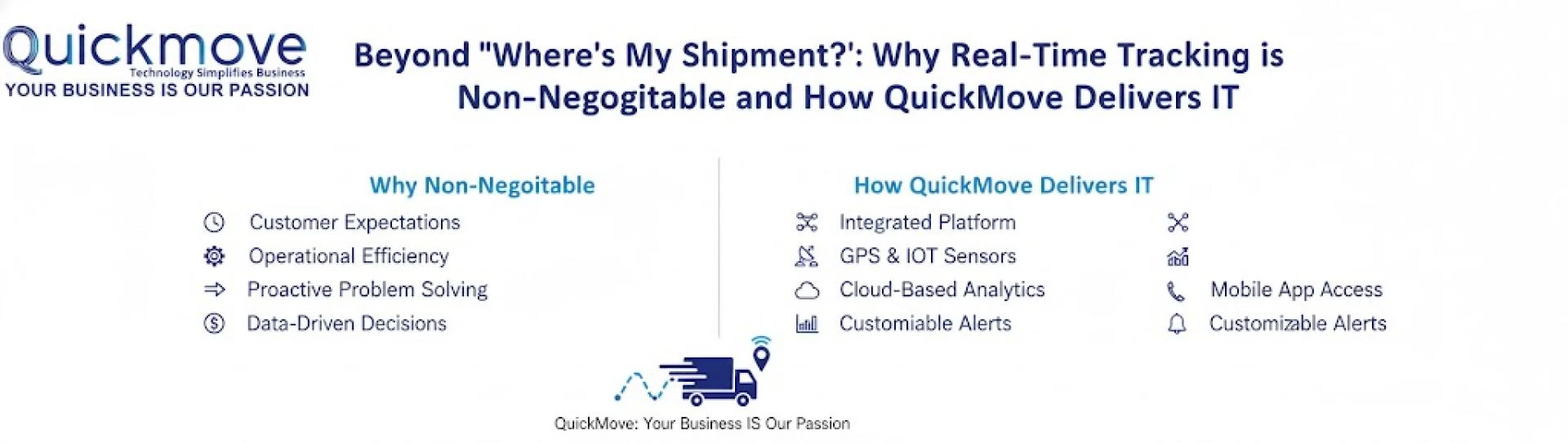
In today's global supply chain, information is as critical as the physical goods being moved. The simple question, "Where's my shipment?" holds immense weight. For freight forwarders, the ability to answer this question instantly and accurately is no longer a premium service—it's a fundamental expectation that defines customer trust and operational competence. This blog explores why real-time shipment tracking is indispensable and how QuickMove's Freight Forwarding Software provides a comprehensive solution that transforms tracking from a reactive task into a proactive strategic advantage.
The High Stakes of Poor Shipment Visibility
Operating without robust tracking isn't just an inconvenience; it's a significant business risk that impacts every stakeholder:
- For Your Customers: Lack of visibility creates anxiety, erodes trust, and damages your reputation. It forces them to make blind business decisions about production, inventory, and sales.
- For Your Operations Team: Manual tracking—scouring carrier websites, making phone calls, and updating spreadsheets—consumes hours of valuable time each day. It leads to reactive firefighting instead of proactive exception management.
- For Your Business: Inefficient tracking contributes to poor resource planning, inability to optimize costs, and a higher risk of incurring detention and demurrage charges due to missed milestones.
The QuickMove Solution: Proactive, Unified, Intelligent Tracking
QuickMove's freight forwarding software is engineered to eliminate tracking blind spots. We move beyond simply providing a tool to check status; we build end-to-end visibility into the core of your operations. Here’s how:
1. Unified Multi-Carrier, Multi-Modal Dashboard
Instead of juggling ten different airline, shipping line, and trucking company portals, your team has one single source of truth. QuickMove aggregates tracking data from all your carriers—whether ocean, air, or road—into a centralized dashboard. This gives you a holistic, real-time view of every active shipment's status, from booking confirmation to final proof of delivery.
2. Automated Milestone Capture & Real-Time Alerts
The system does the heavy lifting. It automatically captures key milestones (e.g., Vessel Departed, Arrived at Port, Customs Cleared, Out for Delivery) via API/EDI integrations or smart parsing of carrier updates. More importantly, it configures proactive alerts. Your team and your customers can receive automatic notifications for critical events or exceptions (like a missed port arrival or a customs hold), enabling immediate action before a small delay becomes a major problem.
3. Enhanced Customer Transparency with Self-Service Portals
Stop being an information switchboard. QuickMove allows you to offer branded customer portals where your clients can log in to see the live status of their shipments, view documents (like Bills of Lading and Commercial Invoices), and access historical data. This 24/7 self-service capability dramatically reduces the "status update" calls to your team, boosting customer satisfaction while freeing your staff for higher-value work.
4. Data-Driven Insights for Operational Excellence
Tracking data is more than just location pins on a map. QuickMove's platform turns this data into intelligence. The profitability and cost analysis tools can correlate transit times with costs, while reporting features help you:
- Analyze carrier performance (on-time pickup, transit delays).
- Identify bottlenecks in specific lanes or ports.
- Provide accurate ETAs based on historical data, improving your planning reliability.
5. Seamless Integration with Your Entire Workflow
Tracking in QuickMove isn't a siloed module. It's deeply integrated with shipment management, documentation, and billing. When a shipment is marked "Delivered" in the tracking system, it can automatically trigger the generation of the final invoice, creating a seamless, efficient workflow that closes the operational and financial loop.
Key Tracking Capabilities that Set QuickMove Apart
- Proactive Exception Management: Alerts for deviations from the planned route or schedule.
- Estimated Time of Arrival (ETA) Accuracy: AI-enhanced ETAs that improve as more data is gathered.
- Document Trail Integration: View tracking milestones alongside corresponding shipping documents.
- Mobile Accessibility: Manage and monitor shipments on-the-go from any device.
Conclusion: Transform Tracking from a Cost Center to a Value Engine
In the visibility-driven economy, your ability to track shipments effectively is a direct reflection of your company's professionalism and reliability. With QuickMove's Freight Forwarding Software, you gain more than just a tracking tool—you gain a comprehensive visibility platform that empowers your team, delights your customers, and provides the data needed to optimize your entire network.
Investing in robust, integrated tracking is an investment in operational resilience, customer loyalty, and sustainable growth. Stop chasing shipments and start mastering your supply chain.
The Tracking Evolution: Manual vs. QuickMove
AspectManual, Disconnected TrackingWith QuickMove Freight SoftwareData SourceMultiple carrier websites, emails, phone calls.Unified dashboard aggregating all carrier data automatically.Team WorkflowReactive; constant searching and updating spreadsheets.Proactive; focus on managing exceptions from automated alerts.Customer CommunicationReactive responses to frequent "where is it?" calls.Proactive transparency via automated alerts and self-service portals.Data UtilityStatic, used only for basic status updates.Actionable intelligence for carrier performance, lane analysis, and forecasting.Operational ImpactHigh administrative overhead, delayed response to issues.Lower overhead, faster resolution of delays, improved planning.