
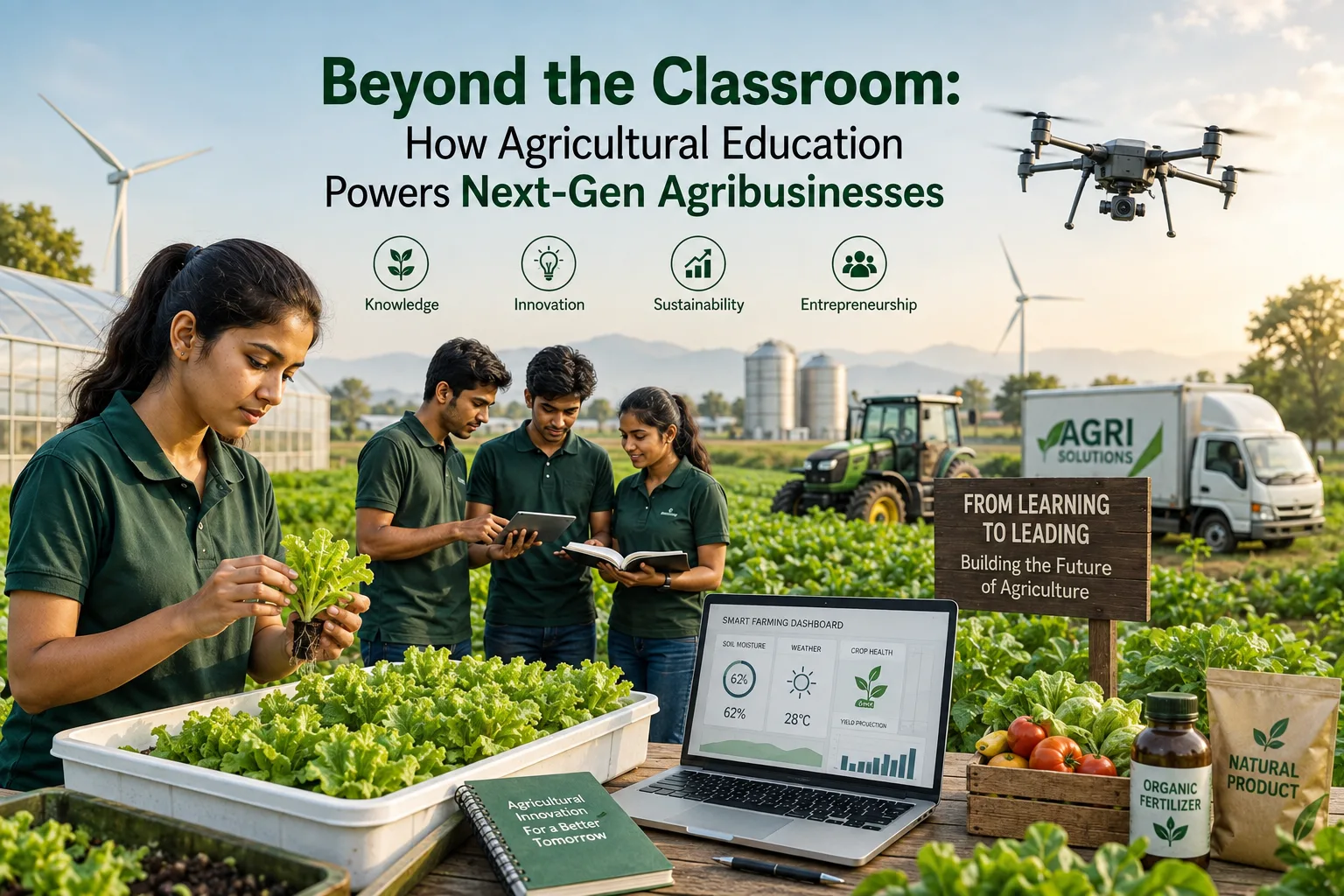
When people think of agriculture, the thought process usually involves farming in the old sense of the word. However, upon entering this particular institute, one can see that it is actually a step into the future, where the newest ideas and concepts are being developed by the future's leading minds.
With the world's supply chains evolving, weather patterns changing, and consumers becoming more conscious of their impact on the world, the face of agriculture is changing as well, and new professionals are needed who are capable of creating the type of businesses that will help meet the needs of the future.
Here is how modern agricultural education is transcending traditional learning to build the enterprise leaders of tomorrow.
1. Merging Agronomy with Enterprise Management
Building a successful agribusiness requires far more than an understanding of crop physiology or soil dynamics. It requires navigating market volatility, optimizing supply chains, and leveraging digital tools to maximize yield and profitability.
A comprehensive 4-year B.Sc. (Hons.) Agriculture program bridges this exact gap. By integrating multi-disciplinary subjects—spanning Crop Management, Horticulture, Social Sciences, and Farm Machinery—students develop a holistic, 360-degree understanding of the agricultural ecosystem.
When young professionals understand both the biological fundamentals of crop growth and the economic principles of market access, they are uniquely positioned to launch ventures that are biologically viable and financially sustainable.
2. Hands-On Field Experience as a Business Testing Ground
You cannot innovate in agribusiness from behind a desk. The most successful agri-entrepreneurs are those who have worked directly with soil, analyzed crop health under real-world weather constraints, and experimented with resource management techniques.
Modern agricultural institutes provide experiential learning environments—such as dedicated research farms, weather tracking stations, and advanced crop protection labs—where students can directly test hypotheses:
- Resource Optimization: Testing water management systems that cut operational overhead.
- Precision Farming: Applying modern equipment and techniques to track land usage and soil health.
- Biotechnology Application: Exploring sustainable pest and disease management solutions that reduce chemical reliance.
This practical exposure transforms abstract theory into actionable business models before students even graduate.
3. Unlocking New Avenues for Agri-Innovation
The modern agricultural landscape is no longer restricted to traditional farming roles. Today’s graduates are founding and scaling enterprises across a diverse range of high-growth sectors:
- Agri-Tech Startups: Building IoT-driven soil monitoring platforms, automated irrigation networks, and drone-based crop assessment tools.
- Sustainable Supply Chains: Establishing direct-to-consumer farm networks, cold-chain logistics, and organic certification channels.
- Biotech & Seed Innovation: Developing drought-resistant crop varieties and bio-fertilizers that meet stringent global standards.
- Agri-Consulting & Finance: Guiding financial institutions, policymakers, and private equity funds on sustainable agricultural investments.
4. Solving Global Challenges Through Local Enterprise
At its core, agribusiness is about addressing the most pressing problems of humanity: ensuring food security, saving scarce resources, and increasing the economic security of rural areas.
Education in modern agribusiness encourages young people to develop new practical ways to make local agriculture more competitive. Such projects can be of different types: they can be addressed to local producers, helping them find ways to save on resources, or be designed to process raw materials into more competitive products for broader sales.
The Road Ahead
The future of global food systems relies on leaders who can combine scientific knowledge with business vision. As the sector continues to digitize and scale, pursuing a structured, industry-aligned agricultural education program is no longer just a path into scientific research—it is the ultimate launchpad for the next generation of agribusiness pioneers.