Introduction
In automotive manufacturing, vehicle quality depends on much more than the design of individual components. The way metal panels are formed, positioned, and joined also plays an important role in the appearance, fit, and durability of the finished vehicle.
One process that contributes to these outcomes is hemming. Commonly used for doors, hoods, and tailgates, hemming involves folding the edge of an outer metal panel around an inner panel to create a finished joint.
With advances in automation, robotics, and precision tooling, modern hemming equipment helps manufacturers achieve greater process consistency and manage increasingly complex body-panel designs. Its value extends beyond joining two panels: it also supports dimensional accuracy, surface appearance, and efficient automotive production.
What Is Hemming in Automotive Body Manufacturing?
Hemming is a metal-forming process used to fold the edge of a panel over another panel. In automotive body manufacturing, it is commonly used to join exterior skins with inner structures while creating a clean, finished edge.
The process typically involves an initial bend, followed by further forming to bring the edge into its final position. The exact sequence depends on the component design, material, and required joint characteristics.
Hemming is especially important for visible body components because small inconsistencies along an edge can affect panel fit, appearance, and the alignment of adjacent parts.
A well-designed hemming process must therefore balance forming accuracy, material behavior, tooling design, and production efficiency.
1. Improving Panel Fit and Dimensional Accuracy
Accurate panel geometry is essential for consistent gaps and flushness between adjacent vehicle components. If a door, hood, or tailgate has inconsistent edge dimensions, it may become more difficult to achieve the intended fit during final vehicle assembly.
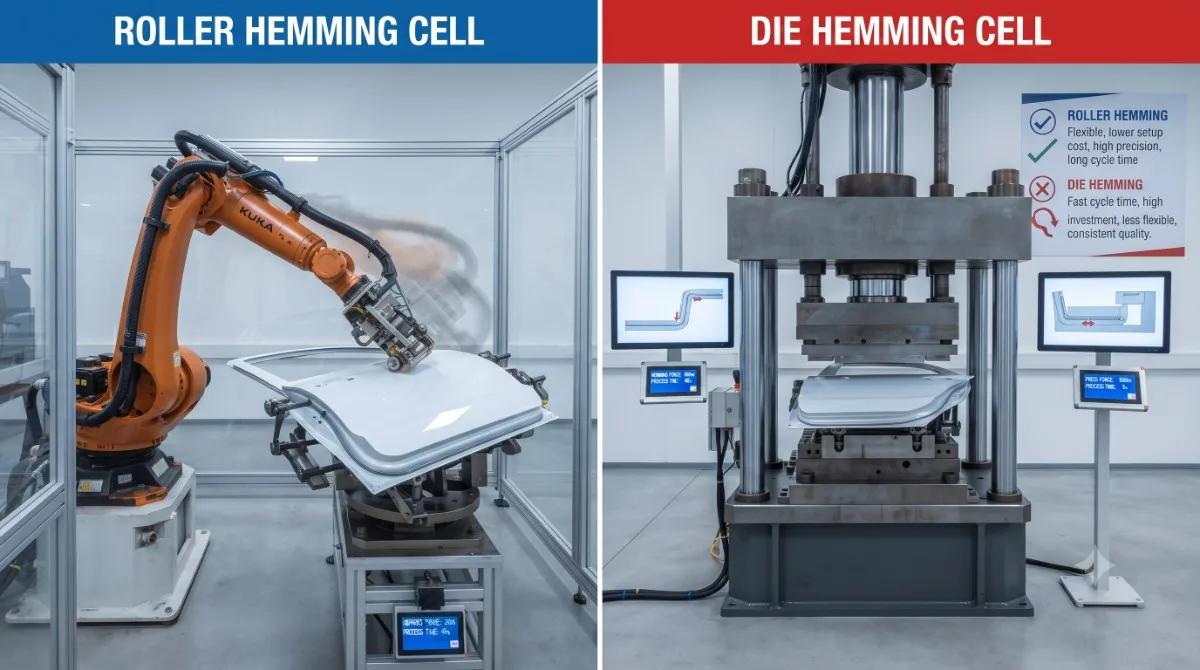
Advanced hemming equipment can help control the forming path and apply repeatable process conditions. Robotic systems follow programmed tool paths, while dedicated die-based systems use carefully engineered tooling to form the panel edge.
However, the final dimensions depend on the entire process, including panel stamping accuracy, fixture positioning, material variation, tool condition, and springback.
By controlling these factors, manufacturers can improve dimensional consistency and reduce the risk of downstream adjustment or rework.
2. Enhancing Exterior Surface Appearance
A vehicle's exterior panels contribute significantly to its perceived quality. Customers notice uneven edges, inconsistent gaps, surface marks, and differences in the alignment of doors and body panels.
Hemming quality can influence the appearance of the finished panel edge and the way inner and outer panels fit together.
Modern equipment can help maintain controlled tool movement and consistent forming conditions. Appropriate roller profiles, die geometry, lubrication where required, and process parameters are important for reducing defects such as wrinkles, edge distortion, and unwanted surface marks.
The result depends on selecting the right process for the component and validating it against the manufacturer's appearance standards.
3. Supporting Reliable Panel Joints
Hemming creates a mechanical joint between metal panels. Depending on the component and design, adhesives may also be incorporated into the joint to provide additional bonding, sealing, or structural performance.
The quality of the finished joint depends on factors such as edge folding, material properties, adhesive application where applicable, and the geometry of the assembled panels.
Advanced hemming equipment helps manufacturers apply controlled forming operations that support repeatable joint formation. Inspection and process validation are still needed to verify that the joint meets the relevant engineering specifications.
For automotive manufacturers, this consistency is important when producing large numbers of components across repeated production cycles.
4. Reducing Defects and Rework
Manufacturing defects can lead to additional inspection, repair, material waste, and production delays. In hemming operations, common concerns include uneven edges, panel deformation, wrinkles, dimensional variation, and inconsistent joint formation.
Automated equipment can reduce variation caused by inconsistent manual handling and tool movement. When combined with suitable fixtures, process monitoring, and effective quality checks, it can help manufacturers identify problems and improve process repeatability.
Simulation can also help engineers evaluate robot paths and potential interference before equipment is commissioned.
Automation alone does not guarantee defect-free production. Material consistency, tooling maintenance, operator training, and regular process validation remain essential.
5. How Robotic Roller Hemming Supports Flexibility
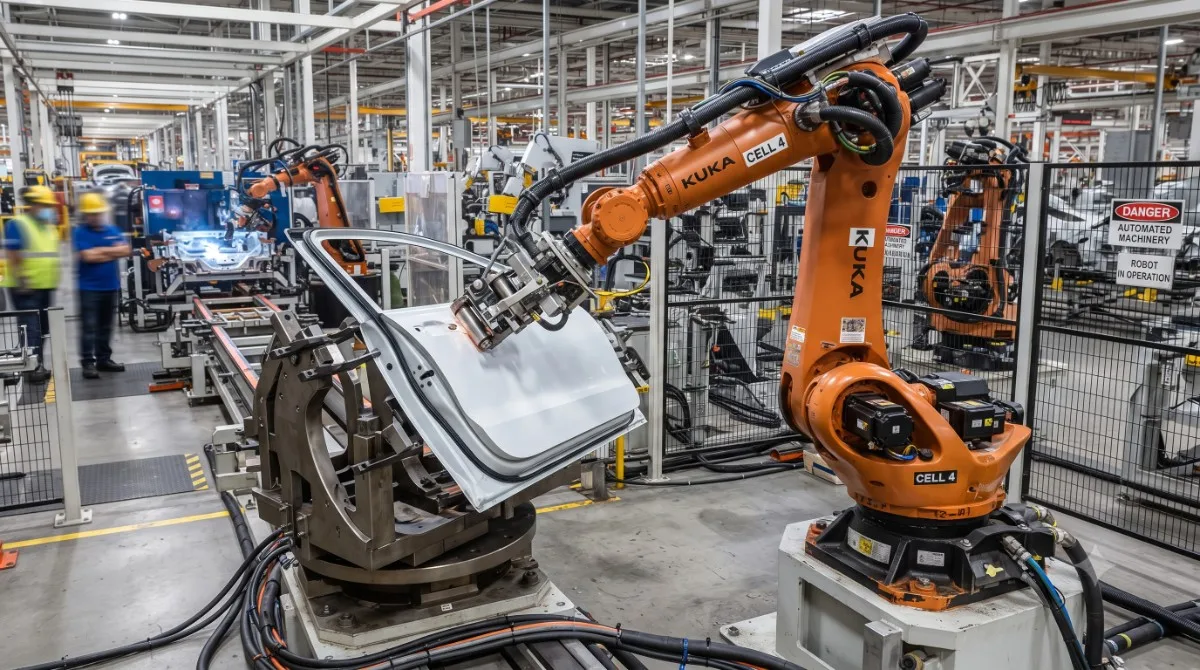
Robotic roller hemming is one approach used to form automotive panel edges. An industrial robot guides a roller tool along a programmed path, progressively folding the edge into the required shape.
This approach can be useful when manufacturers need to accommodate different component geometries or multiple vehicle variants.
Its potential benefits include:
- Adaptable tool paths: Robot programs can be updated for different panel designs when the equipment and fixtures support those parts.
- Reduced dependence on dedicated full-size dies: Some applications can be handled with flexible roller tooling instead of a separate dedicated hemming die for every variant.
- Controlled movement: Programmed robot motion helps repeat the validated forming path.
- Support for mixed-model production: Flexible cells can be useful when production requirements include several component types.
The best choice depends on cycle-time targets, part complexity, tooling costs, and required production volumes. Die hemming may remain attractive for applications that benefit from dedicated tooling and high-volume processing.
6. The Role of Advanced Hemming Equipment
A modern hemming system is more than a robot or a press. It may include forming tools, precision fixtures, part-positioning systems, control software, safety equipment, and inspection technologies.
Each element contributes to the overall process.
Precision tooling helps create the required edge geometry.
Accurate fixtures hold panels in the correct position during forming.
Automation and controls support repeatable movement and coordinated production operations.
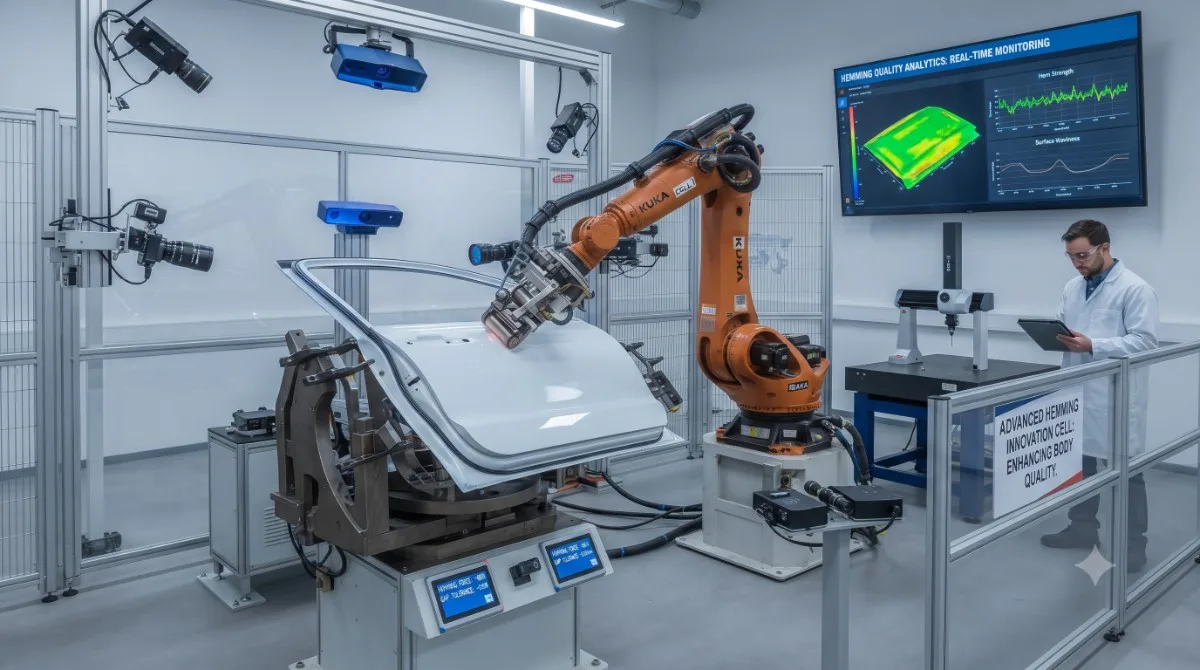
Inspection systems help verify that finished components meet dimensional and appearance requirements.
Maintenance programs help preserve equipment performance and identify wear before it affects production quality.
Manufacturers should consider the complete system when evaluating a new hemming solution rather than focusing only on the forming machine.
HIROTEC offers automotive manufacturing and equipment solutions, including hemming technology. Learn more about its capabilities on the HIROTEC hemming manufacturing equipment page.
7. Choosing the Right Hemming Process
Selecting a suitable hemming system requires balancing quality requirements with production needs.
Manufacturers should evaluate several factors before investing in equipment:
- Component geometry: Complex curves and edge profiles may influence the choice of forming method.
- Production volume: High-volume programs and mixed-model production may require different equipment strategies.
- Dimensional requirements: Panel fit, gap consistency, and edge appearance must meet design specifications.
- Material characteristics: Thickness, strength, coatings, and springback affect forming behavior.
- Operating costs: Tooling, maintenance, energy use, changeovers, and equipment utilization all influence total cost.
- Future product changes: The expected lifespan of the vehicle program can affect the value of flexible equipment.
A thorough engineering assessment helps manufacturers choose a process that meets quality standards while supporting long-term production goals.
8. The Future of Hemming and Automotive Body Quality
Automotive production is becoming increasingly data-driven, with manufacturers using simulation, automation, and process monitoring to improve consistency and efficiency.
In hemming operations, digital simulation can help engineers develop forming strategies and check robotic accessibility before installation. Monitoring equipment conditions and analyzing quality data can also help teams investigate recurring defects and identify opportunities for process improvement.
As these technologies develop, manufacturers may be able to integrate hemming more closely with other body-shop operations, creating production systems that are easier to monitor, maintain, and adapt.
The goal is not simply to automate panel joining. It is to establish a reliable process that consistently produces components meeting the required engineering and appearance standards.
Conclusion
Advanced hemming equipment plays an important role in automotive body quality by helping manufacturers control panel-edge formation, improve dimensional consistency and reduce variation in production.
From robotic roller hemming to dedicated die-based systems, each technology offers different advantages depending on the component, production volume and manufacturing requirements.
Achieving reliable results requires the right combination of equipment, tooling, fixtures, process parameters, and quality inspection. When these elements work together, hemming becomes more than a panel-joining operation: it becomes an important part of delivering well-fitted, visually consistent automotive body components.
What do you think has the greatest influence on automotive body quality: precision tooling, automation, material consistency or inspection technology? Share your thoughts in the comments.