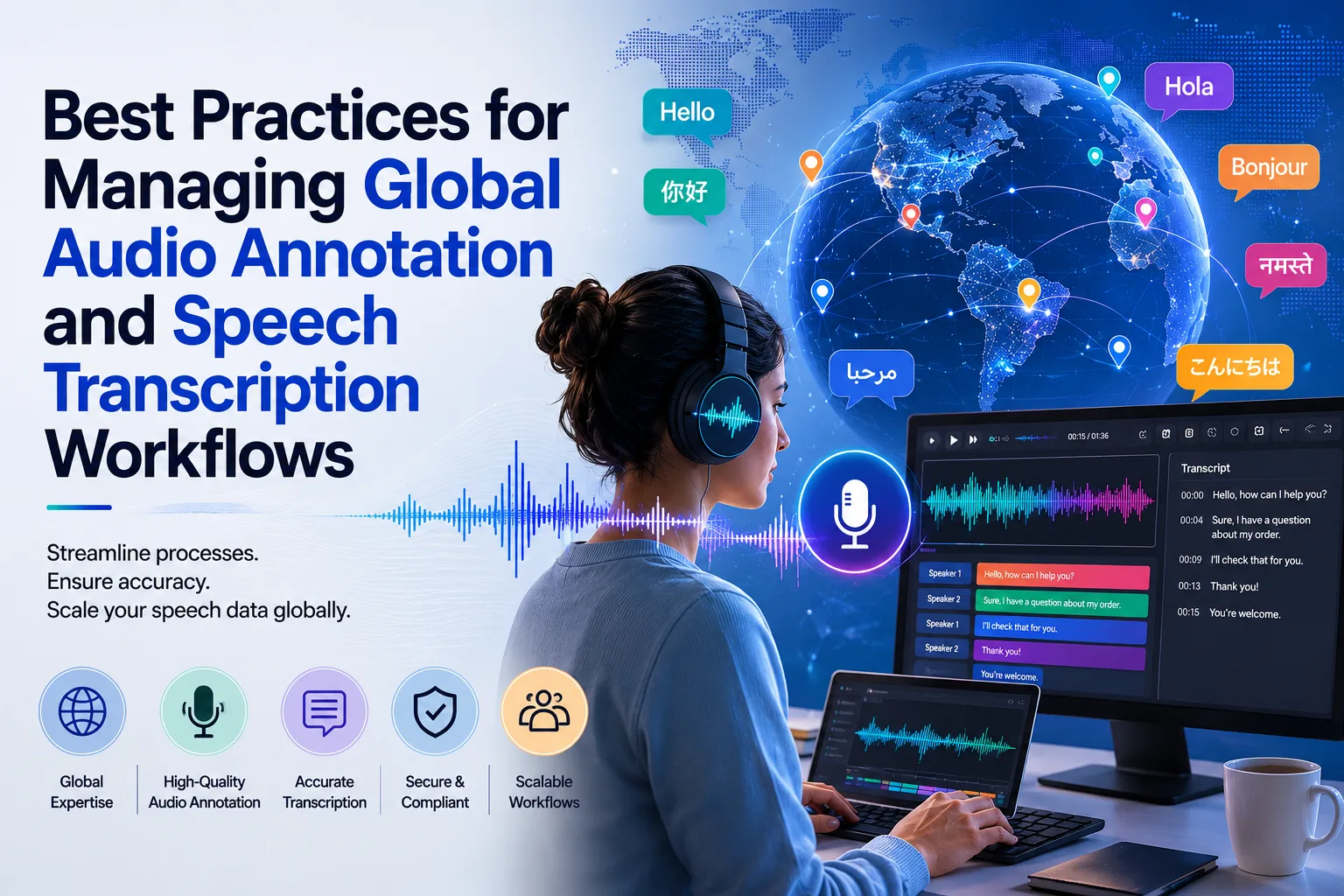
As speech-enabled technologies continue to transform industries, organizations are increasingly relying on large-scale audio datasets to train, validate, and improve AI models. From virtual assistants and customer support bots to voice analytics and healthcare applications, the performance of these systems depends heavily on the quality of audio annotation and speech transcription.
However, managing audio data projects across multiple languages, accents, regions, and regulatory environments presents significant operational challenges. Ensuring consistency, accuracy, scalability, and compliance requires a structured workflow supported by experienced annotation teams and robust quality control processes.
At Annotera, we help organizations streamline global speech data operations through specialized audio annotation and transcription services. This article explores the best practices organizations should follow when managing global audio annotation and speech transcription workflows for AI success.
Why Global Speech Data Workflows Are Complex
Unlike text-based datasets, audio data introduces additional layers of complexity. Speech recordings often contain:
- Diverse accents and dialects
- Background noise and overlapping conversations
- Multiple speakers
- Industry-specific terminology
- Cultural and linguistic variations
- Variable recording quality
When projects span multiple countries and languages, these complexities multiply. Without standardized processes, inconsistencies can quickly affect dataset quality and ultimately reduce AI model performance.
A successful workflow requires a balance between linguistic expertise, technology, quality assurance, and project management.
Establish Clear Annotation and Transcription Guidelines
One of the most important steps in any speech data project is creating comprehensive annotation guidelines.
Global teams often interpret audio differently unless detailed instructions are provided. Annotation documentation should define:
- Transcription conventions
- Speaker identification rules
- Handling of pauses and fillers
- Treatment of background noise
- Timestamping requirements
- Language-switching protocols
- Accent and dialect labeling standards
- Quality acceptance criteria
Clear guidelines reduce ambiguity and ensure that geographically distributed teams produce consistent outputs.
As projects evolve, documentation should be regularly updated to reflect new use cases and feedback from quality reviewers.
Build Region-Specific Linguistic Teams
Language expertise goes far beyond basic fluency.
Global speech datasets require annotators who understand regional accents, slang, idioms, pronunciation patterns, and cultural nuances. Native-speaking annotators are often best positioned to accurately interpret speech and contextual meaning.
For example:
- English spoken in India differs significantly from English spoken in the United States.
- Spanish varies across Mexico, Spain, Argentina, and Colombia.
- Arabic includes multiple regional dialects that may differ substantially.
Partnering with an experienced audio annotation company ensures access to qualified linguistic specialists across multiple languages and regions.
By leveraging local expertise, organizations can significantly improve annotation accuracy and dataset reliability.
Standardize Quality Control Across Regions
Maintaining consistent quality becomes challenging when teams operate across different locations and time zones.
A structured quality assurance framework should include:
Multi-Level Review Processes
Implement layered review systems involving:
- Primary annotators
- Senior reviewers
- Linguistic experts
- Quality auditors
Multiple validation stages help identify and correct inconsistencies before datasets reach model training pipelines.
Inter-Annotator Agreement (IAA)
Measure consistency among annotators by tracking inter-annotator agreement scores. Low agreement rates often indicate unclear guidelines or insufficient training.
Monitoring IAA regularly helps maintain annotation consistency across global teams.
Random Sampling Audits
Conduct periodic audits of completed datasets to ensure quality standards remain consistent over time.
Organizations that prioritize continuous quality monitoring typically achieve better AI outcomes and reduced rework costs.
Leverage Technology for Workflow Management
Managing thousands of hours of audio manually is inefficient and difficult to scale.
Modern workflow platforms can automate many operational tasks, including:
- Task allocation
- Progress tracking
- Quality monitoring
- Version control
- Performance reporting
- Data security management
AI-assisted pre-labeling can further accelerate annotation processes by generating initial transcripts or labels that human experts can review and refine.
The most successful workflows combine automation with human expertise rather than relying solely on either approach.
This human-in-the-loop approach delivers both efficiency and accuracy.
Prioritize Data Security and Compliance
Global audio datasets often contain sensitive information, including customer conversations, healthcare records, financial discussions, or personal identifiers.
Organizations must establish robust security protocols throughout the annotation lifecycle.
Key measures include:
- Role-based access controls
- Secure file transfers
- Data encryption
- Non-disclosure agreements
- Regular security audits
- Compliance monitoring
Projects involving international datasets may also require adherence to regulations such as:
- GDPR
- HIPAA
- CCPA
- Regional privacy laws
An experienced data annotation company understands these regulatory requirements and can help organizations maintain compliance while scaling operations.
Implement Scalable Workforce Models
Speech AI projects often experience fluctuating data volumes.
A product launch, new language expansion, or model retraining initiative can dramatically increase annotation requirements within a short period.
Building a flexible workforce strategy enables organizations to respond effectively to changing project demands.
Best practices include:
- Maintaining trained reserve annotator pools
- Cross-training team members
- Using modular project structures
- Establishing rapid onboarding processes
This scalability allows projects to expand without compromising quality or turnaround times.
Many organizations choose data annotation outsourcing to gain access to large, specialized workforces that can scale according to project needs.
Create Language-Specific Quality Benchmarks
Different languages present unique transcription and annotation challenges.
For example:
- Tonal languages require careful attention to pronunciation.
- Morphologically rich languages may involve complex word structures.
- Low-resource languages often lack standardized linguistic resources.
Instead of applying universal quality metrics across all projects, organizations should establish language-specific benchmarks.
These benchmarks should account for:
- Linguistic complexity
- Accent diversity
- Domain specialization
- Available reference resources
Customized evaluation frameworks provide a more accurate picture of dataset quality and annotation performance.
Foster Continuous Annotator Training
Speech patterns, technologies, and AI requirements evolve constantly.
Regular training programs help annotators stay aligned with project objectives and industry standards.
Training initiatives should cover:
- Updated annotation guidelines
- New language requirements
- Domain-specific terminology
- Emerging AI use cases
- Quality improvement strategies
Providing frequent feedback also helps teams improve performance and maintain consistency across large-scale operations.
Organizations that invest in workforce development often achieve higher annotation accuracy and reduced project variability.
Optimize Communication Across Global Teams
Time zone differences can create communication bottlenecks if workflows are not properly structured.
Successful global annotation programs establish:
- Clear escalation paths
- Standardized communication channels
- Detailed project documentation
- Regular status reviews
- Centralized knowledge repositories
Transparent communication reduces misunderstandings and ensures alignment across distributed teams.
Project managers should also maintain continuous collaboration between annotators, reviewers, AI engineers, and stakeholders to address challenges quickly and efficiently.
Measure Performance Using Meaningful Metrics
Data-driven workflow management enables continuous optimization.
Key performance indicators (KPIs) should include:
- Annotation accuracy
- Review pass rates
- Turnaround time
- Inter-annotator agreement
- Productivity metrics
- Error frequency
- Language-specific quality scores
Regular performance analysis helps identify bottlenecks and opportunities for improvement.
Organizations that continuously monitor workflow metrics are better positioned to maintain high-quality speech datasets while controlling costs.
Why Organizations Choose Audio Annotation Outsourcing
Managing multilingual speech projects internally can be resource-intensive and difficult to scale.
As a result, many enterprises turn to audio annotation outsourcing providers that offer:
- Global linguistic expertise
- Established quality frameworks
- Scalable workforce capacity
- Advanced workflow infrastructure
- Faster project delivery
- Cost efficiencies
By partnering with specialized providers, organizations can focus on AI innovation while ensuring their speech datasets meet rigorous quality standards.
Conclusion
The success of modern speech AI systems depends on the quality, consistency, and scalability of audio annotation and speech transcription workflows. Managing global speech data projects requires more than simply labeling audio—it demands structured processes, linguistic expertise, quality assurance frameworks, secure infrastructure, and effective workforce management.
Organizations that establish clear guidelines, leverage regional language experts, implement rigorous quality controls, and embrace scalable operations are better equipped to build high-performing AI solutions.
At Annotera, we combine global linguistic expertise, advanced quality management processes, and scalable delivery models to help organizations manage complex speech data projects with confidence. Whether you require multilingual transcription, speech labeling, or large-scale annotation support, our team delivers the high-quality datasets needed to power next-generation AI systems.
Looking to scale your global speech data initiatives? Contact Annotera today to discover how our audio annotation and speech transcription solutions can accelerate your AI development journey.