The rise of cyberattacks requires businesses and organizations to have skilled professionals who can safeguard their systems against potential threats. One of the best ways to advance your career in this field is by earning a network security certification. Not only do certifications help you gain specialized knowledge, but they also increase your chances of landing a well-paying job in cybersecurity.
It will take you through some of the best network security certifications to help you grow in the industry. We’ll also introduce a certification offered by the International Institute for Information Security (IIFIS), which is an excellent option for those looking to specialize in network security.
Why Are Network Security Certifications Important?
Let's first evaluate the value of network security certifications before getting into the specifics.
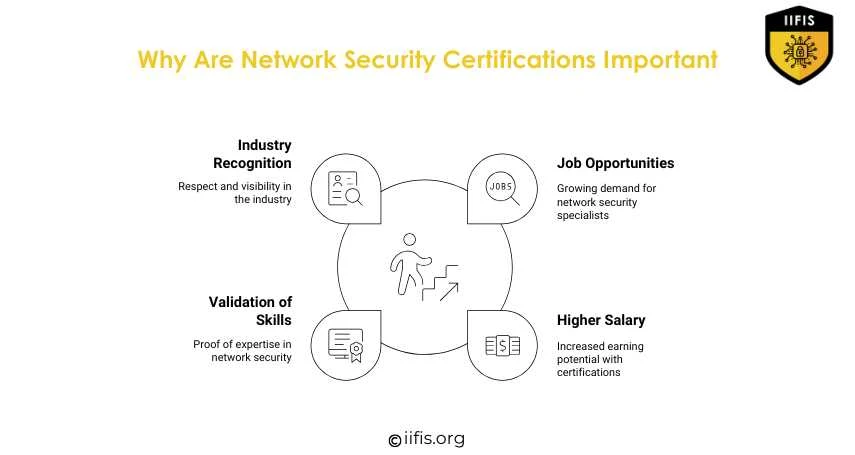
- Job Opportunities: The need for qualified network security specialists is growing as cyber threats rise. You'll be more likely to be hired for positions like administrator, engineer, or network security analyst if you have a certification.
- Higher Salary: Professionals who hold certificates typically make more money than those who don't. Companies are prepared to pay more for professionals who can defend their networks against intrusions.
- Validation of Skills: Certifications attest to your possession of the skills and know-how required to address network security issues. They also show potential employers your commitment to remaining current with emerging cybersecurity developments.
- Industry Recognition: The industry respects a lot of certifications. Including one on your CV can help you stand out from the competition.
Let's now review a few of the top certifications available to network security experts.
1. IIFIS Network Security Certification
Level: Advanced
Cost: Check the site for pricing
The International Institute for Information Security (IIFIS) provides a specialized Network Security Certification that focuses on protecting complex network systems. Full instruction in network threat detection, encryption, cloud-based network security, and security protocols is part of this certification.
The methodology of IIFIS blends theory with real-world, experiential learning. Professionals who wish to further their careers and work on complex network security tasks will find it perfect.
Why Choose IIFIS Network Security Certification?
- Hands-on Learning: This method offers real-world, practical training.
- Extensive Coverage: A variety of network security topics are covered in the certification.
- Flexible Learning: It's simple to incorporate into your schedule because you can learn on your own.
For more details on this certification, you can visit the IIFIS Network Security Certification.
2. CompTIA Security+
Level: Beginner to Intermediate
Cost: $349
CompTIA Security+ is an excellent starting point for those who are new to network security. This globally recognized entry-level certification covers the fundamentals of network security, including risk management, firewalls, and encryption.
The best aspect is that this certification can be obtained without any prior experience. It's perfect for people who are just beginning their cybersecurity careers.
Why Choose CompTIA Security+?
- Simple to Get Started: It's perfect for beginners who have never worked in the IT industry.
- Wide Recognition: In the cybersecurity field, it's one of the most well-liked certificates.
- Foundational Knowledge: It provides you with an excellent understanding of the field by covering a wide range of security-related topics.
3. Certified Information Systems Security Professional (CISSP)
Level: Advanced
Cost: $749
An advanced certification for seasoned cybersecurity specialists is the CISSP. For people who wish to advance into management or leadership positions, it's excellent. You must have at least five years of information security work experience in order to obtain the CISSP certification.
Risk management, security architecture, and network security are just a few of the many subjects covered in this certification. If you wish to focus on advanced security tactics and regulations, this is the best option.
Why Choose CISSP?
- International Recognition: It is among the most recognized certificates in the field.
- Excellent for Managers: It equips you for cybersecurity leadership positions.
- Detailed Topics: You become a specialist in a variety of security disciplines because the CISSP covers a wide range of network security topics.
4. Certified Ethical Hacker (CEH)
Level: Intermediate
Cost: $1,199
The CEH certification may be for you if hacking is something you're interested in doing (but legally and ethically). To defend networks and systems against assaults, this certification teaches you how to think like a hacker.
In order to find issues before malicious hackers can take advantage of them, ethical hackers will learn how to perform penetration testing, which involves attempting to access systems with authorization.
Why Choose CEH?
- Develop Your Hacker Mindset: It focuses on penetration testing and ethical hacking.
- Practical Skills: To find weaknesses, you will master real-world hacking techniques.
- Excellent Demand: Due to their skill in protecting enterprises from cybercriminals, ethical hackers are in great demand.
5. Cisco Certified Network Associate (CCNA)
Level: Beginner to Intermediate
Cost: $300
Leading networking equipment manufacturer Cisco has one of the most prestigious CCNA certifications in the business. You can install, configure, and troubleshoot Cisco routers and switches with this certification.
The CCNA is a great option if you want to work as a network engineer or administrator. It gives you the fundamental information required to secure and manage networks.
Why Choose CCNA?
- Cisco-focused: This is the best option for anyone who wishes to work with Cisco networking hardware.
- Practical expertise: You will have hands-on expertise in network configuration and troubleshooting.
- Solid Foundation: It's perfect for anyone with an interest in network administration or engineering.
6. Certified Network Defender (CND)
Level: Intermediate
Cost: $2,499 (includes training and exam)
Protecting networks from cyberattacks is the main goal of the Certified Network Defender certification. It shows you how to use tools like intrusion detection systems, firewalls, and virtual private networks (VPNs) to monitor and safeguard networks.
For individuals who wish to focus on defending networks against both internal and external threats, this certification is ideal.
Why Choose CND?
- Focus on Defense: It teaches you how to protect networks from online threats.
- Specialized Skills: You'll learn how to identify and address security risks.
- In-demand Profession: Network defenders are becoming more and more necessary as cyberattacks rise.
7. Certified Information Security Manager (CISM)
Level: Advanced
Cost: $760
Information security management is the emphasis of the CISM certification. This is an excellent choice if you want to handle security programs or manage a group of network security experts.
Information risk management, governance, incident response, and program creation are the four main areas of concentration for the certification. It's perfect for anyone who wants to be at the top of the network security industry.
Why Choose CISM?
- Management Focus: It gets you ready for security management leadership positions.
- Strategic Approach: It involves not only technical system security but also organizational system security.
- International Recognition: CISM enjoys great respect and recognition on a global scale.
Getting certified in network security is a terrific method to progress in the cybersecurity field. They help you get paid more, expand your work options, and confirm your skills. There are certificates to fit your experience level and professional objectives, regardless of whether you're just starting out or want to specialize in network security.
CompTIA Security+, CISSP, CEH, CCNA, and IIFIS Network Security Certification are a few of the top certifications. You can progress in your cybersecurity career and acquire the skills and expertise required to defend networks against online attacks by selecting the appropriate certification.