Since almost everything in the modern world is online, network security has emerged as one of the most important technological fields. Every gadget, including your laptop, smartphone, and even smart refrigerator, uses networks to communicate, so protecting them from hackers is a major duty.
If you want to work in network security but don't know where to start, this is for you. We'll walk you through the top network security certifications for beginners, break them down into easily understood terms, and help you in selecting the one that most suits your goals.
What Is Network Security?
Network security is the practice of protecting computer networks from unauthorized access, misuse, or theft. It involves using tools and techniques to block hackers, malware, and cybercriminals from getting into your system.
A career in network security could involve tasks like:
- Monitoring network traffic
- Installing firewalls
- Configuring VPNs
- Testing systems for weaknesses
- Responding to cyberattacks
If that sounds exciting to you, a network security certification is the first step to making it a reality.
Why Get Certified in Network Security?
If you’re just starting out. Here’s why:
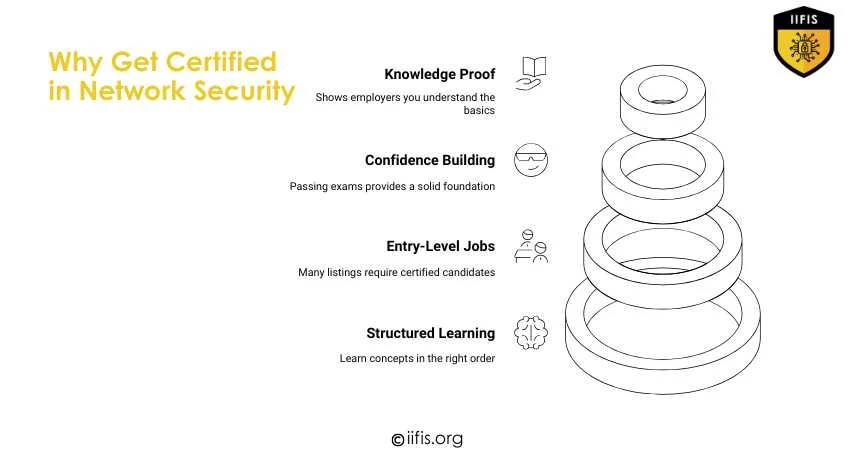
- Certifications prove your knowledge. They show employers you understand the basics.
- They give you structured learning. You learn the right concepts in the right order.
- They open doors to entry-level jobs. Many job listings ask for certified candidates.
- They help you build confidence. Knowing you’ve passed an industry exam gives you a solid foundation.
How to Choose the Right Certification?
With so many options out there, choosing the right certification can be confusing. But don’t worry—here are some things to keep in mind:
- Beginner-friendly: Make sure the certification is designed for people with little or no experience.
- Affordable: If you’re new, start with something that fits your budget.
- Recognized: Look for certifications that are respected in the industry.
- Practical learning: A good course includes real-world labs or examples.
Top Network Security Certifications for Beginners
Let's review the best certifications that are ideal for beginners in more detail. These offer excellent value, are widely accepted, and are simple to follow.
1. IIFIS Network Security Certification
Website: https://iifis.org/network-security-certification/
For beginners who want a hands-on, uncomplicated learning style, the IIFIS Network Security Certification is a great place to start. The syllabus provides practical instruction in an approachable, straightforward manner and is intended for those without any prior expertise.
Why Choose IIFIS?
- A curriculum that is easy for beginners to understand.
- Covers important subjects like threat detection, secure connections, and firewalls.
- Includes tests, labs, and the final evaluation.
- Acknowledged within the cybersecurity and IT community.
- You may learn at your own pace because it's inexpensive and accessible online.
IIFIS is an excellent place to start if you're searching for a high-impact, low-stress method to get started with network security.
2. CompTIA Security+
One of the most well-liked entry-level cybersecurity certifications is CompTIA Security+. It addresses a variety of subjects, such as vulnerabilities, threats, and network security.
Key Highlights:
- Prior experience is not necessary, while having a basic understanding of IT is helpful.
- Discusses risk management, network security, cryptography, and other topics.
- Widely recognized in both the public and private sectors
- Exam price: around $392
- Three-year validity
If you want a foundation in cybersecurity that goes beyond networks, Security+ is the best option.
3. Cisco Certified Support Technician (CCST) – Cybersecurity
The CCST Cybersecurity certification from Cisco, a major player in the networking industry, is an excellent choice for beginners.
What It Offers:
- Made for complete beginners
- Emphasizes threat detection, network security, and fundamental mitigation methods.
- Helps you become ready for later, more complex Cisco certifications (such as CCNA or CCNP).
- Respected and reasonably priced
If you want to pursue a career working only with Cisco technologies, this is an excellent start.
4. Certified Cybersecurity Entry-Level Technician (ISC2 – CC)
A more recent certification for those just beginning their cybersecurity adventure is the Certified in Cybersecurity (CC) from ISC2.
Why It’s Good:
- Experience is not necessary.
- Covers the essentials, including incident response, security principles, and network security.
- Provided by ISC2, the same body that created the well-known CISSP certification.
- Excellent for beginners who wish to have a reputable name on their resume.
The best aspect? This is an accessible alternative because ISC2 occasionally provides cheap exam vouchers and free training.
5. Google Cybersecurity Certificate (via Coursera)
The foundations of cybersecurity, including network defense strategies, are taught in Google's cybersecurity program, which is offered online by Coursera.
Pros:
- Flexible and easy for beginners to use
- Practical laboratories and real-world situations
- Instructed by Google specialists
- Experience is not required.
- Based on subscriptions: around $39 per month
This is ideal for students who want practical skills in a controlled setting, even if it's not a formal certification like CompTIA or Cisco.
Topics You’ll Learn in These Certifications
The majority of basic network security certificates will instruct you in:
- Networking fundamentals: IP addresses, switches, routers, and protocols.
- Firewalls and Antivirus Tools: How to Use and Configure Them.
- Secure Connections: SSL, encryption, and VPNs.
- Risks and Weaknesses: Malware, phishing, social engineering, and viruses.
- Incident Response: Procedures for responding to a security breach.
- Authentication and Access Control: Passwords, fingerprints, and role-based access.
Career Opportunities After Certification
You can begin applying for entry-level positions like these as soon as you obtain your first network security certification.
- Network Security Analyst
- Security Operations Center (SOC) Analyst
- IT Support with a Security Focus
- Junior Penetration Tester
- Cybersecurity Technician
Your income may vary depending on the country and organization, but the majority of these positions provide competitive pay and opportunities for advancement.
Tips to Succeed in Network Security
Here are a few recommendations to help you succeed on your network security journey.
1. Practice a Lot
To gain practical experience, use free software like TryHackMe, Kali Linux, or Wireshark.
2. Follow Cyber News
You may stay informed by visiting websites such as Krebs on Security, The Hacker News, and Cybersecurity News.
3. Join Online Communities
You can meet other students and professionals through LinkedIn groups, Reddit forums, or Discord servers.
4. Build a Home Lab
Test your skills by simulating networks with outdated laptops or cloud services like AWS.
You must be serious about pursuing a career in cybersecurity if you have read this far. That's a fantastic attitude! Proceed to the next step now.
We strongly advise looking into the IIFIS Network Security Certification if you want to start your path in a methodical, reasonably priced, and approachable manner.