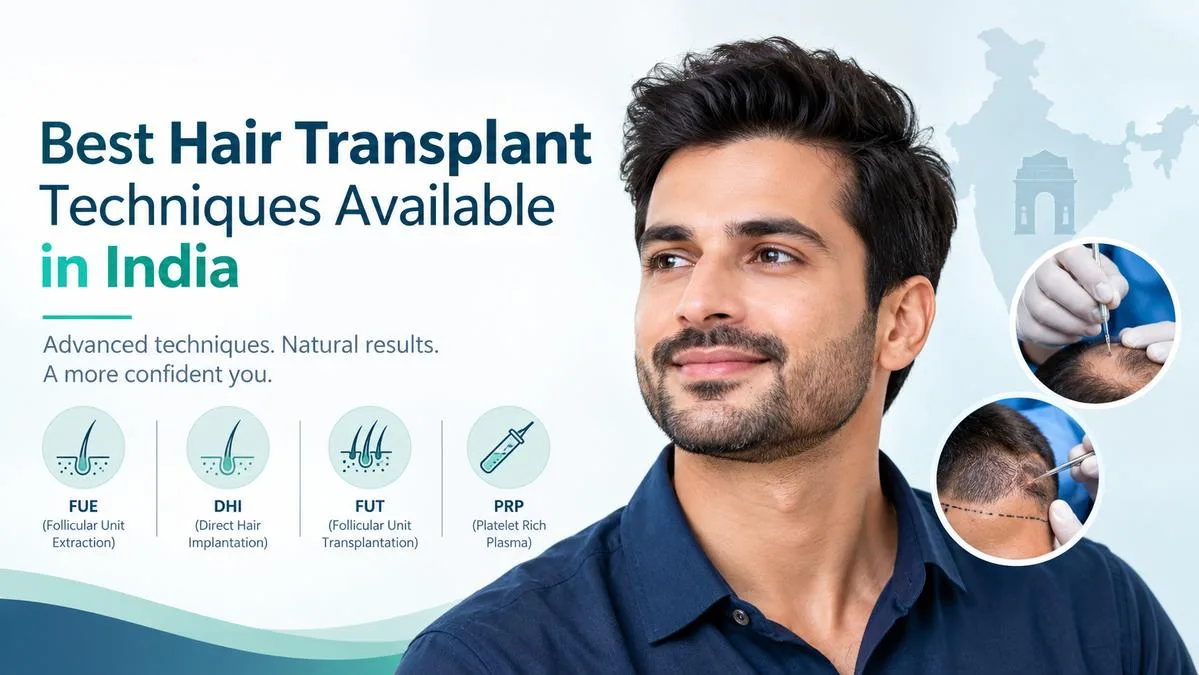
Hair loss is a common concern among men and women. Factors such as genetics, hormonal changes, medical conditions, stress, and ageing can contribute to hair thinning and baldness. While medicines and other treatments may help manage some types of hair loss, a hair transplant can be an option for people who want to restore hair in areas affected by permanent hair loss.
India has several hair restoration clinics offering different hair transplant techniques. Each method has its own process, benefits, and limitations. Understanding these options can help individuals make informed decisions before choosing a treatment.
What Is a Hair Transplant?
A hair transplant is a surgical procedure in which hair follicles are taken from a donor area, usually the back or sides of the scalp, and placed in areas with thinning or no hair. The procedure aims to create natural-looking hair growth by using the patient's own hair follicles.
The results depend on several factors, including donor hair quality, the extent of hair loss, the surgeon's experience, and the technique used. A consultation with a qualified hair transplant specialist is important to determine whether the procedure is suitable.
Best Hair Transplant Techniques Available in India
Several hair restoration methods are available in India. The most suitable technique depends on the patient's hair loss pattern, donor area, treatment goals, and medical suitability.
1. Direct Hair Implantation (DHI)
Direct Hair Implantation (DHI) is a hair transplant technique in which extracted hair follicles are implanted into the recipient area using a specialised implantation instrument. Depending on the technique and clinical plan, the process may allow the surgeon to control the direction, angle, and depth of implantation.
DHI is often considered by people seeking a precise approach to hairline design and hair density. It requires proper planning and trained professionals to achieve appropriate placement.
Potential benefits of DHI:
- Allows controlled placement of hair follicles.
- Supports customised hairline design.
- May help achieve natural-looking results when performed appropriately.
- Can be used for selected cases of hair thinning and baldness.
The suitability of DHI depends on the patient's condition, available donor hair, and the expertise of the treating team.
2. Follicular Unit Extraction (FUE)
Follicular Unit Extraction (FUE) is one of the widely used hair transplant techniques. In this method, individual follicular units are extracted from the donor area using a specialised punch instrument. The follicles are then prepared and implanted into the areas requiring hair restoration.
FUE does not usually involve removing a long strip of scalp tissue. However, it can leave small, scattered scars in the donor area, particularly when the hair is cut short.
Potential benefits of FUE:
- Individual follicle extraction.
- No long linear donor scar.
- Suitable for many patients with pattern hair loss.
- Can be used to restore hair in selected scalp, beard, and eyebrow cases.
The final appearance depends on graft handling, extraction planning, implantation technique, and the patient's healing response.
3. Follicular Unit Transplantation (FUT)
Follicular Unit Transplantation (FUT), also called the strip method, involves removing a strip of scalp tissue from the donor area. The strip is divided into individual follicular units under magnification, and these units are implanted into the recipient area.
FUT may be considered for certain patients who need a substantial number of grafts and have suitable donor characteristics. However, it usually leaves a linear scar in the donor area.
Potential benefits of FUT:
- Can provide a large number of grafts in selected cases.
- Allows follicular units to be prepared under magnification.
- May be appropriate for patients whose treatment goals and donor characteristics suit the strip method.
The possibility of a linear scar and the patient's hairstyle preferences should be discussed before treatment.
4. Sapphire FUE
Sapphire FUE is a variation of the FUE approach in which sapphire blades are used to create recipient sites for implantation. Hair follicles are still extracted individually, and the prepared grafts are placed into the recipient area.
The use of sapphire blades does not automatically guarantee better results than other methods. Outcomes depend on the surgeon's skill, recipient-site planning, graft handling, and patient-specific factors.
Potential benefits may include:
- Precise creation of recipient sites.
- Flexibility in planning the direction and distribution of grafts.
- An alternative for patients who are suitable for an FUE-based procedure.
Patients should compare the complete treatment approach rather than choosing a procedure based only on the instrument used.
DHI vs FUE vs FUT: Which Technique Is Better?
Each technique has different characteristics. The right choice depends on the individual's needs rather than a universal ranking.
TechniqueHow it worksImportant considerationDHIFollicles are implanted using a specialised implantation instrumentRequires careful control of placement and graft handlingFUEIndividual follicles are extracted and implanted into prepared recipient sitesUsually avoids a long linear scar but may leave small extraction scarsFUTA strip of scalp is removed and divided into follicular unitsLeaves a linear scar in the donor areaSapphire FUEFUE extraction is combined with sapphire blades for recipient-site creationThe blade material alone does not guarantee superior outcomesA qualified specialist can explain the advantages and limitations of each approach after assessing the scalp, donor area, hair loss pattern, and expectations.
How to Choose the Best Hair Transplant Technique in India
Choosing a hair transplant technique requires more than comparing prices or promotional offers. Patients should consider the following factors before making a decision.
1. Assess the Cause of Hair Loss
Not all hair loss requires surgery. A specialist should assess whether the hair loss is permanent, progressive, or related to a condition that may respond to medical treatment.
2. Evaluate the Donor Area
The density and quality of donor hair influence the number of grafts that can be safely harvested. A suitable treatment plan should protect the donor area for the long term.
3. Check the Experience of the Medical Team
Ask about the qualifications of the treating doctor, who performs each stage of the procedure, and the clinic's approach to patient safety and follow-up care.
4. Review Realistic Results
Look for consistent before-and-after photographs with similar lighting and angles. Ask how many months the photographs represent after treatment and whether the cases are comparable to your own hair loss pattern.
5. Understand the Cost
Hair transplant costs in India vary according to the number of grafts, technique, clinic, medical team, and complexity of the case. Patients should request a clear breakdown of the total cost and understand what is included in the treatment package.
6. Consider Aftercare and Recovery
Follow-up appointments and proper aftercare are important. Patients should understand the clinic's instructions for washing the scalp, returning to normal activities, and managing temporary side effects.
What Results Can You Expect After a Hair Transplant?
Hair transplant results develop gradually rather than immediately. Some transplanted hair may shed during the initial weeks, which can be a normal part of the process. New growth typically becomes noticeable over the following months, while the final appearance may take around 9–12 months or longer, depending on the individual and the treated area.
Possible side effects include temporary swelling, redness, discomfort, scabbing, and temporary shedding. As with any surgical procedure, infection, scarring, poor growth, or an unnatural appearance can occur. A medical consultation helps patients understand the expected recovery period and possible risks.
It is also important to remember that a hair transplant does not stop ongoing hair loss in untreated areas. A specialist may recommend suitable medical management and long-term monitoring when appropriate.
Why Consult a Hair Restoration Specialist?
A professional assessment helps determine whether a hair transplant is suitable and which method best matches the patient's goals. A specialist can evaluate the donor area, estimate the required grafts, discuss hairline design, and explain realistic outcomes.
Clinics such as DHI International offer information about Direct Hair Implantation and hair restoration options. Patients considering treatment should verify the services available at their chosen location, review the medical team's qualifications, and attend a consultation before making a decision.
Conclusion
India offers several hair transplant techniques, including DHI, FUE, FUT, and Sapphire FUE. Each method has its own procedure, benefits, and limitations. The best choice depends on the patient's hair loss pattern, donor hair availability, medical suitability, and desired results.
Before selecting a clinic or technique, compare the treatment plan, medical expertise, safety standards, expected outcomes, and aftercare arrangements. A consultation with a qualified hair restoration specialist can help you choose an appropriate approach to achieving natural-looking hair restoration.