Summary
Full Stack Python Development is a popular career path for students, freshers, graduates, and working professionals interested in software and web development. A comprehensive course should cover Python programming, frontend development, backend frameworks, databases, APIs, Git, projects, and interview preparation. This guide explains what students should expect from a Full Stack Python Development Course in Thane, including fees, syllabus, career scope, eligibility, and job-oriented skills.
Keywords: Full Stack Python Development Course in Thane, Full Stack Python Course in Thane, Python Full Stack Developer Course, Python Course in Thane, Full Stack Python Training in Thane, Python Developer Jobs in Thane
Introduction
Python has emerged as one of the most popular languages to learn due to its simple structure and extensive range of applications. Apart from data science and artificial intelligence, Python is extensively used for developing the web and applications.
Full-stack Python development takes the learner to the next level and aims to build the complete web applications using the concepts mentioned above. Here a student doesn't just need to learn the concept of Python programming but also frontend technologies, backend frameworks, databases, APIs, and development tools.
For any student or fresher in Thane, joining a training institute can make the process much more structured. Thus, if you are searching for the best full-stack Python development course in Thane, go beyond the advertisements and analyze the training syllabus, practical training, fees, projects, and career support before making any decision.
What is Full-Stack Python Development?
Full-stack Python development comprises developing the entire web application or website, consisting of both the frontend and backend sides, whereas in many scenarios, Python is the prime language used to develop the backend of the application.
The different technology stacks for full-stack Python development include:
- Python
- HTML
- CSS
- JavaScript
- Backend framework
- SQL & Databases
- REST APIs
- Git & GitHub
Of course, these differ from companies to companies and even from institutes to institutes. The basic idea is to have thorough knowledge of the development of the web application from the database up to user interface elements.
Full Stack Python Development Course Syllabus
When it comes to learning, there should be no compromise with it. Thus, it is always a priority for students to first inquire about the syllabus of the training to avoid the problem later.
Python Programming
This should first start with the fundamentals of Python programming, like:
- Variables and Data Types
- Operators
- Conditional statements (if-else statements)
- Loops (for loop, while loop)
- Functions
- Lists, Tuples, Sets, and Dictionaries
- Strings and so on
- File handling
- Exception handling
- Object-oriented programming
- Module and package
Students should be taught in a way that they understand how to work with data and build logical application flow. Furthermore, the learning process must involve ample coding practices that help a student solve programming problems with independence.
Frontend Development
Along with backend development, the concept of the frontend development of the applications is also essential, and here's what should be involved:
- HTML
- CSS
- JavaScript
- Forms
- DOM (Document Object Model)
- Responsive web design
- Form validations
- Frontend logic and interaction
Based on the training module and learning platform, they might also learn some popular modern frontend framework like React.
Backend Development
As this course would deal with Python development, the concept of using specific backend frameworks like Django or Flask is a part of this learning process. However, the overall logic of the backend should be taken into account:
- Routing
- Views
- Models
- Templates
- CRUD operations
- Authentication
- Authorization
- REST APIs
- Database integration
- Error Handling
The students should mainly focus on the logic of the backend, where they get to work with the system to fulfill the user requests.
Database and SQL Training
Data is also an important feature wherein the students would get to work with databases and their applications. Students will learn:
- Database Fundamentals
- Table and Relations
- SQL Commands
- CRUD operations
- Joins
- Constraints
- Indexes
- Transaction
- Design data models
Moreover, the trainer may also include a little bit of databases like MySQL, PostgreSQL, or MongoDB depending on their curriculum and learning platform. SQL practicals are helpful for developers dealing with application databases on a day-to-day basis.
API Development
The modern web applications are often built over an API. Students should learn about the concept of API, REST architecture, and working with HTTP methods (POST, GET, PUT, DELETE), among other such key topics:
- REST architecture
- HTTP methods
- Request-Response
- JSON
- Authentication
- API testing and how it helps connect frontend to backend
Git and Development Tools
Git and GitHub are the most important things while working in a team on software applications. A developer needs to learn how to keep track of code changes and merge new contributions without a conflict. The process of learning would involve concepts like:
- Create Repository
- Commit code
- Create branch
- Merge changes
- Push, pull
- GitHub
Exposure to certain other helpful developmental tools can make a student understand how professional development works.
Full Stack Python Course Fees in Thane
There isn't any one standard price charged across different institutes; every institute has their fee set accordingly for certain reasons, which can include factors like:
- Course duration
- Technologies involved
- Trainer experience
- Practical sessions conducted
- Number of projects included
- Online or classroom mode
- Study materials
- Career assistance/placement help
Never go for a course that just offers cheap prices, while comparing courses focuses on what benefits that total fee provides to the student. Always inquire whether the course includes practical coding, project work, and interview practice, as well as a career guide.
Why are practical projects the most important component of this training?
Projects have always been part of job-oriented courses. With the help of projects, you not only learn how to develop an application but also how to implement and integrate new concepts into the real-world project.
Projects may include:
- E-commerce website.
- Employee Management System.
- Online learning platform.
- Appointment booking system.
Career Scope after Learning Full Stack Python
If students master the concepts asked during the development of web applications, they can get numerous opportunities and roles:
- Junior Python Developer
- Python Developer
- Full-stack developer
- Backend Developer
- Web Developer
- Software developer
- Django developer
- API developer
Depending on his performance, with time one can even rise and become a senior developer, technical leader, architect, or specialist developer based on the specialized domains they want to cater to, but all this is dependent on skills, practice, project perfection, institution, and specialization of the domain, as well as continuous learning by students.
What do employers look for in a candidate?
When any employer looks at a candidate for a full-stack Python development role, what do they actually look for?
- Good understanding of Python programming, OOP concepts, and its various components.
- Expertise in HTML, CSS, and JavaScript.
- Fundamental knowledge of SQL, RDBMS, and working with databases.
- Proficiency with a Python web framework (like Django or Flask).
- Experience in designing and developing RESTful APIs.
- Well versed in version control, primarily Git.
- Ability to identify and fix bugs through efficient debugging.
- Capability to solve programming problems efficiently.
- Basic awareness about data structures and algorithms.
- Hands-on project experience.
Communication and interpersonal skills are a plus point since they enable interaction with the team, clients, and testers, as well as other technical people at the workplace.
Who can join a full-stack Python course?
- BCA Students
- BSC Graduate
- BTECH Graduates
- MCA Students
- Final Year Students
- Freshers
- Working professionals and others
- People wanting to switch to development
Students without any previous experience of programming should search for a course that also starts from basic Python concepts in order to get started well and is not focused only on frameworks.
How to choose the best full-stack Python course in Thane
The selection procedure of the best institute depends totally on the student's requirement, and also considering the following, one can definitely identify the best place for learning:
- Updated Syllabus.
- Expert and experienced trainers.
- Hands-on coding practices.
- Real-world projects.
- Python Backend Framework.
- Frontend development
- SQL and Databases
- REST API development
- Git and GitHub
- Debugging practices
- Resume building sessions.
- Mock interviews.
- Career guidance.
- Placement assistance.
At the end, they should consider whether students will get support and doubt clearance or not. Ultimately, the most practical course would be the one that gives the students ample opportunities to do coding and debugger work alone.
Why choose QUASTECH for full-stack Python training?
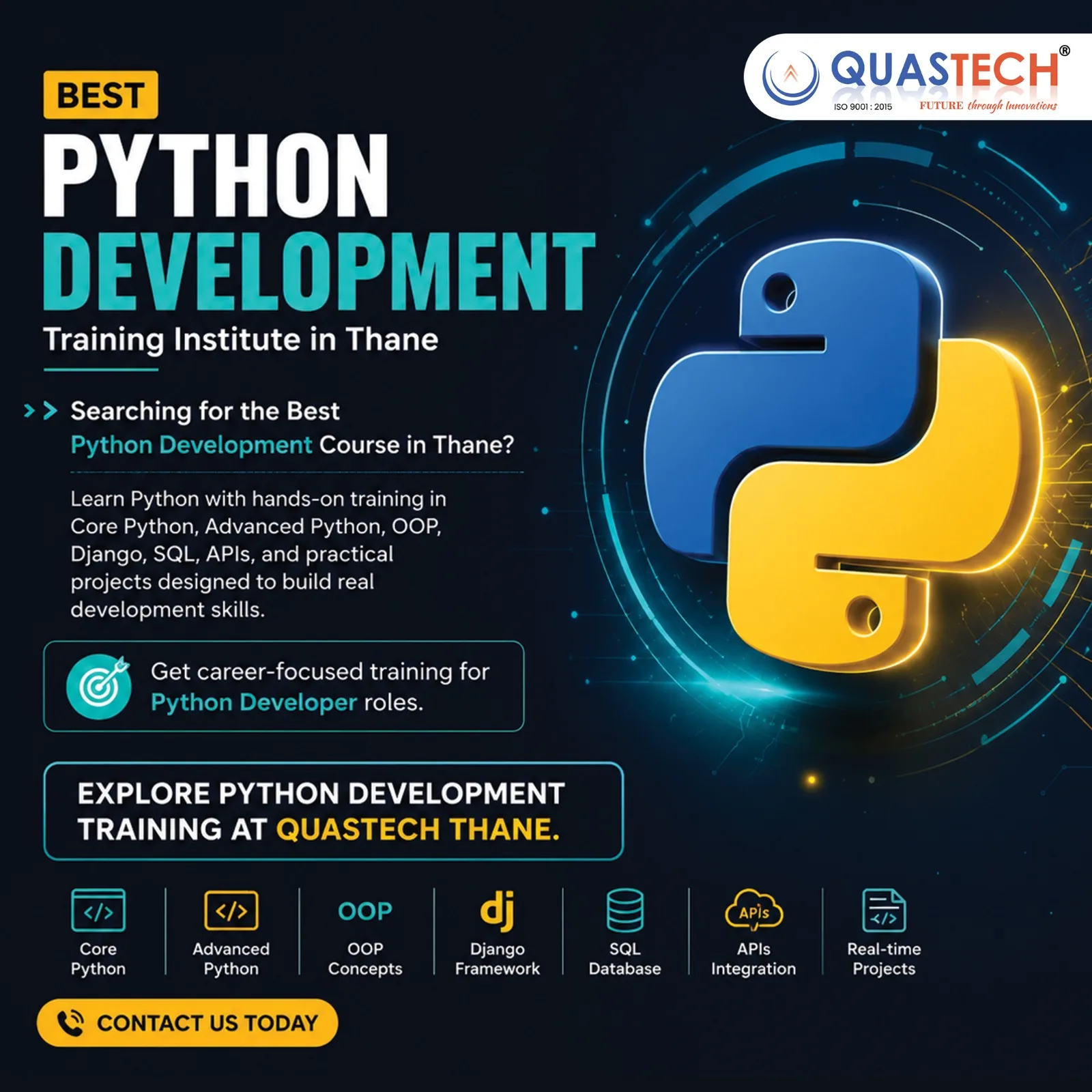
QUASTECH offers career-focused IT trainings for students, freshers, working professionals, and those looking for career switches. The full-stack learning, which emphasizes Python programming, frontend, backend technologies, databases, APIs, and real-time applications, is expected to impart to students a set of skills to kickstart their career development journey.
Thus, the training needs to revolve around acquiring job-oriented skills and working on projects they can proudly explain during interview rounds.
IS FULL STACK PYTHON A good career?
A career in full-stack Python would be beneficial and ideal for those students who love to create dynamic web applications using technology. The plus point of learning Python for developing web applications could later make him easily adaptable to different technologies like data science, automation, artificial intelligence, and scripting.
Nonetheless, one should not try to explore or gain knowledge in everything at the same time.
13. How Long does it take to learn Full stack Python
There isn't a fixed duration for learning Full Stack Python, as it is based on your existing programming knowledge, time and effort you put into learning, and your consistency of practice.
A complete beginner should spend time to learn the basics of Python well before hopping into backend frameworks. A good learning path could be as:
- Python Basics
- OOP
- HTML, CSS, JavaScript
- SQL
- Django/Flask
- REST API
- Projects
- Interview preparation
The key here is to consistently work on all the concepts rather than speeding up.
In the end. Choosing a good Full stack Python development course in Thane depends on several factor besides course fees. Students must check the syllabus, trainer expertise, practical sessions, Frontend framework, backend frameworks, database training, API creation, project completion, mock interviews, placement assistance.
A good full stack Python programme will take students from beginner level to learn full stack Python development and built full fledged web applications.
Don't let the course syllabus define how long you take to build your career, Rather, it is your dedication to practice to get hired. If you are targeting a software development as your career path, keep it practical. Don't try to collect only certificates. Build a project based application, practice to code regularly and be firm about application architectures and prepare for interviews effectively.
With the right approach, Full stack Python has been a launching pad for many career growth.
Frequently Asked Questions (FAQs)
1. What is a Full Stack Python Development Course?
It is a program that teaches Python-based backend development along with frontend technologies, databases, APIs, version control, and application development.
2. What are the Full Stack Python Course Fees in Thane?
Fees vary depending on the institute, duration, syllabus, training format, projects, and career support. Students should compare the complete course offering before enrolling.
3. Can freshers learn Full Stack Python?
Yes. Freshers can start with Python fundamentals and gradually progress to frontend, backend, databases, APIs, and projects.
4. Which Python frameworks are used for Full Stack Development?
Django and Flask are commonly used Python backend frameworks. The framework taught depends on the course and its objectives.
5. Is SQL necessary for Full Stack Python?
Yes. SQL and database knowledge are important because web applications frequently need to store and retrieve information.
6. Do I need JavaScript for Full Stack Python?
Yes. Python is commonly used on the backend, while JavaScript is important for frontend development and browser-based interactions.
7. What jobs can I get after Full Stack Python training?
Depending on your skills and experience, you can explore roles such as Python Developer, Junior Python Developer, Backend Developer, Full Stack Developer, Django Developer, and Software Developer.
8. Are projects important for Python freshers?
Yes. Practical projects demonstrate your ability to apply Python and other technologies to build functional applications.
9. Can BCA or BSc students learn Full Stack Python?
Yes. Graduates from BCA, BSc, BTech, MCA, and other backgrounds can learn Full Stack Python if they are willing to develop programming skills and practice consistently.
10. What should I check before joining a Full Stack Python course in Thane?
Check the syllabus, practical training, projects, trainer experience, technologies covered, course duration, interview preparation, career guidance, and placement assistance.
Author Bio – About QUASTECH
QUASTECH is an IT training and placement institute offering practical, career-focused programs for students, freshers, working professionals, and career switchers.
Its training portfolio includes Full Stack Development, Python, Java, Data Science, Data Analytics, Software Testing, Generative AI, Digital Marketing, Cyber Security, Cloud, and DevOps.