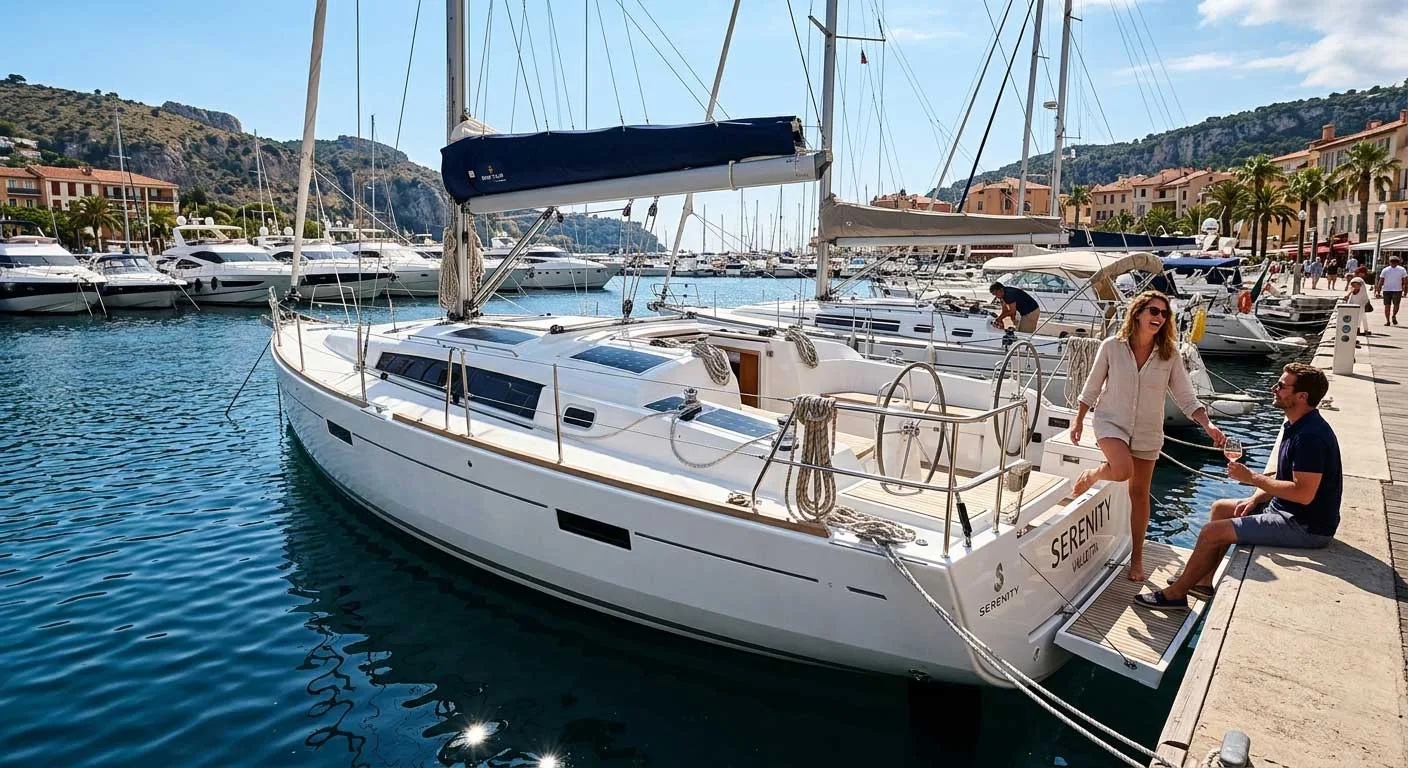
The best flexible solar panels for boats are not simply the panels with the highest wattage. For marine use, flexibility, weight, weather resistance, available mounting space, shading, and electrical compatibility all matter. A good panel should fit the boat instead of forcing the boat owner to redesign the deck around the solar system.
That is why flexible solar panels have become an interesting option for sailboats, yachts, fishing boats, catamarans, and smaller cruising vessels. They can fit spaces where a conventional framed panel is simply awkward or impossible to install.

Why Flexible Solar Panels Make Sense on Boats
A boat is not a house roof.
You may have a curved cabin top, a narrow deck, a bimini, hatch covers, or limited roof space surrounded by rails and other equipment. Adding a large rigid panel can mean extra brackets, weight, wind resistance, and a mounting structure.
Flexible panels solve part of that problem. They are thin, lightweight, and designed to conform to suitable curved surfaces. Recent marine solar guides also highlight limited mounting space, salt spray, UV exposure, vibration, and shading as important factors when selecting panels for boats.
For a small boat, even a 100W panel can be useful for maintaining batteries and supporting basic electronics. Larger boats may combine several panels to provide energy for refrigeration, lighting, navigation equipment, communications, fans, and other onboard loads.
What Makes a Flexible Solar Panel “Best” for Marine Use?
This is where I would look beyond the wattage printed on the label.
1. Marine-ready construction
Saltwater is unforgiving. The panel surface, connectors, junction box, cables, and mounting materials all need to cope with moisture, UV exposure, and salty air.
A panel that performs well on a backyard shed is not automatically a good marine panel.
2. The right flexibility
More flexibility is not always better.
Check the manufacturer's minimum bend radius and installation instructions. A flexible panel should conform to a suitable curve, not be repeatedly folded or forced around a sharp edge.
3. Low weight
Weight becomes more important when panels are installed high on a bimini or cabin structure. A lightweight panel can also make installation easier when you are working alone.
4. Good surface protection
For marine applications, the top surface needs to tolerate regular exposure to sunlight, water, dirt, and salt spray. ETFE is one material commonly used in flexible solar construction, although the complete panel construction matters more than judging the panel by one material alone.
5. Shading performance
This is a big one for boats.
Masts, booms, antennas, sails, radar equipment, rails, and other structures can cast shadows across a panel throughout the day. Even a small shadow can affect solar production, so panel placement and electrical configuration deserve attention.
Best Flexible Solar Panels for Boats by Application
There isn't one perfect panel for every boat.
For a small fishing boat, a compact 50W–100W panel may be enough to help maintain a battery.
For a sailboat or weekend cruiser, 100W–300W can provide a more useful amount of daily solar energy, depending on the battery bank and onboard loads.
For a liveaboard yacht or larger cruising boat, several panels may be needed. Instead of asking, “What is the best panel?” start with, “How much energy does the boat actually use each day?”
That small change in thinking can save a lot of money.
Flexible Solar Panels for Boat Bimini Tops
Bimini mounting is one of the most interesting applications for flexible solar.
The available surface is often large enough for useful solar capacity, but it can be difficult to support heavy rigid modules. Flexible panels provide a low-profile alternative.
However, don't ignore movement. A bimini moves in the wind, and a panel mounted on fabric or a flexible structure needs an installation method appropriate for that movement. Marine solar guidance specifically notes that canvas and curved surfaces require different considerations from rigid deck installations.
Also think about cable routing before installing the panel. A beautiful installation can quickly become messy if the cable has to cross a walkway or hang loosely from the bimini.
How Much Solar Power Does a Boat Need?
Start with your daily energy consumption.
Make a simple list:
- Refrigerator
- Navigation equipment
- Cabin lights
- Phones and laptops
- Water pumps
- Communication equipment
- Fans
- Inverter loads
Then estimate how many watt-hours you use each day and compare that with realistic solar production in your cruising area.
Don't size the system from panel wattage alone. Weather, orientation, shading, temperature, installation angle, and system losses all affect actual energy production.
And remember: solar panels charge the battery through a properly sized charge controller. For many marine systems, MPPT is worth considering because it can make better use of available PV voltage, particularly when panel voltage and battery voltage differ.
A Practical Buying Checklist
Before ordering, check:
Panel wattage: Does it match your actual energy requirements?
Dimensions: Will it fit the usable area without interfering with hatches, ropes, rails, or equipment?
Bend radius: Can the panel safely follow the shape of the mounting surface?
Protection: Is the construction appropriate for prolonged outdoor and marine exposure?
Connectors: Are the connectors and cable routing suitable for a wet environment?
Controller compatibility: Do the panel voltage and current fit your MPPT or PWM controller?
Shading: What happens when the mast, boom, or other equipment blocks sunlight?
These details are easy to overlook when shopping by price alone.
Final Thoughts
The best flexible solar panels for boats are the ones that balance power, durability, flexibility, weight, and installation conditions rather than simply offering the biggest number on the specification sheet.
For Bright Solar, the starting point is always the actual marine application. A small fishing boat, a sailboat with a bimini, and a large yacht have very different solar requirements. Get the installation area and daily energy demand right first, then choose the panel configuration around them.