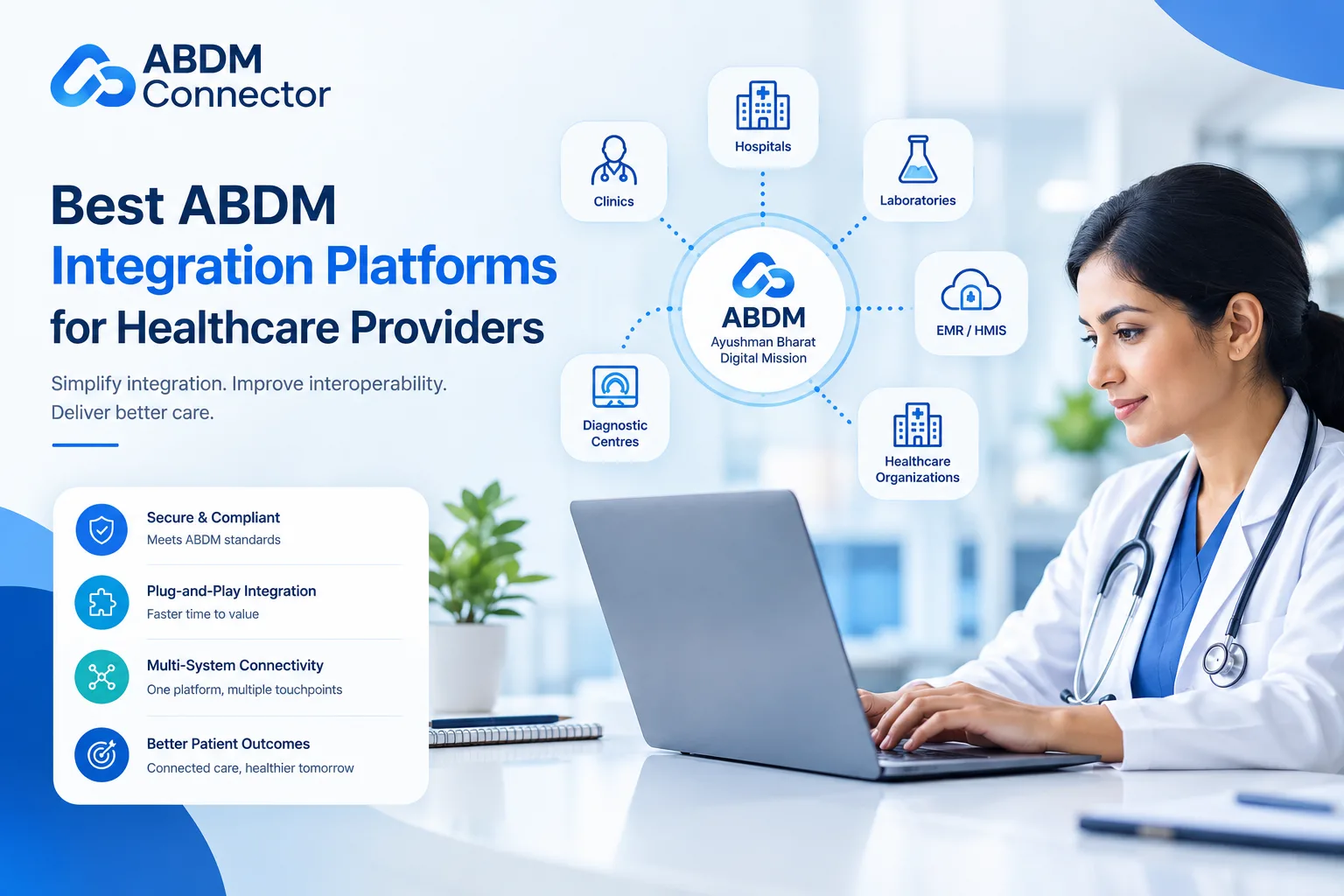
The Ayushman Bharat Digital Mission (ABDM) is transforming India's healthcare ecosystem by creating a connected and interoperable digital health infrastructure. Hospitals, clinics, diagnostic laboratories, HMIS providers, EMR companies, and health-tech platforms can use ABDM integration to connect their existing healthcare systems with India's digital health ecosystem.
Choosing the right ABDM integration platform can help healthcare organizations simplify implementation, improve interoperability, and reduce the technical effort required to connect with ABDM.
What is ABDM?
ABDM (Ayushman Bharat Digital Mission) is a Government of India initiative focused on building an interoperable digital health ecosystem.
The objective of ABDM is to create a connected healthcare environment where patients, healthcare providers, and digital health applications can securely participate in digital health services.
Traditionally, hospitals and healthcare organizations use different systems for patient registration, medical records, laboratory reports, prescriptions, billing, and other clinical workflows. These systems may operate independently and may not easily exchange information.
ABDM aims to improve this interoperability by establishing common digital health infrastructure, registries, standards, and consent-based health information exchange.
Key Components of ABDM
Some important components of the ABDM ecosystem include:
- ABHA (Ayushman Bharat Health Account): A digital health identity for individuals.
- Health Facility Registry (HFR): A registry of healthcare facilities.
- Healthcare Professional Registry (HPR): A registry of healthcare professionals.
- Healthcare Information Provider (HIP): A system or organization that can provide health information.
- Healthcare Information User (HIU): A system or organization that can request and use health information with appropriate consent.
- Consent-based health information exchange: Enables health information to be shared according to applicable consent workflows.
- FHIR-based interoperability: Supports standardized healthcare data exchange between systems.
Why is ABDM Important for Healthcare Providers?
ABDM integration allows healthcare organizations to connect their existing HMIS, EMR, EHR, LIS, diagnostic, and healthcare applications with the broader digital health ecosystem.
For example, instead of completely replacing an existing hospital management system, a healthcare provider can use an ABDM integration layer to connect its existing software with relevant ABDM services.
This can help organizations:
- Improve healthcare interoperability
- Enable digital health workflows
- Support ABHA-related services
- Facilitate consent-based health information exchange
- Connect different healthcare applications
- Reduce isolated data systems
- Improve the digital healthcare experience
For this reason, ABDM integration is becoming increasingly important for healthcare providers and health-tech companies in India.
ABDM Integration Platforms for Healthcare Providers
1. ABDM ConnectorABDM Connector is an ABDM integration platform designed to help healthcare providers and health-tech companies connect their existing applications with ABDM.
The platform can support organizations working with HMIS, EMR, EHR, LIS, diagnostic systems, and healthcare applications.
Key Features:
- ABDM APIs
- ABHA integration
- Consent-based workflows
- Health information exchange
- FHIR data mapping
- REST APIs and SDKs
- Webhooks
- Sandbox testing
- Healthcare system integration
A major advantage of using a dedicated integration platform is that organizations can avoid building every ABDM workflow completely from scratch.
2. Eka Care
Eka Care is a digital healthcare platform that provides solutions for healthcare providers and digital health applications.
Its ecosystem includes digital health records and healthcare technology capabilities that can support organizations looking to participate in India's digital health infrastructure.
3. MediBuddy
MediBuddy is a digital healthcare platform offering healthcare services and technology solutions.
Healthcare organizations evaluating ABDM-related solutions can consider platforms with established digital healthcare infrastructure and connectivity capabilities.
4. Practo
Practo provides healthcare technology solutions for doctors, clinics, and patients.
Its healthcare software ecosystem can be relevant for providers looking for digital healthcare management and connectivity solutions.
5. HealthPlix
HealthPlix provides digital healthcare technology focused on doctors, clinics, and patient management.
Its technology infrastructure can be considered by healthcare providers looking for digital clinical workflows and connected healthcare solutions.
How to Choose the Best ABDM Integration Platform
Before selecting an ABDM integration platform, healthcare providers should compare:
- ABDM compatibility
- API and SDK availability
- FHIR support
- Data mapping
- Consent management
- Security and authentication
- Sandbox testing
- Scalability
- HMIS/EMR compatibility
- Technical support
- Integration and maintenance costs
A good ABDM solution should work with your existing healthcare infrastructure and minimize unnecessary changes to your current systems.
Benefits of ABDM Integration
- Better Interoperability: ABDM integration helps different healthcare systems communicate through standardized digital health workflows.
- Improved Patient Experience: Connected digital health systems can make healthcare information and services more accessible to patients through applicable ABDM workflows.
- Reduced Development Effort: A dedicated integration platform can reduce the need for healthcare organizations to develop every ABDM component internally.
- Scalable Infrastructure: Healthcare providers can add ABDM capabilities while continuing to use their existing HMIS, EMR, EHR, or LIS systems.
- Secure Health Information Exchange: ABDM is built around privacy, security, and consent-based health information exchange, supporting a more connected digital healthcare ecosystem.
Conclusion
The Ayushman Bharat Digital Mission (ABDM) is playing an important role in India's transition toward interoperable digital healthcare.
For hospitals, clinics, diagnostic laboratories, HMIS providers, and health-tech companies, choosing the right ABDM integration platform can simplify connectivity and help them participate in the digital health ecosystem.
Frequently Asked Questions
Q1. What is ABDM integration?
A1. ABDM integration is the process of connecting healthcare software such as HMIS, EMR, EHR, LIS, and healthcare applications with the Ayushman Bharat Digital Mission ecosystem.
Q2. What is ABDM?
A2. ABDM stands for Ayushman Bharat Digital Mission. It is a Government of India initiative designed to create an interoperable digital health ecosystem.
Q3. What is ABHA?
A3. ABHA stands for Ayushman Bharat Health Account. It provides individuals with a digital health identity within the ABDM ecosystem.
Q4. Why do hospitals need ABDM integration?
A4. ABDM integration can help hospitals participate in digital health workflows and connect existing healthcare systems with relevant ABDM services.
Q5. Can an existing HMIS be integrated with ABDM?
A5. Yes. Existing HMIS, EMR, EHR, and other healthcare systems can be connected with ABDM using suitable integration solutions and APIs.
Q6. What is FHIR in ABDM?
A6. FHIR is a healthcare interoperability standard that helps systems represent and exchange health information in a standardized format.
Q7. Can diagnostic laboratories integrate with ABDM?
A7. Yes. Diagnostic laboratories can use applicable ABDM workflows to support digital health information and diagnostic report exchange.
Q8. Can health-tech companies integrate with ABDM?
A8. Yes. Health-tech companies can integrate their applications with applicable ABDM services based on their use case and technical requirements.
Q9. Is it better to build ABDM integration in-house?
A9. It depends on the organization's technical resources, budget, customization requirements, and maintenance capabilities. A dedicated ABDM integration platform may reduce development and maintenance effort.
Q10. Which is the best ABDM integration platform?
A10. There is no single best platform for every organization. Healthcare providers should compare ABDM capabilities, APIs, FHIR support, consent workflows, security, scalability, documentation, support, and compatibility with their existing healthcare software before making a decision.