Every child deserves a chance to thrive. For families in the Charlotte area raising a child on the autism spectrum, finding the right support can feel overwhelming at first. The good news is that high-quality autism services Charlotte NC has to offer are more accessible than many parents realize, and the impact those services can have on a child's development is genuinely profound.
At Adapt For Life, we see it every day. Children who once struggled to communicate begin expressing their needs clearly. Kids who felt frustrated and disconnected start building meaningful friendships. Parents who felt lost find a roadmap. That kind of transformation does not happen by chance. It happens because of consistent, individualized, evidence-based care.
So what exactly are the benefits of autism services for children, and how do you know if your child could benefit from them? Let's walk through what the research shows, what families in Charlotte are experiencing, and what you can expect when you take that first step.
Why Early Access to Autism Services Charlotte NC Makes Such a Difference
One of the most well-established findings in autism research is that early intervention produces better outcomes. The earlier a child receives targeted support, the more opportunity the brain has to build new pathways, develop language, and learn adaptive behaviors. This is not a minor edge. Early access to autism services Charlotte NC can genuinely alter the developmental trajectory for a child.
Think about a child named Marcus. His parents noticed he was not making eye contact around 18 months and was not pointing at objects or responding to his name consistently. By the time he was two, a developmental pediatrician referred him for evaluation. He began receiving services shortly after his second birthday. Within a year, Marcus was using two-word phrases, tolerating new environments more easily, and engaging in simple back-and-forth play with his older sister. His parents describe that first year of services as a turning point they almost missed.
Are you noticing signs in your child that something might be different, but you're not sure where to start? You are not alone, and reaching out early is always the right call.
Children who receive early, intensive support often show meaningful gains in communication, social skills, and daily living abilities. Those gains tend to be lasting. That is why families across the greater Charlotte region are actively seeking services before their children even reach kindergarten.
What Applied Behavior Analysis Actually Looks Like
Applied Behavior Analysis, commonly called ABA, is the most research-supported approach to autism intervention. Autism ABA therapy Charlotte NC uses structured techniques to teach skills and reduce behaviors that interfere with learning and daily life. But what does that look like in a real session with a real child?
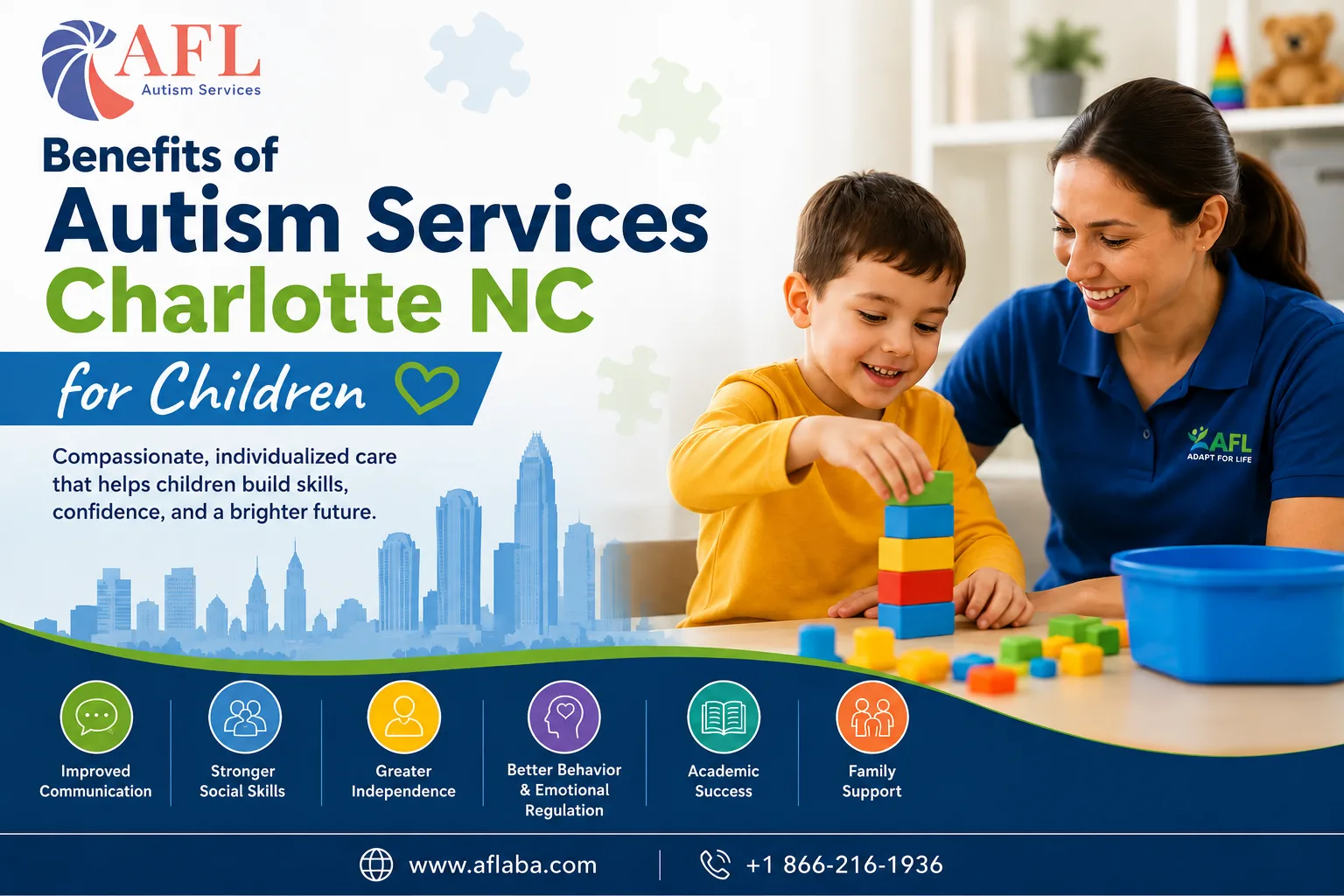
It does not look like rote repetition or a child sitting rigidly at a table for hours. Modern ABA is naturalistic, playful, and child-led in many of its methods. A skilled behavior technician might spend part of a session on the floor building blocks with a child, teaching them to request help, take turns, and celebrate small wins together. Another part of the session might focus on a specific communication goal, like using pictures or a speech-generating device to express a want.
Consider Sofia, a six-year-old who joined our program primarily because of significant meltdowns that were affecting her family's ability to go out in public. Grocery trips had become nearly impossible. Her team developed a plan that included teaching Sofia to communicate discomfort before reaching her breaking point, combined with gradual exposure to sensory-heavy environments. Over several months, her parents began taking small outings again. By the end of her first year, Sofia attended a birthday party at a local park with minimal support. Her mother cried happy tears the whole drive home.
Stories like Sofia's are not exceptional. They are the standard we work toward with every child we serve through autism ABA therapy Charlotte NC.
Core Skills Children Build Through Structured Autism Support
Parents sometimes ask us what areas therapy actually targets. The scope is broader than many people expect. Depending on the child's needs and goals, services may focus on:
• Communication and language development, including both verbal and non-verbal strategies
• Social skills like turn-taking, recognizing emotions, making and keeping friendships
• Daily living skills such as toileting, dressing, meal routines, and hygiene
• Academic readiness, including attention, following instructions, and classroom behavior
• Emotional regulation and coping strategies for difficult sensory or social situations
• Reducing behaviors that cause harm or significantly limit participation in daily life
Every child's program is individualized. What matters for one child may be entirely different for another. That individualization is one of the things that makes autism ABA therapy Charlotte NC so effective when delivered well.
What skills does your child most need to build right now? That question drives every treatment plan we create at Adapt For Life.
How Autism Services Charlotte NC Support the Whole Family
Something that does not get enough attention is the impact autism services have on the entire family, not just the child receiving therapy. Raising a child with autism can be isolating. Parents often feel they have to become experts overnight on topics they never expected to navigate. Siblings sometimes feel overlooked. Caregiver burnout is real and common.
Quality autism services include meaningful parent training and family support. This is not optional or secondary. When parents understand the techniques being used in therapy and know how to apply them at home, children make faster progress. Consistency across environments matters enormously. A skill a child learns in a therapy room needs to generalize to the dinner table, the classroom, and the playground.
James and Patricia had been told by a previous provider to "just watch" and that their son Eliot would likely catch up on his own. By the time Eliot was four, the gap between him and his peers had widened. When they connected with Adapt For Life, the first thing that struck them was not the therapy schedule. It was the intake conversation, which lasted more than an hour, during which a clinician listened carefully, asked about the whole family's experience, and explained exactly how they would be involved. Three months in, Patricia told us: "For the first time, I feel like we are actually on a team." That feeling is not incidental. It reflects what good services are supposed to do.
When families feel supported and informed, outcomes improve. It really is that connected.
What to Look For in a Charlotte Autism Services Provider
Not all providers are equal. Choosing the right autism services for your child is one of the most consequential decisions you will make as a parent, and it is worth taking the time to evaluate your options carefully. Here is what matters most:
Board Certified Behavior Analysts in Clinical Oversight
Every child's program should be designed and supervised by a Board Certified Behavior Analyst (BCBA). This credential means the clinician has met rigorous training and ethical standards. At AFL, every program is developed and overseen by a BCBA who stays closely involved throughout treatment.
Individualized Assessment Before Treatment Begins
A provider who jumps straight into a generic program without thorough assessment is not serving your child well. A proper intake should include direct observation, standardized assessments, parent interviews, and collaboration with other professionals involved in your child's care.
Regular Progress Monitoring and Communication
Treatment goals should be reviewed frequently, and parents should always know how their child is progressing. If data collection and transparent communication are not central to how a provider operates, that is a concern worth raising.
Asking these questions before you commit to a provider is not being difficult. It is being a good advocate for your child.
Taking the First Step Toward Autism Services Charlotte NC
Many families tell us they waited longer than they wish they had before seeking services. Sometimes it was uncertainty about the diagnosis. Sometimes it was fear of the process. Sometimes it was simply not knowing where to start. Whatever has kept you hesitating, we want to make that first step as simple and pressure-free as possible.
At Adapt For Life, we accept a wide range of insurance plans and have a dedicated intake team that will walk you through every step of the process. We serve children across Charlotte and the surrounding communities, offering both clinic-based and home-based service options depending on what fits your family's needs.
Does your child have a recent autism diagnosis, or are you currently in the process of evaluation? Either way, we can help you understand your options and what comes next.
Contact Adapt For Life Today
Your child's progress does not have to wait. The Adapt For Life team is ready to help you take the next step toward meaningful growth and a better quality of life for your whole family.
Reach out to us today to schedule a free consultation. Our intake specialists are available to answer your questions, help you understand your insurance coverage, and match your child with the right clinicians. Call us, fill out our online intake form, or send us a message. We will get back to you promptly because we know that time matters when it comes to your child's development.
Contact Adapt For Life now and let's get started.
Frequently Asked Questions
What age should my child start autism services?
Research supports starting as early as possible, ideally between ages two and five, when the brain is most responsive to learning. However, children of all ages benefit from well-designed services. If your child is older and has not yet received support, it is not too late to make meaningful progress.
How many hours of therapy does my child need?
The appropriate intensity depends on your child's age, needs, and treatment goals. Some children benefit from 10 to 15 hours per week, while others may need more intensive programming. Your child's BCBA will make a recommendation based on a thorough assessment and adjust hours over time as your child progresses.
Does insurance cover autism ABA therapy in Charlotte, NC?
North Carolina state law requires most insurance plans to cover autism services, including ABA therapy, for children with a diagnosis. Adapt For Life works with many major insurance providers and can help you verify your benefits before treatment begins. Our intake team handles much of this process on your behalf.
What is the difference between clinic-based and home-based services?
Clinic-based services take place at our facility and offer access to specialized materials, a structured learning environment, and peer interaction opportunities. Home-based services allow therapy to happen in your child's natural environment, which can support generalization of skills and makes participation easier for some families. Many children receive a combination of both settings.
How will I know if my child is making progress?
Adapt For Life uses ongoing data collection to track your child's progress toward every goal in their treatment plan. You will receive regular updates from your child's BCBA, and goals are reviewed and updated on a consistent schedule. You will always know where your child stands and what we are working toward next.