
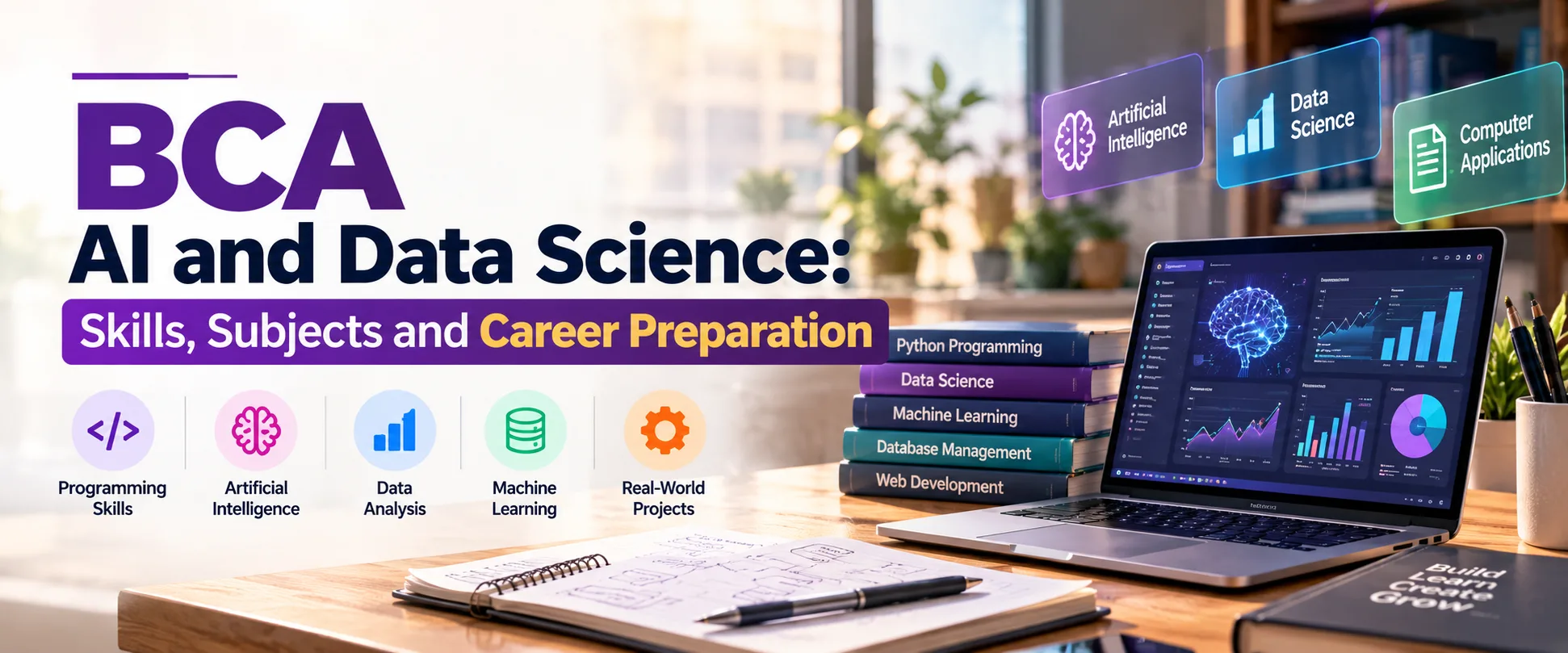
Artificial Intelligence and Data Science are becoming important areas of modern technology. Students who are interested in programming, data, automation, and intelligent applications can explore degree programs that combine computer applications with AI and Data Science.
A BCA in AI and Data Science can provide students with a foundation in computer applications while introducing them to areas such as artificial intelligence, data analysis, machine learning, programming, and databases.
However, choosing a course is only the first step. Students should also understand the subjects they may study, the skills they can develop, and how they can prepare for practical technology work during their degree.
What Is BCA in AI and Data Science?
BCA in AI and Data Science is a computer applications degree that combines traditional computing concepts with artificial intelligence and data-focused subjects.
The program can introduce students to programming, databases, computer fundamentals, data analysis, artificial intelligence, machine learning, and related technologies.
Students who want a more detailed introduction can read about what BCA in AI and Data Science means.
Subjects Students May Study
The exact curriculum can vary between institutions, but a BCA AI and Data Science program may include subjects related to:
- Programming fundamentals
- Python programming
- Database management
- Data structures
- Computer networks
- Web technologies
- Statistics
- Data analysis
- Artificial Intelligence
- Machine Learning
- Data visualization
- Cloud technologies
- Software development
- Computer science fundamentals
Understanding the curriculum is important because students should know what they will learn before selecting a degree program.
Skills Students Can Build
A BCA AI and Data Science program can help students develop a combination of computer application and data-focused skills.
Programming Skills
Programming is an important foundation for working with AI and data. Students can begin with programming fundamentals and gradually work with languages and tools used for data and software development.
Data Analysis Skills
Students can learn how to collect, organize, process, and interpret data. These skills can be useful for understanding patterns and creating data-driven solutions.
Artificial Intelligence Fundamentals
Students can learn basic concepts related to AI and machine learning and understand how intelligent systems can be developed using data and algorithms.
Database Knowledge
Working with data requires an understanding of databases. Students can learn how information is stored, managed, queried, and organized.
Problem-Solving Skills
Technology education is not only about learning programming languages. Students also need to understand how to break a problem into smaller parts and develop practical solutions.
Practical Projects Are Important
Students should not depend only on classroom learning. Practical projects can help them apply concepts and understand how different technologies work together.
For example, students can work on projects such as:
- Student performance analysis
- Sales data dashboards
- Recommendation systems
- Basic prediction models
- Chatbot applications
- Data visualization projects
- Attendance analysis systems
- AI-based classification projects
Students looking for project inspiration can explore BCA AI and Data Science final-year project ideas.
How Students Can Prepare During the Degree
Students can gradually build their technical skills throughout the program rather than waiting until the final year.
A simple learning approach can be:
First stage: Learn programming and computer fundamentals.
Second stage: Develop database, data structures, and problem-solving knowledge.
Third stage: Explore statistics, data analysis, AI, and machine learning.
Fourth stage: Build practical projects and create a technical portfolio.
This approach allows students to develop their knowledge step by step.
Building a Technical Portfolio
A portfolio can help students demonstrate what they have learned.
Students can include:
- Academic projects
- Personal projects
- Data analysis work
- AI experiments
- GitHub repositories
- Technical presentations
- Certifications
- Internship projects
A portfolio does not need to contain complicated projects. Well-documented projects that demonstrate clear problem-solving can be useful.
Who Can Consider BCA AI and Data Science?
This type of program can be considered by students who are interested in:
- Computer applications
- Programming
- Artificial intelligence
- Data analysis
- Machine learning
- Technology problem solving
- Software applications
- Data-driven systems
Students should also check the eligibility requirements of the institution before applying. More information can be found in this guide to BCA AI and Data Science eligibility.
BCA AI and Data Science and Future Learning
A BCA in AI and Data Science can provide a foundation for students who want to continue developing their knowledge in areas such as artificial intelligence, data science, machine learning, software development, analytics, and related technology fields.
After completing the degree, students can also consider advanced education, certifications, specialized training, internships, or practical projects based on their interests.
Students can explore the broader AI and Data Science degree landscape in India to understand different educational pathways.
Choose a Program Based on Your Learning Goals
Students should compare programs carefully before selecting a degree.
Important factors include:
- Course curriculum
- Practical learning
- Faculty
- Laboratory facilities
- Projects
- Technology exposure
- Learning resources
- Internship opportunities
- Academic support
The course title is only one part of the decision. Students should examine what they will actually learn and how the program supports practical development.
Students interested in this field can also explore the BCA AI and Data Science program.
Final Thoughts
BCA AI and Data Science combines computer applications with important areas of artificial intelligence and data. For students interested in technology, the program can provide a foundation for developing programming, data, AI, and problem-solving skills.
The most effective way to benefit from the degree is to combine academic learning with practical projects, technical practice, portfolio development, and continuous learning.
Students should research the curriculum, understand the eligibility requirements, compare learning opportunities, and choose a program that matches their interests and long-term learning goals.