
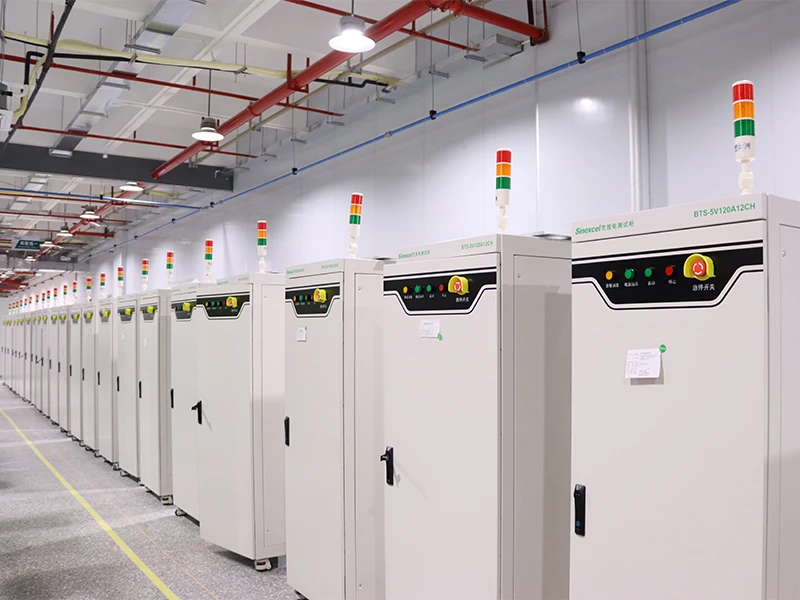
Introduction to Battery Tests
Battery tests play a crucial role in ensuring the reliability, safety, and performance of modern energy storage systems. As the demand for electric vehicles (EVs), renewable energy solutions, and backup power systems grows, battery quality standards have become stricter than ever. At Sinexcel, we understand that battery testing is not just a technical procedure — it’s the foundation for delivering dependable, long-lasting, and safe energy solutions.
From capacity verification to safety compliance, battery tests help manufacturers, engineers, and end-users assess whether a battery meets the performance requirements of its intended application. Without rigorous testing, risks such as capacity loss, overheating, or even dangerous thermal runaway events could compromise an entire system.
Why Battery Tests Are Essential
- Safety Assurance
- Battery failures can result in severe safety hazards, including fires or explosions. Through thermal stability and abuse tests, manufacturers can identify weak points in cell chemistry or design before products reach the market.
- Performance Validation
- Battery tests measure how well a battery maintains voltage, current, and capacity under various operating conditions. This ensures that the performance matches the manufacturer’s claims.
- Quality Control
- Consistent testing helps detect manufacturing defects early, preventing large-scale recalls or warranty issues.
- Compliance with International Standards
- Regulations such as IEC 62619 for industrial batteries or UN 38.3 for transportation require batteries to undergo specific tests before approval.
Types of Battery Tests
Battery testing is a multi-step process, often tailored to the chemistry, application, and operational conditions of the battery. The main categories include:
1. Performance Tests
- Capacity Test: Measures the actual charge storage compared to the nominal capacity.
- Cycle Life Test: Determines how many charge/discharge cycles a battery can undergo before its capacity falls below a certain threshold.
- Rate Capability Test: Evaluates performance under different discharge currents.
2. Safety Tests
- Overcharge Test: Checks how a battery reacts to excessive charging.
- Short-Circuit Test: Simulates an accidental short to assess safety features.
- Thermal Stability Test: Monitors behavior under high-temperature conditions.
3. Environmental Tests
- High/Low Temperature Storage: Evaluates how batteries hold up under extreme climates.
- Vibration and Shock Test: Ensures durability during transportation.
- Humidity Resistance: Tests corrosion resistance in humid environments.
4. Impedance and Internal Resistance Tests
- Determines how internal resistance changes over time, which impacts efficiency and heat generation.
Battery Testing in Energy Storage Systems
In the context of large-scale energy storage solutions, battery tests go beyond single-cell evaluation. Sinexcel integrates battery testing protocols into the development and maintenance of Battery Energy Storage Systems (BESS), ensuring:
- System-level reliability by testing battery modules and packs under real-world load conditions.
- Optimized battery management systems (BMS) for accurate state-of-charge (SOC) and state-of-health (SOH) monitoring.
- Predictive maintenance capabilities by analyzing historical performance data to detect degradation trends.
Testing Equipment and Methods
Modern battery tests use advanced instruments such as:
- Battery Analyzers for precise voltage, current, and capacity measurement.
- Environmental Chambers to simulate extreme temperatures and humidity.
- High-Precision Cyclers for controlled charge/discharge cycles.
- Impedance Spectroscopy for in-depth electrochemical diagnostics.
Sinexcel works with state-of-the-art testing equipment to ensure results are accurate and repeatable, meeting the highest industry standards.
Standards and Certifications in Battery Testing
Compliance is a critical part of battery testing. Common standards include:
- IEC 62133 – Safety requirements for portable sealed secondary cells.
- IEC 62619 – Safety for industrial lithium batteries.
- UL 2054 – Household and commercial battery safety.
- UN 38.3 – Transport of lithium batteries.
By adhering to these guidelines, Sinexcel guarantees that our solutions can be shipped and deployed globally without regulatory obstacles.
How Battery Tests Improve Longevity
Battery degradation is a natural process, but testing helps mitigate it. For example:
- Cycle life tests guide optimization of charging algorithms to extend lifespan.
- Thermal performance tests help in designing better cooling systems.
- Capacity retention tests inform end-users about realistic operational life.
At sinexcel-re, we integrate these insights into product development, ensuring our energy storage systems maintain top performance for years.
Challenges in Battery Testing
While battery tests are essential, they also face challenges:
- Time-Intensive: Some cycle life tests can take months to complete.
- Cost: High-precision equipment and safety facilities are expensive.
- Rapid Technological Change: New chemistries (e.g., solid-state, sodium-ion) require updated testing protocols.
Sinexcel continuously updates its testing facilities and methodologies to stay ahead of industry evolution.
Future Trends in Battery Testing
Looking forward, battery testing will become more data-driven and automated. AI-based predictive analytics will allow real-time monitoring of battery health, enabling proactive maintenance. Additionally, non-invasive testing techniques, such as ultrasound diagnostics, will reduce the need for destructive testing.
Conclusion
Battery tests are the backbone of a safe, efficient, and reliable energy storage ecosystem. From verifying capacity to ensuring compliance with safety standards, these tests safeguard both users and the technology itself.
At sinexcel-re, our expertise in battery testing ensures that every solution we deliver meets the highest standards of performance and safety. Whether for electric vehicles, renewable energy storage, or industrial applications, we believe that rigorous testing is the key to powering a sustainable future.