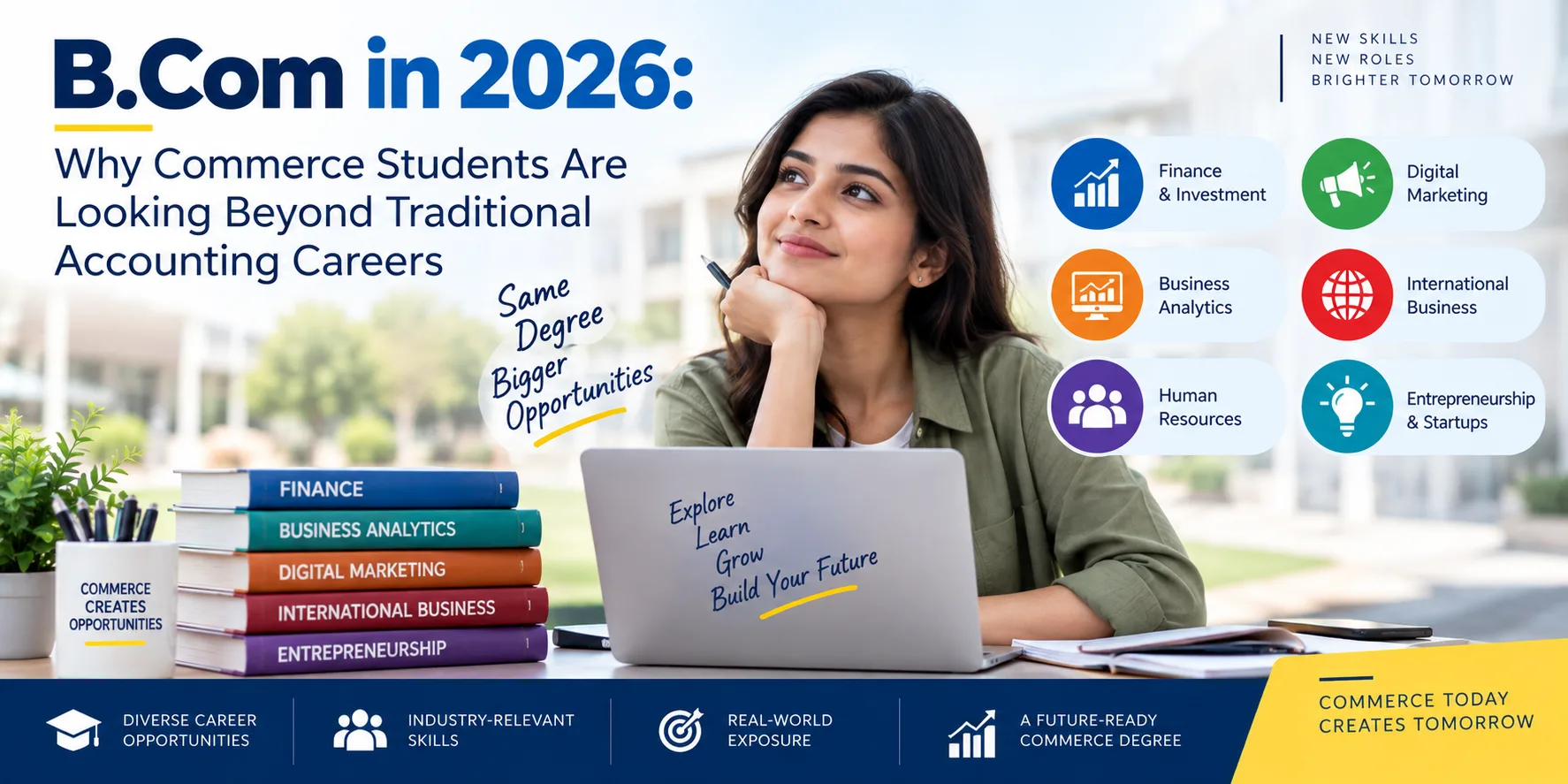
For decades, commerce education was closely associated with accounting, taxation, banking, and finance. These areas remain important, but the career landscape for commerce graduates has expanded considerably. Today, students pursuing a b com course in bangalore can explore opportunities connected with finance technology, business analytics, digital commerce, consulting, entrepreneurship, financial services, and management.
This changing career environment is also influencing how students evaluate B.Com programmes. Instead of asking only which subjects are included in a degree, many students are asking a more practical question: What skills can I develop during my B.Com that will remain useful after graduation?
The answer goes beyond traditional accounting.
The B.Com Degree Is Evolving
Commerce remains closely connected with how businesses make money, manage resources, understand customers, and plan for growth.
However, businesses now operate in increasingly digital environments.
Financial transactions happen online. Businesses use data to make decisions. E-commerce has transformed buying and selling. Financial technology has changed how people access financial services. Companies rely on digital platforms for accounting, marketing, operations, and customer management.
This means today's commerce graduate can benefit from combining traditional business knowledge with modern digital and analytical skills.
Accounting Is Still Important
Looking beyond traditional accounting does not mean ignoring accounting.
Accounting provides an important foundation for understanding business performance.
Students learn how transactions are recorded, how financial statements are prepared, how costs are analysed, and how financial information can support business decisions.
These fundamentals remain relevant across organisations.
The difference is that modern commerce professionals may use accounting knowledge alongside software, analytics, automation, financial technology, and business intelligence.
Understanding the numbers is still important.
Knowing how to interpret and use those numbers can make the knowledge even more valuable.
1. Finance and Financial Services
Finance remains one of the natural career areas for commerce graduates.
Students can explore areas such as:
- Financial analysis
- Banking
- Investment services
- Corporate finance
- Financial planning
- Risk management
- Insurance
- Fintech
A strong foundation in accounting, economics, mathematics, and financial concepts can help students understand how money moves through businesses and financial institutions.
Students interested in finance can also develop analytical and technology skills alongside their academic studies.
2. Fintech Is Creating New Commerce Opportunities
Financial technology has changed how consumers and businesses interact with financial services.
Digital payments, online banking, automated financial services, financial platforms, and data-driven decision-making have created new areas where commerce and technology overlap.
This creates an interesting opportunity for B.Com students.
They do not necessarily need to become programmers.
But understanding digital financial systems, data, technology-enabled services, and customer behaviour can help them understand the modern financial environment.
Students interested in fintech can therefore combine commerce fundamentals with digital and analytical learning.
3. Business Analytics Is Opening Another Career Route
Businesses have access to more data than ever.
Sales information, customer behaviour, financial performance, website activity, inventory data, and operational information can all help companies make decisions.
This has increased the importance of people who can understand and interpret business data.
Commerce students can build useful analytical foundations through:
- Excel
- Statistics
- Data visualisation
- Business intelligence
- SQL basics
- Financial analysis
- Data interpretation
A graduate who understands both business concepts and data can potentially work across multiple business functions.
4. Digital Commerce Has Changed the Business Landscape
E-commerce has become an important part of modern business.
Commerce students can explore how digital businesses manage:
- Pricing
- Payments
- Customer acquisition
- Inventory
- Online sales
- Customer experience
- Digital operations
- Revenue
This creates career opportunities that combine commerce knowledge with digital business understanding.
Students can also learn how traditional businesses are adapting their models for online customers.
5. Taxation Remains a Valuable Specialisation
Taxation continues to be an important area within commerce.
Businesses and individuals need professionals who understand tax regulations, compliance processes, financial documentation, and changing requirements.
Students interested in taxation can develop their knowledge through academic study and additional professional learning.
Technology is also influencing tax-related work, with digital systems increasingly involved in accounting and compliance processes.
Therefore, taxation itself is evolving rather than disappearing.
6. Consulting and Business Advisory
Commerce graduates can also explore business consulting and advisory-related career paths.
Consulting requires more than subject knowledge.
Professionals may need to analyse information, understand business problems, communicate recommendations, prepare presentations, and work with clients.
Students interested in this direction can strengthen:
- Analytical thinking
- Communication
- Presentation skills
- Business knowledge
- Research
- Problem-solving
- Financial understanding
Participating in case studies and business projects during college can help students develop these abilities.
7. Entrepreneurship Is Another Option
A commerce degree can also provide useful knowledge for students who want to build a business.
Understanding accounting, costs, revenue, pricing, taxation, finance, and business operations can help entrepreneurs make better-informed decisions.
Entrepreneurship does not necessarily mean launching a large company immediately after graduation.
Students can start small.
They can experiment with a business idea, create a digital service, sell products online, or work on a startup project while continuing their education.
The important lesson is understanding how a business works.
Why Practical Learning Matters in B.Com
Academic concepts become more meaningful when students can apply them.
For example, instead of simply learning financial statements, students could analyse the financial performance of a real or publicly available company.
Instead of studying marketing concepts only from textbooks, students could examine how an online business attracts customers.
Instead of learning business statistics without context, students could use a dataset to identify trends.
These activities help students understand how commerce concepts operate in real situations.
This is one factor students should consider when comparing bcom courses in bangalore.
What Skills Should a Commerce Student Build in 2026?
A modern commerce student can benefit from developing a combination of business and digital skills.
Financial Understanding
Accounting, finance, taxation, and business economics remain fundamental.
Data Literacy
Students should become comfortable reading, interpreting, and communicating information from data.
Digital Awareness
Understanding digital platforms, online commerce, fintech, and business technology can provide valuable context.
Communication
Professionals need to explain financial and business information clearly to different audiences.
Analytical Thinking
Employers value people who can identify problems, examine evidence, and develop logical solutions.
Professional Skills
Time management, teamwork, presentations, documentation, and workplace communication can support the transition from college to employment.
How to Evaluate B.Com Courses in Bangalore
Students comparing bcom courses in bangalore should look beyond the programme title.
Consider the curriculum first.
Does it provide a strong foundation in commerce?
Then examine practical exposure.
Are students encouraged to work on projects, case studies, presentations, internships, or industry-related activities?
Technology exposure is another consideration.
Does the learning environment encourage students to understand digital business, analytics, financial technology, or other modern areas?
Students should also examine faculty interaction, career guidance, extracurricular activities, and opportunities for professional development.
Choosing a B.Com Programme Based on Your Career Goal
Different students may need different learning experiences.
Interested in Finance?
Focus on accounting, financial analysis, economics, investment concepts, and analytical skills.
Interested in Business Analytics?
Build knowledge of statistics, Excel, data visualisation, business intelligence, and data interpretation.
Interested in Fintech?
Combine commerce and finance fundamentals with digital technology awareness.
Interested in Entrepreneurship?
Learn about finance, accounting, marketing, operations, taxation, and business planning.
Interested in Corporate Careers?
Develop business knowledge alongside communication, teamwork, presentation, analytical, and professional skills.
The goal is to create a skill combination that matches your interests.
Why Bangalore Can Be an Interesting Place for Commerce Students
Bangalore is not only a technology destination.
It also has companies across banking, finance, consulting, retail, e-commerce, healthcare, manufacturing, technology, and startups.
This diversity can give commerce students exposure to different types of businesses.
A student can study traditional finance while observing how fintech companies operate.
Another student can learn accounting while exploring digital commerce.
Someone interested in entrepreneurship can observe startup business models.
The city therefore provides an environment where traditional commerce knowledge and modern business practices can overlap.
Exploring B.Com Education at AIMS IBS
Students exploring undergraduate commerce education in Bangalore can also review institutions such as AIMS IBS Business School and examine its B.Com-related programme offerings, curriculum, practical learning approach, industry exposure, and career-development opportunities.
Students should always verify the latest programme information, eligibility requirements, university affiliation, fees, curriculum, and admission details directly with the institution before applying.
The right programme depends on the student's academic interests and career objectives.
What Can You Do During Your B.Com?
A three-year degree can provide enough time to gradually develop a career profile.
First Year
Build strong foundations in accounting, economics, business concepts, mathematics, and communication.
Begin exploring different career areas.
Second Year
Identify areas of interest.
Develop digital and analytical skills.
Participate in projects, presentations, competitions, workshops, and internships where possible.
Third Year
Focus on your preferred career direction.
Build your resume, complete meaningful projects, gain practical exposure, and prepare for employment or higher education.
This approach allows students to leave college with more than academic marks.
Higher Education After B.Com
A B.Com degree can also be a foundation for further education.
Depending on their interests, graduates may consider postgraduate study or professional qualifications in areas related to management, finance, accounting, taxation, analytics, economics, or other business disciplines.
The appropriate route depends on the student's career goals, eligibility, interests, and long-term plans.
Final Thoughts
The role of a commerce graduate is no longer limited to traditional accounting-related work.
Accounting and finance remain important, but new opportunities are emerging at the intersection of commerce, technology, data, and digital business.
Students pursuing a b com course in bangalore can therefore use their undergraduate years to develop a broader combination of skills.
Learn the fundamentals.
Understand the numbers.
Develop digital awareness.
Practise analysing information.
Work on real projects.
Improve communication.
Gain practical exposure.
The future of commerce is not about replacing traditional knowledge. It is about combining that foundation with the skills required by a changing business environment.