Introduction
When organizations move to the cloud, one of the first real challenges they face is not deployment, it’s connectivity. How do you securely connect your existing data center to AWS without exposing sensitive data over the internet?
I encountered this exact situation while working on a hybrid cloud setup. We needed a reliable and secure way to extend our on-premises network into AWS. That’s when I started working with the AWS Virtual Private Gateway, and it quickly became clear how important this component is in cloud networking.
In this article, I’ll explain what a Virtual Private Gateway in AWS is, how it works, and why it’s essential for hybrid cloud architectures.
What is AWS Virtual Private Gateway?
An AWS Virtual Private Gateway (VGW) is a gateway that allows communication between your AWS VPC and external networks, such as your on-premises data center.
It is primarily used for:
Site-to-Site VPN connections
Secure communication over encrypted tunnels
In simple terms, it acts as the AWS-side endpoint of a VPN connection, enabling secure data transfer between your infrastructure and the cloud.
Why Virtual Private Gateway is Important
Without a proper gateway, connecting your internal network to AWS would require complex configurations and would likely expose traffic to security risks.
The Virtual Private Gateway solves this by:
Providing encrypted communication
Enabling secure hybrid cloud connectivity
Allowing seamless integration between on-prem and cloud
It is a key component for organizations that are not fully cloud-native and still rely on existing infrastructure.
How the Virtual Private Gateway in AWS Works
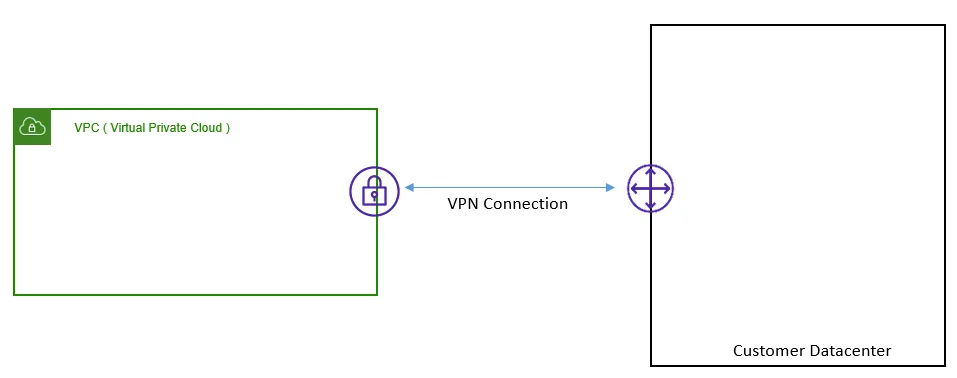
To understand its role, let’s look at how it fits into a typical architecture.
1. VPC (Your Cloud Network)
The Virtual Private Gateway is attached to your Amazon VPC, which contains your cloud resources:
EC2 instances
Databases
Applications
2. Customer Gateway (On-Premises Side)
On your side, you configure a Customer Gateway, which represents:
Your physical router or firewall
Public IP address of your network
3. VPN Connection
A Site-to-Site VPN connection is established between:
Customer Gateway (on-premises)
Virtual Private Gateway (AWS side)
This connection uses:
Encrypted IPsec tunnels
Secure data transmission
4. Routing Configuration
Routes are configured so that:
Traffic destined for AWS goes through the VPN
AWS traffic returns to the on-prem network securely
This ensures smooth and controlled communication.
Real-World Use Case: Hybrid Cloud Setup
Let’s take a practical example:
A company has:
Applications running in AWS
Databases are still hosted on-premises
Using a Virtual Private Gateway:
A VPN tunnel is established
Applications in AWS communicate with on-prem databases
Data flows securely through encrypted channels
This setup allows organizations to:
Gradually migrate to the cloud
Maintain legacy systems
Ensure business continuity
Key Features of AWS Virtual Private Gateway
1. Secure Communication
All traffic is encrypted using industry-standard protocols.
2. High Availability
AWS provides redundant VPN tunnels for reliability.
3. Easy Integration
Works seamlessly with AWS VPC and networking components.
4. Cost-Effective
Ideal for organizations that need secure connectivity without investing in dedicated lines.
Virtual Private Gateway vs Other AWS Connectivity Options
Feature → Virtual Private Gateway → AWS Direct Connect
Connectivity Type: Encrypted VPN, Dedicated private connection
Performance → depends on the internet. Consistent
Cost → Lower → Higher
Setup → Faster → More complex
Many organizations start with Virtual Private Gateway and later move to Direct Connect for higher performance needs.
Common Challenges and How to Handle Them
1. VPN Configuration Issues
Misconfigured tunnels can cause connectivity problems. Always verify:
IP addresses
Routing rules
Encryption settings
2. Routing Confusion
Incorrect route tables can block communication. Proper planning is essential.
3. Performance Limitations
Since VPN runs over the internet, performance may vary. For critical workloads, consider hybrid solutions.
Learning Virtual Private Gateway Practically
Understanding the concept is one thing, but implementing it is another.
Platforms like Dclessons help learners:
Configure Site-to-Site VPN step by step
Understand gateway behavior
Practice routing and troubleshooting
Build real hybrid architectures
Hands-on experience makes it much easier to understand how all components work together.
Career Importance of AWS Networking Skills
Knowledge of Virtual Private Gateway and hybrid connectivity is valuable for roles such as:
AWS Solutions Architect
Cloud Network Engineer
DevOps Engineer
Infrastructure Specialist
As hybrid cloud adoption increases, these skills are becoming essential.
Final Thoughts
The AWS Virtual Private Gateway plays a critical role in bridging the gap between on-premises infrastructure and cloud environments. It enables organizations to move to the cloud securely without disrupting existing systems.
Key takeaway:
VPC is your cloud network
Virtual Private Gateway connects it to the outside world
VPN ensures secure communication
If you’re working with AWS or planning a cloud career, understanding the Virtual Private Gateway in AWS is fundamental. Combine theory with hands-on practice to gain real confidence in hybrid cloud networking.