Presentations are the heartbeat of business communication. From sales pitches and weekly reports to investor updates and company-wide training, slides are how we share ideas and drive decisions. Yet, for decades, the process of creating them has been a universal source of frustration—a slow, manual task that often requires a designer’s eye to get right.
But that landscape is rapidly changing. The rise of Artificial Intelligence (AI) has triggered a profound shift, moving us from clunky, time-consuming software to intelligent, automated platforms. This evolution is not just about making prettier slides faster; it’s about democratizing design and empowering professionals to communicate their ideas with greater impact.
This article explores the journey of presentation tools—from the manual days to the AI-powered present—and explains why modern solutions like Autoppt are becoming indispensable for businesses today.
From Manual Labor to Digital Templates: The Early Days of a Presentation
Before the digital age, creating a presentation was a complex, hands-on affair. Professionals relied on overhead projectors with transparent sheets or even 35mm slides, which were expensive and took days to produce. The arrival of early software like PowerPoint in the late 1980s was revolutionary, digitizing the process and putting creation tools directly into the hands of the user.
However, this first wave of software came with its own set of challenges:
- It was incredibly time-consuming. Users had to manually adjust every element on a slide—aligning text boxes, choosing color palettes, formatting charts, and arranging images. Building a professional-looking deck could easily consume an entire day or more.
- Design skills were essential. Without a background in graphic design, it was difficult to create slides that looked polished and professional. The result was often inconsistent layouts, clashing colors, and poorly chosen fonts that distracted from the core message.
- Consistency was a constant struggle. For teams, ensuring every presentation followed the company’s branding guidelines was a nightmare. Slides created by different people often looked completely different, weakening the brand’s professional image.
To solve these problems, the next generation of tools introduced templates. Platforms like Keynote and newer versions of PowerPoint offered pre-designed slide layouts. These were a step forward, providing a baseline for quality and consistency. However, they were still rigid. Users had to manually fit their content into predefined boxes, and customization was often limited and frustrating. Templates saved some time but didn't solve the core problem: content creation and design were still two separate, demanding tasks.
The AI Revolution: When Presentations Started Building Themselves
The true game-changer arrived with the integration of Artificial Intelligence. Instead of just providing static templates, AI presentation generators began to actively participate in the creation process. They became intelligent partners, capable of understanding content and making smart design decisions automatically.
This new wave of technology introduced features that were once unimaginable:
- Text-to-Slide Generation: The most significant leap was the ability for AI to take a raw text outline, a document, or even just a simple prompt and instantly generate a complete, multi-page presentation. The AI analyzes the content, identifies key themes, and structures it into a logical flow with titles, bullet points, and summaries.
- Smart Layout and Design: AI tools can now automatically arrange elements on a slide for optimal readability and visual appeal. They suggest layouts, align objects perfectly, and ensure a clean, uncluttered look without any manual adjustments.
- Automated Charts and Diagrams: Instead of building charts from scratch, users can now input their data, and the AI will generate a visually appealing chart or infographic that best represents the information. It can turn complex data into simple, easy-to-understand visuals in seconds.
- Brand Consistency on Autopilot: Modern AI platforms can be configured with a company’s brand guidelines (logos, colors, and fonts). The AI then acts as a brand guardian, automatically applying the correct branding to every slide, ensuring perfect consistency across the entire organization.
The Impact on Business: Speed, Professionalism, and Focus
For businesses, the adoption of AI presentation generators has been transformative. It addresses the timeless constraints of limited time, resources, and design expertise. The benefits are clear and directly impact the bottom line.
Consider a sales team preparing for a client meeting. In the past, they might spend hours adapting a generic company deck for a specific client, a tedious and uninspired process. With an AI tool, they can input key information about the client’s needs and generate a customized, professional-looking pitch deck in minutes. This frees them to spend more time on strategy and building client relationships—the work that actually drives revenue.
Similarly, startups seeking investment no longer need to hire expensive freelance designers to create a compelling pitch deck. An entrepreneur can now focus entirely on the business model and narrative, trusting the AI to handle the visual storytelling. This levels the playing field, allowing great ideas to shine without being held back by a limited design budget.
Why Autoppt Stands Out in the New Era of AI Presentations
As the market for AI tools has grown, many solutions have emerged, but they are not all created equal. A standout platform that exemplifies the power of this new generation is Autoppt. It was designed specifically to solve the core challenges faced by business users, combining a vast content library with powerful AI to create a seamless workflow.
What makes Autoppt particularly effective is its dual approach:
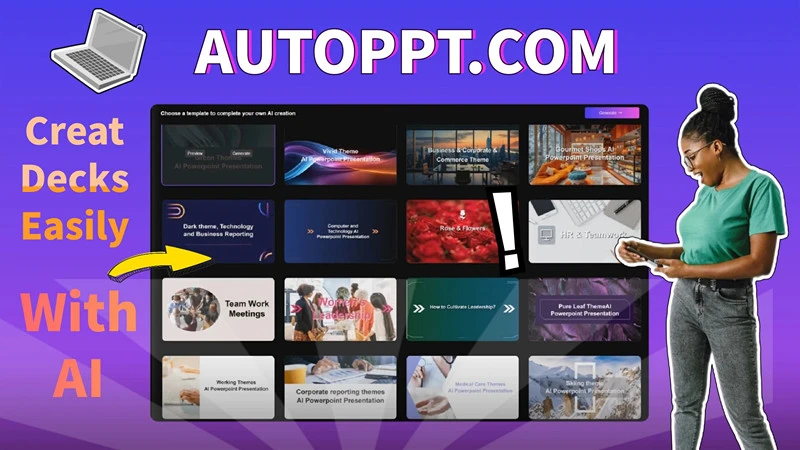
- A Rich Library of Professional PPT Templates: While many AI tools generate slides from scratch, they can sometimes lack the strategic structure needed for specific business goals. Autoppt addresses this with an extensive collection of templates for every conceivable scenario—from detailed business plans and financial reports to high-impact sales pitches and marketing strategies. These aren’t just pretty backgrounds; they are professionally structured narratives designed to persuade and inform. Users can start with a proven framework, ensuring their message is not only well-designed but also logically sound.
- Powerful AI-Powered Slide Generation: This is where Autoppt truly shines. It takes the best of both worlds—structured templates and AI automation. You can provide a simple outline or a few sentences about your topic, and Autoppt’s AI engine will instantly build a full presentation of 20-30 slides. It populates the professionally designed template with relevant content, images, and data visualizations. This feature alone reduces the creation process from hours to minutes, eliminating the blank-page anxiety that plagues so many professionals.
By combining a rich template library with cutting-edge AI, Autoppt ensures that the final output is not just fast, but also polished, professional, and strategically sound. It saves teams countless hours of manual formatting, enforces brand consistency effortlessly, and empowers anyone—regardless of their design skills—to create presentations that command attention.
Conclusion: The Future of Presentations is Intelligent
The evolution of presentation software has been a long journey from manual inefficiency to intelligent automation. We’ve moved beyond the limitations of static templates into an era where AI acts as a co-creator, helping us turn ideas into compelling visual stories faster than ever before.
For businesses, this isn't a luxury; it's a competitive advantage. The ability to communicate ideas clearly and professionally without wasting precious time is crucial for success. Tools like Autoppt are at the forefront of this movement, offering a smart, efficient, and powerful solution for the modern professional. By handling the design, formatting, and structuring, they free us to focus on what truly matters: the message itself.