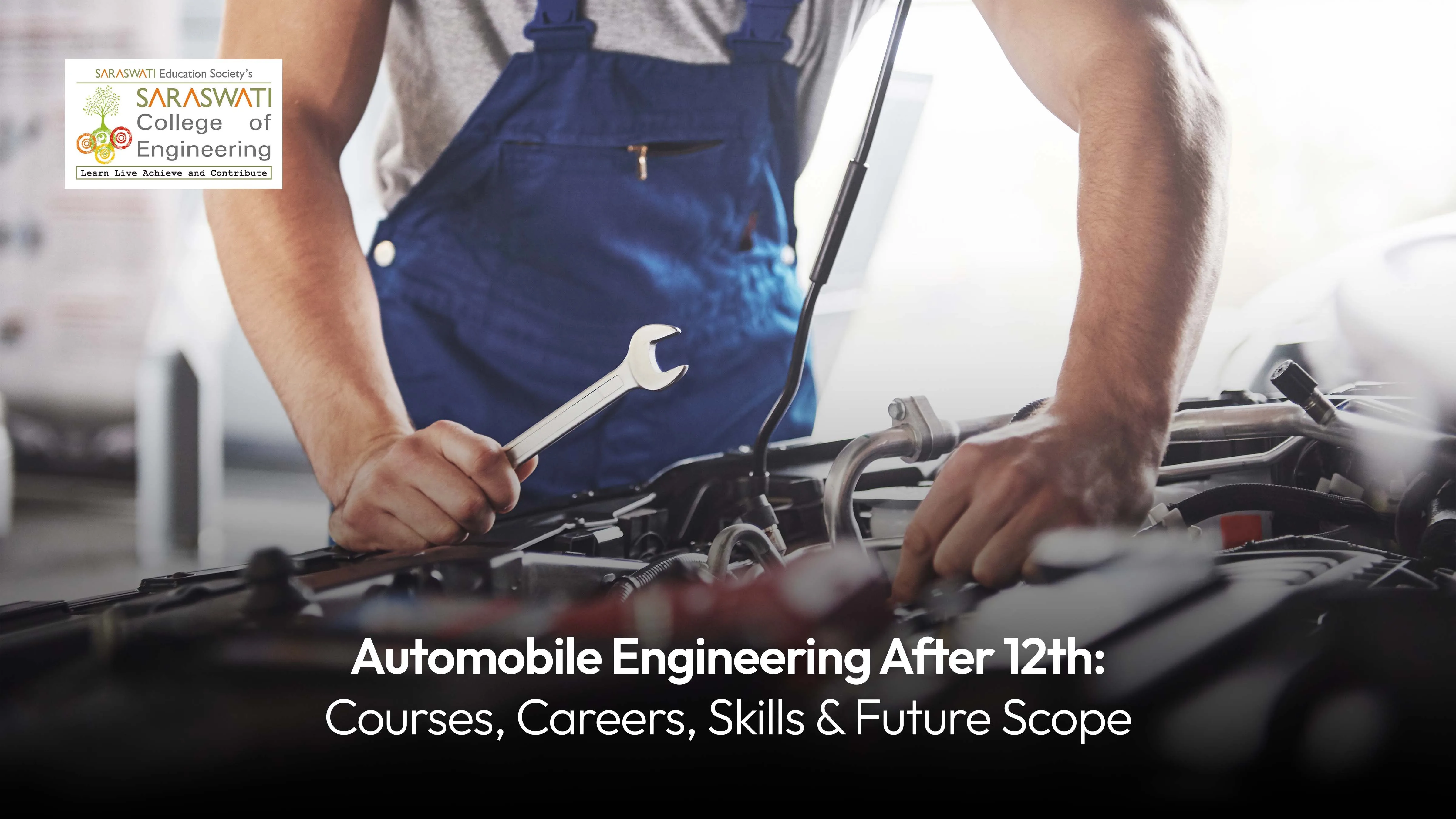
If you enjoy understanding how vehicles work, how engines perform, and how automotive systems are designed, Automobile Engineering after 12th can be an interesting career path to explore. The field combines engineering fundamentals with vehicle design, manufacturing, propulsion systems, testing and emerging automotive technologies.
For students completing Class 12 with Science, a B.E. or B.Tech in Automobile Engineering provides a structured route into the automotive sector while developing the technical and practical skills needed for professional engineering roles.
What Is Automobile Engineering?
Automobile Engineering is a specialised branch of engineering concerned with the design, development, manufacturing, testing and functioning of automobiles and their systems.
The field brings together concepts from engineering fundamentals, vehicle systems, thermal engineering, manufacturing and computer-aided engineering. Modern automobile engineers also need to understand safety, environmental considerations, efficiency and the use of advanced engineering tools.
A good Automobile Engineering course therefore combines classroom learning with practical work, projects and exposure to automotive applications.
Which Automobile Engineering Course Can You Pursue After 12th?
After completing Class 12 with Science, one of the undergraduate pathways is a B.E. in Automobile Engineering.
At Saraswati College of Engineering (SCOE), the B.E. Automobile Engineering programme has a four-year duration divided into eight semesters. Eligibility requires 10+2 or an equivalent qualification from a recognised school board, with Science as a mandatory stream. The listed eligibility requirement is 50% for the Open Category and 45% for the reserved category. Admission routes include MH CET or JEE, with a three-year Diploma route also listed.
What Do You Study in Automobile Engineering?
An Automobile Engineering course covers different aspects of automotive engineering, from vehicle systems and propulsion to manufacturing and design.
At SCOE, the programme's learning objectives include identifying and analysing complex problems related to automobile, design, thermal and manufacturing engineering. Students also develop the ability to design automobile systems, components and processes while considering safety, standards, economic, environmental and social factors.
Practical learning is supported through specialised laboratories, including:
- ATRX Lab
- TFPE Lab
- CBE Lab
- CAD/CAM Lab
- MQE Lab
- VM Lab
- IC Engine Lab
What Skills Do Automobile Engineers Need?
A successful automobile engineer needs more than an interest in cars.
Important skills include:
- Engineering mathematics and science fundamentals
- Automobile system analysis
- Design and manufacturing knowledge
- CAD/CAM/CAE tool awareness
- Problem-solving and investigation
- Understanding of safety and environmental considerations
- Communication and teamwork
- Leadership and project-management skills
- Professional ethics
- Willingness to keep learning as automotive technology changes
The programme also emphasises applying advanced engineering and software tools, working in multidisciplinary teams, communicating effectively and adapting to changing technology.
What Are the Career Opportunities After Automobile Engineering?
An Automobile Engineering degree can lead to opportunities across vehicle manufacturing, engineering, testing, design, sales and production.
Potential roles include:
- Auto Engineer
- Auto Mechanic
- Process Engineer
- Quality Testing Engineer
- Auto Designer
- Auto Sales Manager
- Car Salesperson
The automotive sector also offers opportunities across vehicle manufacturers, component companies, engineering organisations and related businesses. The career direction you take will depend on your technical skills, interests, experience and area of specialisation.
What Is the Future Scope of Automobile Engineering?
The future of Automobile Engineering is closely connected to the development of safer, more efficient and technologically advanced vehicles.
Engineers will continue to work across vehicle design, manufacturing, testing, propulsion systems and automotive technologies. Sustainability, efficiency, advanced engineering tools and changing mobility requirements are also influencing the skills expected from automotive professionals.
This makes continuous learning particularly important. Building strong fundamentals during your degree and developing the ability to work with evolving technologies can help you remain adaptable throughout your career.
Why choose SCOE for Automobile Engineering?
Located in Kharghar, Navi Mumbai, SCOE provides an environment focused on technical excellence, practical learning, project-based education, and career-oriented engineering development.
Key institutional highlights include:
- 50+ Awards
- 20+ Years of Educational Excellence
- 2.5K+ Students
- 15K+ Alumni Network
- Industry-Oriented Engineering Programs
- Placement-Focused Training
- Modern Laboratory Infrastructure
- Skill Development Initiatives
- Practical Project Exposure
These factors contribute to a strong engineering learning ecosystem that supports long-term student success.
Conclusion
Automobile Engineering can be a good choice after 12th if you have a genuine interest in vehicles, engineering design, manufacturing and automotive technology.
Before choosing a college, compare the curriculum, practical laboratories, project opportunities, internships, faculty, admission requirements and career support. A programme that balances theoretical knowledge with hands-on learning can help you understand how engineering concepts are applied to real automotive systems.
For students considering Automobile Engineering after 12th, the most important step is to choose a programme that matches both their interests and their long-term career goals.