
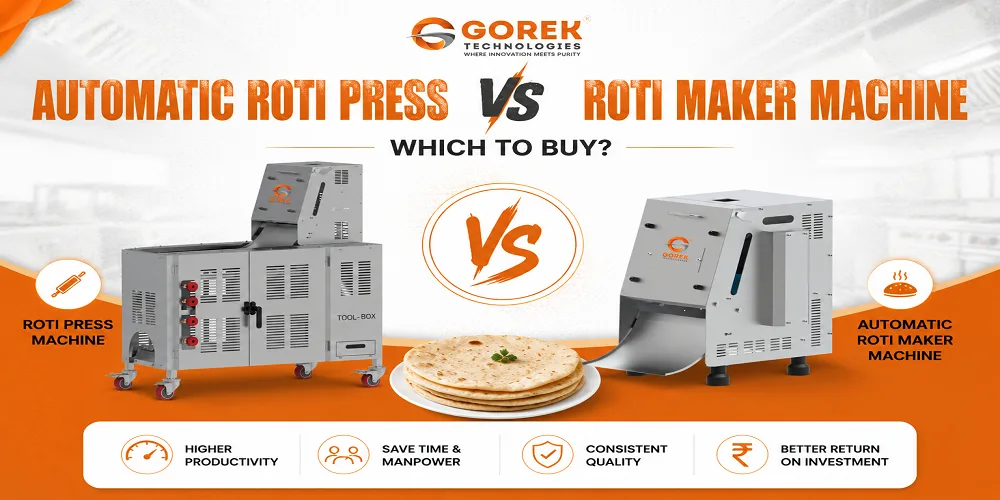
Making rotis for a family is one thing, but making hundreds of rotis every day for a restaurant, hotel, canteen or catering business is completely different. The work becomes repetitive, time consuming and it also needs more people.
This is where a roti press machine or an automatic roti maker machine can be useful.
But there is one common confusion among buyers: should you purchase a roti pressing machine or go for a fully automatic roti maker?
Both machines can help in commercial roti production, but they are not exactly made for the same purpose. The right option mainly depends on how many rotis you need, your budget and how much of the work you want to automate.
What Is a Roti Press Machine?
A roti press machine is mainly used for pressing prepared dough balls into round and evenly shaped rotis. Instead of manually rolling each dough ball with a rolling pin, the machine makes the pressing process much quicker.
For a small restaurant, mess, catering business, hostel or cloud kitchen, this can be a very practical machine.
One of the biggest advantages is that you don't need to spend a very high amount in the beginning. For businesses where pressing is taking most of the time, a roti press machine can solve that particular problem without investing in a complete automatic setup.
At Gorek Tech, the current roti pressing machine range shown starts from around ₹33,000 and goes up to ₹64,900, depending on the model and production capacity.
Some available options include:
- GT-RP300 Automatic Roti Pressing Machine – ₹33,000, up to 300 rotis per hour
- GT-RP500 Automatic Chapati Press Machine – ₹53,900, around 400–500 pcs/hour
- GT-RP1000 Fully Automatic Roti Pressing Machine – ₹64,900, around 800–1000 pcs/hour
So, if you are not looking for a very big production setup, a roti press may be the better starting point.
What Is an Automatic Roti Maker Machine?
An automatic roti maker machine is for businesses that want to automate much more of their roti production process.
Instead of only helping with pressing, these machines are designed for higher-volume commercial production. They are generally more suitable when a kitchen has to prepare a large number of rotis every day.
For example, hotels, industrial canteens, large caterers, food businesses and institutional kitchens may have a requirement of hundreds or even thousands of rotis in a day. Doing this manually can take a lot of manpower.
Gorek Tech currently lists automatic roti making machines starting from around ₹1,21,000, with higher-capacity models going up to approximately ₹3,02,500.
The listed machines include:
- GT-RM300 Automatic Roti Maker Machine – ₹1,21,000
- GT-RM500 Automatic Chapati Making Machine – ₹1,76,000
- GT-RM1000 Fully Automatic Roti Maker Machine – ₹3,02,500
The price is higher than a basic roti press machine, but you are also looking at a higher level of production and automation.
Roti Press vs Roti Maker: Which One Is Different?
This is actually the most important part before buying.
A roti press machine is a good option when you already have your dough preparation process and mainly want to make the pressing part faster.
A roti maker machine is more suitable when you want to reduce manual work and handle larger production requirements.
In simple words:
Roti Press Machine:
- Lower investment
- Mainly focuses on pressing
- Suitable for small to medium production
- Good option for restaurants and caterers
- Helps reduce manual rolling work
- Starting price around ₹33,000
Automatic Roti Maker Machine:
- Higher investment
- Designed for more automation
- Suitable for high-volume production
- Can reduce manual labour requirement
- Better for hotels, canteens and large catering operations
- Price range around ₹1.21 lakh to ₹3.02 lakh
Which One Should You Actually Buy?
Don't just look at the machine price and decide.
First, check how many rotis your business actually needs. If you are making around 200 to 500 rotis per hour, buying a very expensive machine may not be necessary. A good roti pressing machine could be enough for your requirement.
For example, if you are running a small restaurant and need around 300 rotis per hour during peak hours, a machine like the GT-RP300 priced at ₹33,000 can be a reasonable option.
On the other hand, if your kitchen is preparing 800 to 1,000 rotis per hour, you should look at a higher-capacity machine. In that case, the GT-RP1000 at around ₹64,900 or a suitable automatic roti maker could be considered depending on your production process.
For very large kitchens, the automatic roti maker range from ₹1,21,000 to ₹3,02,500 may make more sense because the requirement is not only pressing, but handling production at a much bigger scale.
Things to Check Before Buying
There are few things which buyers sometimes forget to ask before ordering a roti making machine.
Check the hourly capacity first. Don't choose a machine just because it has a lower price.
Also ask about the required power supply, machine size, roti diameter, dough requirements, operating process, cleaning and maintenance. If the machine is going to run every day, after-sales service is also very important.
Another simple calculation is manpower saving. If the machine allows your kitchen team to produce the same quantity with fewer people, the higher machine price can sometimes be recovered over time.
Automatic Roti Pressing or Automatic Roti Maker?
There is no single machine which is best for everyone.
If your requirement is moderate and you mainly want to speed up the pressing work, a roti press machine is a more budget-friendly choice. With options starting around ₹33,000, it can be suitable for smaller restaurants, caterers, messes and commercial kitchens.
If your production is much higher and you want more automation, then an automatic roti maker machine is worth considering. Gorek Tech models currently range from around ₹1,21,000 to ₹3,02,500, depending on the model and capacity.
So before buying, don't ask only “Which machine is better?”
Ask yourself “How many rotis do I actually need to make every day, and how much manual work do I want to reduce?”
Once you know this, choosing between a roti pressing machine and an automatic roti maker becomes much easier. The best machine is not always the costliest one. It is the one that fits your kitchen, production and budget properly.