
Market Overview
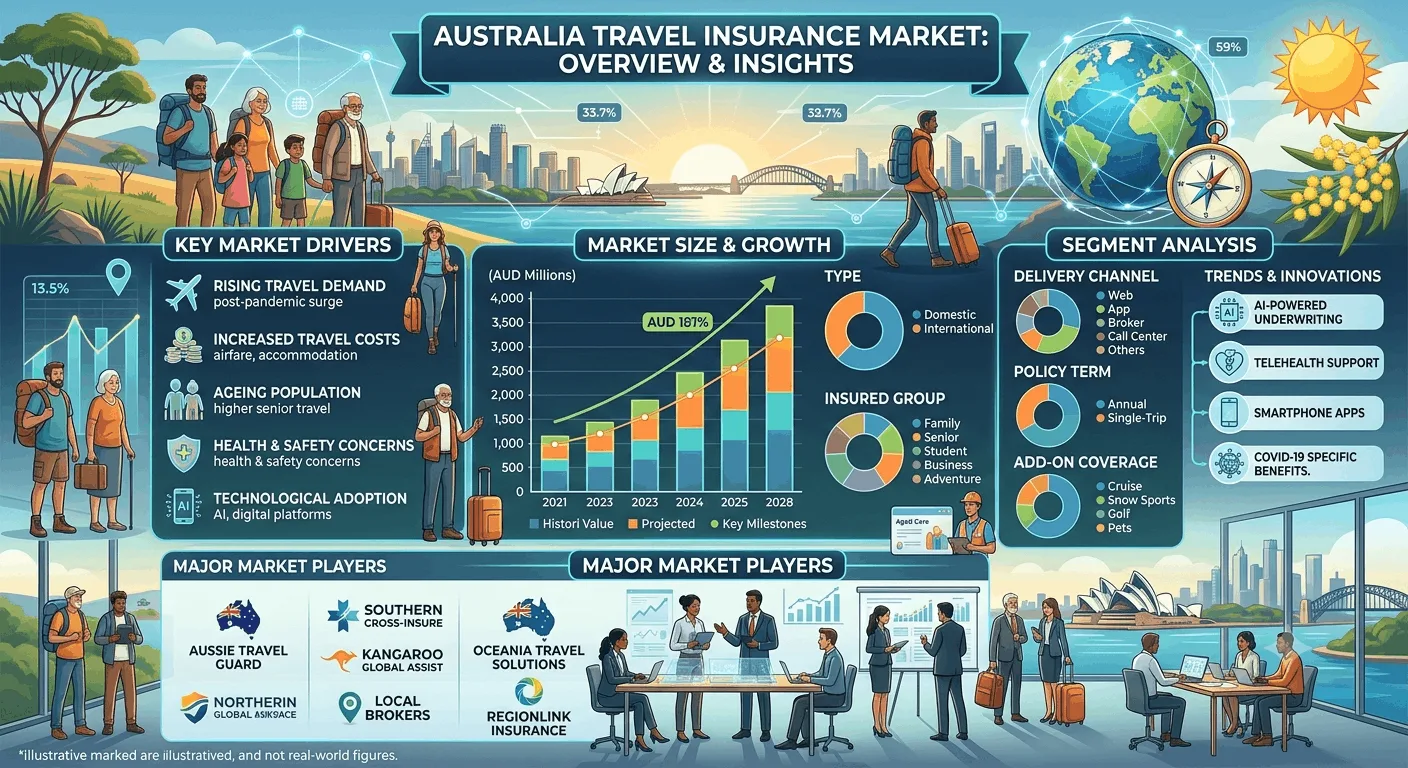
The Australia travel insurance market size increased from USD 362.3 Million in 2025 to USD 375.2 Million in 2026 and is projected to reach USD 463.9 Million by 2034, growing at a CAGR of 2.69% from 2026-2034, driven by surging outbound travel, rising consumer awareness of travel-related financial risks, and rapid adoption of digital insurance platforms. According to the Australian Bureau of Statistics, Australians completed 11.5 million overseas trips in 2024, surpassing pre-pandemic levels for the first time, generating expanding demand for travel protection across the Australia travel insurance market share.
Travel insurance refers to policies that protect travelers against financial losses associated with medical emergencies, trip cancellations, delays, lost luggage, and other travel-related disruptions. The Australia travel insurance market encompasses single-trip travel insurance, annual multi-trip insurance, and long-stay travel insurance, covering medical expenses, trip cancellation, trip delay, property damage, and other risks, distributed through insurance intermediaries, banks, insurance companies, insurance aggregators, insurance brokers, and other channels, serving senior citizens, education travelers, business travelers, family travelers, and other end users across Australia Capital Territory & New South Wales, Victoria & Tasmania, Queensland, Northern Territory & Southern Australia, and Western Australia.
This market is strategically important to Australia's outbound travel ecosystem, consumer financial protection, and insurance sector, supporting the nation's position as one of the world's most active outbound travel markets. Australia's post-pandemic travel habits have significantly altered consumers' perceptions about insurance. Nowadays, it is common for travelers to include coverage in their planning budgets, viewing insurance as an essential safety measure rather than an optional expense. According to industry reports, comprehensive, all-inclusive policies accounted for 86% of all travel insurance sales in Australia in 2025, demonstrating the market's evident preference for breadth over basic coverage. This cultural shift is most evident in product purchase patterns. From distribution to claims processing, the whole travel insurance value chain is being transformed by technology. Leading Australian travel insurance provider Fast Cover and claims technology company Five Sigma collaborated in 2025 to implement an AI-driven claims management platform, which greatly reduced claim turnaround times and sped up the entire process from the first notice of loss to payment.
The Australia travel insurance market is poised for sustained expansion, underpinned by rising risk awareness and post-pandemic behavioral shifts, digital transformation and AI-driven insurance platforms, cruise and niche travel segment expansion, premium customization and add-on culture, embedded insurance at point of sale, annual multi-trip policy uptake, and telemedicine integration in claims. With a projected CAGR of 2.69% through 2034, the market presents significant opportunities for providers focusing on AI-driven claims platforms, embedded insurance distribution, cruise and adventure specialty products, annual multi-trip policies, and telemedicine integration.
AUSTRALIA TRAVEL INSURANCE MARKET SUMMARY
The Australia travel insurance market encompasses the underwriting, distribution, and servicing of policies that protect travelers against financial losses from medical emergencies, cancellations, delays, and other travel-related disruptions, serving leisure, business, family, senior, and education travelers throughout the country.
The ecosystem spans global insurance conglomerates (Allianz Australia, Zurich/Cover-More), specialized domestic providers (Fast Cover, 1Cover, nib Travel Services), travel-affiliate brands, insurance aggregators, banks, brokers, and digital-native insurers serving customers across family travelers, senior citizens, education travelers, and business travelers throughout Australia .
By Insurance Type, the market is segmented into Single-Trip Travel Insurance (dominating at 48%), Annual Multi-Trip Insurance, and Long-Stay Travel Insurance.
By Coverage, the market serves Medical Expenses (dominating at 42%), Trip Cancellation, Trip Delay, Property Damage, and Others.
By Distribution Channel, the market serves Insurance Companies (dominating at 32%), Insurance Intermediaries, Banks, Insurance Aggregators, Insurance Brokers, and Others.
By End User, the market serves Family Travelers (dominating at 35%), Senior Citizens, Education Travelers, Business Travelers, and Others.
By Region, the market serves Australia Capital Territory & New South Wales (dominating at 33%), Victoria & Tasmania, Queensland, Northern Territory & Southern Australia, and Western Australia.
Key trends shaping the market include rising risk awareness and post-pandemic behavioral shifts, digital transformation and AI-driven insurance platforms, cruise and niche travel segment expansion, premium customization and add-on culture, embedded insurance at point of sale, annual multi-trip policy uptake, and telemedicine integration in claims.
PORTER'S FIVE FORCES ANALYSIS – AUSTRALIA TRAVEL INSURANCE MARKET
Competitive Rivalry: High. The market is served by a blend of global insurance conglomerates and specialized domestic providers, with the competitive landscape shaped by significant consolidation activity. Allianz Australia and Zurich's Cover-More collectively command nearly half of the domestic market, while digital-native insurers and travel-affiliate brands are competing on product innovation and platform integration to capture younger, price-sensitive consumers. Competition centres on pricing, coverage breadth, claims service, digital capability, and embedded distribution partnerships. Business implication: Companies must differentiate through digital innovation, product customization, and distribution partnerships.
Supplier Power (Reinsurance and Technology Providers): Moderate to High. Insurers rely on reinsurance providers for risk transfer and technology providers for policy administration, claims management, and AI platforms. Reinsurance capacity and pricing influence underwriting economics, while technology platform concentration creates dependency. Business implication: Strategic partnerships with reinsurance and technology providers can improve risk management and operational efficiency.
Buyer Power (Travelers): Moderate to High. Travelers leverage choice across multiple insurers, aggregators, and embedded distribution channels. Buyers increasingly demand comprehensive coverage, transparent terms, competitive pricing, and digital convenience. Price sensitivity among younger and budget travelers constrains premium flexibility. Business implication: Providers must demonstrate value, coverage clarity, and digital convenience to win and retain customers.
Threat of Substitutes: Low to Moderate. Self-insurance (absorbing risk), credit card travel benefits, and travel agency-provided coverage represent partial substitutes. However, comprehensive medical and cancellation protection requires dedicated travel insurance products that alternatives cannot fully replicate. Business implication: Demonstrating superior coverage and claims reliability is essential.
Threat of New Entrants: Moderate. Significant capital requirements, regulatory compliance (APRA, ASIC), and actuarial expertise create barriers. However, growth of digital-native insurers, embedded insurance platforms, and travel-affiliate brands has enabled new entrants focused on niche segments and digital-first distribution. Business implication: Incumbents must leverage scale, brand trust, and distribution networks while monitoring emerging digital-first competitors.
KEY ASPECTS REQUIRED FOR THE AUSTRALIA TRAVEL INSURANCE MARKET
Market Performance: USD 362.3 Million in 2025, projected to reach USD 463.9 Million by 2034, driven by surging outbound travel, rising risk awareness, and digital insurance platform adoption.
Market Outlook: A 2.69% CAGR through 2034 reflects steady growth led by single-trip travel insurance, medical expenses coverage, insurance companies, family travelers, and ACT and NSW regional dominance.
Growth Drivers: Surging outbound and inbound travel activity (11.5 million overseas trips in 2024; 8,402,400 tourist arrivals in FY2024-25); rising overseas medical costs heightening protection needs; favorable demographics and growing senior traveler base; digital distribution expansion; regulatory oversight and consumer trust (APRA, ASIC); international education and student travel growth; consolidation and product innovation; rising risk awareness and post-pandemic behavioral shifts; digital transformation and AI-driven insurance platforms; cruise and niche travel segment expansion.
Competitive Landscape: A highly competitive market with global insurance conglomerates and specialized domestic providers. Allianz Australia (~25% market share) and Zurich/Cover-More (~24%) collectively command nearly half of the domestic market. Key players invest in AI-driven claims platforms, embedded distribution, and specialty products.
Value Chain Analysis: From underwriting and product design through distribution via insurers, brokers, aggregators, and embedded channels, to claims processing and customer service.
Industry Trends: AI-driven claims management (Fast Cover and Five Sigma); embedded insurance at point of sale (airlines, travel agencies, booking platforms); cruise and niche travel segment expansion (Allianz Partners and Norwegian Cruise Line); premium customization and add-on culture (adventure packs, cruise packs, snow packs); annual multi-trip policy uptake; telemedicine integration in claims; digital distribution expansion; parametric insurance models.
Strategic Recommendations: Invest in AI-driven claims platforms and digital transformation; develop embedded insurance partnerships with airlines, travel agencies, and booking platforms; expand cruise and adventure specialty products; develop annual multi-trip policy offerings for frequent travelers; integrate telemedicine services into claims processes; address pre-existing medical condition coverage gaps for senior travelers; target family travelers, senior citizens, and education travelers; strengthen presence in ACT, NSW, and high-growth markets.
Request for Sample Report: https://www.imarcgroup.com/australia-travel-insurance-market/requestsample
MARKET GROWTH DRIVERS
Surging Outbound and Inbound Travel Activity
Travel volumes in Australia have firmly returned to a rising trend. In the 2024–2025 fiscal year, the Australian Bureau of Statistics recorded 8,402,400 tourist arrivals, a 5.5% increase over the previous year. In January 2025, resident returns increased 10.9% year over year to 1,544,890 journeys as Australians' own international departures reached record speed. Higher travel volumes directly translate into increased uptake across the expansion of the Australian travel insurance market since each new departure represents a potential insurance purchase. According to the Australian Bureau of Statistics, Australians completed 11.5 million overseas trips in 2024, surpassing pre-pandemic levels for the first time, generating expanding demand for travel protection.
Rising Overseas Medical Costs Heightening Protection Needs
Medical coverage is becoming the main factor driving Australian travelers to purchase travel insurance due to rising healthcare costs overseas. Travelers are being encouraged to prioritize comprehensive protection when planning international excursions due to growing awareness of the potential financial risks involved with abroad medical treatment and emergency help. As travelers seek financial stability and access to medical support services while overseas, destinations with higher healthcare costs, especially long-haul travel markets that Australians commonly visit, are highlighting the need of having sufficient insurance coverage. Medical expenses coverage is the single most sought-after component of any Australian travel insurance policy, holding the highest share across all coverage categories at 42%.
Favorable Demographics and Growing Senior Traveler Base
The need for more expensive, all-inclusive travel insurance policies is structurally supported by Australia's aging population. According to industry data from 2025, the top buyer demographic in the Australian travel insurance market is mature travelers and early retirees, who regularly select comprehensive coverage for increased peace of mind. Specialty senior traveler products are positioned as a significant opportunity within the Australia travel insurance market projection due to this demographic's demand for all-inclusive plans with greater coverage limits, which maintains premium revenue growth. International education and student travel growth also drives demand for long-stay insurance, a specialist market with significant growth potential and higher average premiums.
Rising Risk Awareness and Post-Pandemic Behavioral Shifts
Australia's post-pandemic travel habits have significantly altered consumers' perceptions about insurance. Nowadays, it is common for travelers to include coverage in their planning budgets, viewing insurance as an essential safety measure rather than an optional expense. According to industry reports, comprehensive, all-inclusive policies accounted for 86% of all travel insurance sales in Australia in 2025, demonstrating the market's evident preference for breadth over basic coverage. This cultural shift is most evident in product purchase patterns, supporting sustained premium revenue growth.
Digital Transformation and AI-Driven Insurance Platforms
From distribution to claims processing, the whole travel insurance value chain is being transformed by technology. Leading Australian travel insurance provider Fast Cover and claims technology company Five Sigma collaborated in 2025 to implement an AI-driven claims management platform, which greatly reduced claim turnaround times and sped up the entire process from the first notice of loss to payment. Travel insurance market developments in Australia are being defined by this shift toward AI-powered underwriting, real-time policy management, and embedded digital distribution. Digital distribution expansion through online aggregators, mobile apps, and direct insurer websites is greatly reducing obstacles and growing the addressable consumer base. Regulatory oversight by APRA and ASIC guarantees product transparency and claims dependability, bolstering consumer trust.
AUSTRALIA TRAVEL INSURANCE MARKET SEGMENTATION
Segmentation analysis provides a detailed view of the Australia travel insurance market by category:
Insurance Type Insights: Single-trip travel insurance remains the most widely adopted product in the Australia travel insurance market, capturing nearly half of all policy sales at 48% in 2025. Single-trip policies predominate because they perfectly cater to the needs of Australia's largest traveler cohorts, which include business professionals on specified assignments and leisure travelers enjoying yearly vacations. Customers can pay only for the coverage they require without having to make the larger commitment of an annual plan because these policies are activated for a predetermined journey duration. For most Australian outbound travelers, especially families and first-time foreign visitors, single-trip products are the preferred option due to their price and ease of use. Annual multi-trip insurance represents a growing segment, driven by frequent business and leisure travelers seeking cost-effectiveness. Long-stay travel insurance represents a significant segment, driven by international students and long-term travelers.
Coverage Insights: Medical expenses coverage is the single most sought-after component of any Australian travel insurance policy, holding the highest share across all coverage categories at 42% in 2025. Due to the financial risks involved in receiving medical care overseas, medical expense protection is still the main feature of travel insurance coverage in Australia. In order to accommodate overseas travelers' probable treatment and repatriation needs, insurers are designing plans with extensive medical and emergency assistance coverage. Because of this, large medical coverage limits that are intended to offer comprehensive protection against unforeseen health-related accidents abroad are frequently included in Australian travel insurance packages. This reinforces medical coverage as the primary component of policy design in the market. Trip cancellation, trip delay, property damage, and other coverages represent significant segments with growing demand.
Distribution Channel Insights: Direct sales through insurance companies represent the leading distribution channel at 32% in 2025, reflecting Australian consumers' preference for engaging directly with branded, compliance-regulated providers. Strong brand trust and the complexity of travel insurance products, which customers frequently prefer to buy from a reputable supplier they can interact with directly for claims or policy inquiries, are the main reasons why insurance companies dominate direct distribution. According to IBISWorld statistics from 2025, Allianz Australia has a domestic market share of about 25%, while Zurich/Cover-More has a share of about 24%. Together, these companies control almost half of the industry, demonstrating the power that insurer-direct brands have in acquiring customers throughout Australia. Insurance intermediaries, banks, insurance aggregators, insurance brokers, and other channels represent significant segments with growing demand.
End User Insights: Family travelers account for the largest share of end users at 35% in 2025, driven by the compounding financial risk of multi-person trips that makes comprehensive insurance coverage effectively indispensable. Families that travel together are more vulnerable to lost luggage, medical problems, and cancellation fees overall. In response, insurers provide family-specific plan structures that provide coverage for traveling companions and dependents under a single policy, frequently at advantageous all-inclusive premium prices. Both the volume of family vacation travel in Australia and the segment's proven willingness to invest on complete protection for high-stakes trips are reflected in the concentration of family travelers in the 35% leading share position. Senior citizens represent a significant segment, driven by aging population and demand for comprehensive coverage. Education travelers represent a growing segment, driven by international student arrivals and Australians studying overseas. Business travelers represent a significant segment, driven by corporate travel and compliance-driven insurance uptake.
Regional Insights: New South Wales and the Australian Capital Territory together command the largest regional share of the Australia travel insurance market at 33% in 2025, anchored by Sydney's position as the country's primary international aviation gateway. The Australian Bureau of Statistics recorded 308,940 short-term resident returns through New South Wales in November 2025, the highest of any Australian state or territory, confirming the region's structural importance as the national center of outbound travel activity and, by extension, insurance demand. Sydney's concentration of corporate headquarters, financial services firms, and high-income professional households reinforces demand for both individual and business travel insurance across premium policy tiers. The ACT contributes a government and public service traveler base with strong compliance-driven insurance uptake. Victoria & Tasmania, Queensland, Northern Territory & Southern Australia, and Western Australia represent significant markets with growing travel insurance demand.
COMPETITIVE LANDSCAPE
The Australia travel insurance market is served by a blend of global insurance conglomerates and specialized domestic providers, with the competitive landscape currently shaped by significant consolidation activity. Allianz Australia and Zurich's Cover-More collectively command nearly half of the domestic market, while digital-native insurers and travel-affiliate brands are competing on product innovation and platform integration to capture younger, price-sensitive consumers.
Major players include Allianz Australia Limited (~25% market share; Allianz Travel, Allianz Comprehensive, Domestic, Multi-Trip brands; led October 2025 acquisition bid for NIB Holdings' travel unit including World Nomads and Travel Insurance Direct), Zurich Financial Services Australia Ltd./Cover-More (~24% market share), Fast Cover Pty Ltd (leading digital-first travel insurer; partnered with Five Sigma in June 2025 to deploy AI-driven claims platform), American Express Company (bundles premium travel insurance within high-value card membership tiers), nib Travel Services (Australia) Pty Ltd., AIG Australia Limited, 1Cover Pty Ltd., Australia Post Group, and others.
Recent Developments:
In May 2025, a new AI-powered claims management platform created in collaboration with Five Sigma was implemented by Fast Cover, a well-known Australian travel insurance company. The solution shortens processing times and enhances customer results by streamlining the whole claims lifecycle from the initial notice of loss to settlement.
In May 2025, in collaboration with Norwegian Cruise Line, Allianz Partners Australia introduced a cruise-specific travel insurance package that is offered at the time of booking. The product is a calculated addition to Allianz's specialty embedded insurance portfolio for Australian tourists in the expanding cruise travel market. It offers embedded coverage for shipboard medical treatment, emergency evacuation, and cabin confinement.
In October 2025, Allianz led the acquisition bid for NIB Holdings' travel unit (World Nomads, Travel Insurance Direct).
Investment opportunities exist in AI-driven claims platforms, embedded insurance distribution, cruise and adventure specialty products, annual multi-trip policies, and telemedicine integration.
REGIONAL ANALYSIS
New South Wales and the Australian Capital Territory together command the largest regional share of the Australia travel insurance market at 33% in 2025, anchored by Sydney's position as the country's primary international aviation gateway. The Australian Bureau of Statistics recorded 308,940 short-term resident returns through New South Wales in November 2025, the highest of any Australian state or territory, confirming the region's structural importance as the national center of outbound travel activity and, by extension, insurance demand. Sydney's concentration of corporate headquarters, financial services firms, and high-income professional households reinforces demand for both individual and business travel insurance across premium policy tiers. The ACT contributes a government and public service traveler base with strong compliance-driven insurance uptake. Together, the NSW & ACT region's concentration of travel departures, commercial activity, and high-value itineraries makes it the dominant insurance market across all product categories.
Victoria & Tasmania represents a significant market, driven by Melbourne's status as a major international gateway, high household incomes, and strong corporate travel activity. The region's concentration of outbound departures and business travel supports travel insurance demand.
Queensland experiences strong demand, driven by population growth, international gateways in Brisbane and the Gold Coast, and growing outbound travel activity. The state's growing population and travel activity support market expansion.
Northern Territory & Southern Australia represents a growing market, with international gateways in Adelaide and growing outbound travel activity. The region's growing travel activity and business travel support market expansion.
Western Australia represents a significant market, driven by Perth's status as a major international gateway, mining sector travel activity, and growing outbound travel. The state's mining sector and business travel support travel insurance demand.
RECENT INDUSTRY DEVELOPMENTS
2026 Activity: The Australia travel insurance market continued its growth trajectory from USD 362.3 Million in 2025 to USD 375.2 Million in 2026 toward USD 463.9 Million by 2034 at a CAGR of 2.69%.
May 2025: Fast Cover implemented an AI-powered claims management platform created in collaboration with Five Sigma, streamlining the whole claims lifecycle from the initial notice of loss to settlement.
May 2025: Allianz Partners Australia introduced a cruise-specific travel insurance package in collaboration with Norwegian Cruise Line, offered at the time of booking, providing embedded coverage for shipboard medical treatment, emergency evacuation, and cabin confinement.
October 2025: Allianz led the acquisition bid for NIB Holdings' travel unit (World Nomads, Travel Insurance Direct).
FREQUENTLY ASKED QUESTIONS
Q1: What is the current size of the Australia travel insurance market?
A: The Australia travel insurance market grew from USD 362.3 Million in 2025 to USD 375.2 Million in 2026 and is projected to reach USD 463.9 Million by 2034, exhibiting a CAGR of 2.69% from 2026-2034.
Q2: What are the key drivers of the Australia travel insurance market?
A: The market is driven by: (i) surging outbound and inbound travel activity; (ii) rising overseas medical costs heightening protection needs; (iii) favorable demographics and growing senior traveler base; (iv) digital distribution expansion; (v) regulatory oversight and consumer trust; (vi) international education and student travel growth; (vii) consolidation and product innovation; (viii) rising risk awareness and post-pandemic behavioral shifts; (ix) digital transformation and AI-driven insurance platforms; and (x) cruise and niche travel segment expansion.
Q3: What are the major insurance types in the Australia travel insurance market?
A: Major insurance types include Single-Trip Travel Insurance (dominating at 48%), Annual Multi-Trip Insurance, and Long-Stay Travel Insurance.
Q4: What are the major coverages in the Australia travel insurance market?
A: Major coverages include Medical Expenses (dominating at 42%), Trip Cancellation, Trip Delay, Property Damage, and Others.
Q5: What are the major distribution channels in the Australia travel insurance market?
A: Major distribution channels include Insurance Companies (dominating at 32%), Insurance Intermediaries, Banks, Insurance Aggregators, Insurance Brokers, and Others.
Q6: What are the major end users in the Australia travel insurance market?
A: Major end users include Family Travelers (dominating at 35%), Senior Citizens, Education Travelers, Business Travelers, and Others.
Q7: Which region leads the Australia travel insurance market?
A: ACT & New South Wales leads at 33% in 2025, anchored by Sydney's position as the country's primary international aviation gateway, high household incomes, and concentrated corporate travel activity. Victoria & Tasmania, Queensland, Northern Territory & Southern Australia, and Western Australia represent significant markets.
Q8: What are the challenges facing the Australia travel insurance market?
A: Key challenges include complex policy terms and consumer confusion, high premium sensitivity among budget travelers, pre-existing medical condition exclusions and coverage gaps, and the need for continuous product innovation.
Q9: What is the outlook for the Australia travel insurance market?
A: The market is projected to grow at a 2.69% CAGR through 2034, with growth driven by surging outbound travel, rising risk awareness, and digital insurance platform adoption. The shift toward AI-driven claims platforms, embedded insurance distribution, cruise and adventure specialty products, annual multi-trip policies, and telemedicine integration are expected to shape the market's evolution.
Q10: Who are the key players in the Australia travel insurance market?
A: Key players include Allianz Australia Limited, Zurich Financial Services Australia Ltd. (Cover-More), nib Travel Services (Australia) Pty Ltd., Fast Cover Pty Ltd, AIG Australia Limited, 1Cover Pty Ltd., Australia Post Group, and American Express Company.
Note: If you need any specific information that is not covered currently within the scope of the report, we will provide the same as a part of customization.
https://www.imarcgroup.com/request?type=report&id=21979&flag=E
Report Format, Delivery, and Customization Details
Report Format Mode: PPT, PDF, and Excel
Report Delivery Mode: Online Delivery, Physical Delivery
Report Delivery Time: Report Delivered Over Email within 24 to 48 hours. If requested by the client, a physical copy will be delivered within three to ten days.
Report Confirmation Mode: Yes via Email
Report Customization Mode: Yes via Email / Call
Report Table of Content: Yes
Report List of Figures: Yes
Report Methodology Mode: Yes
Request For Sample Report: Yes