Market Overview
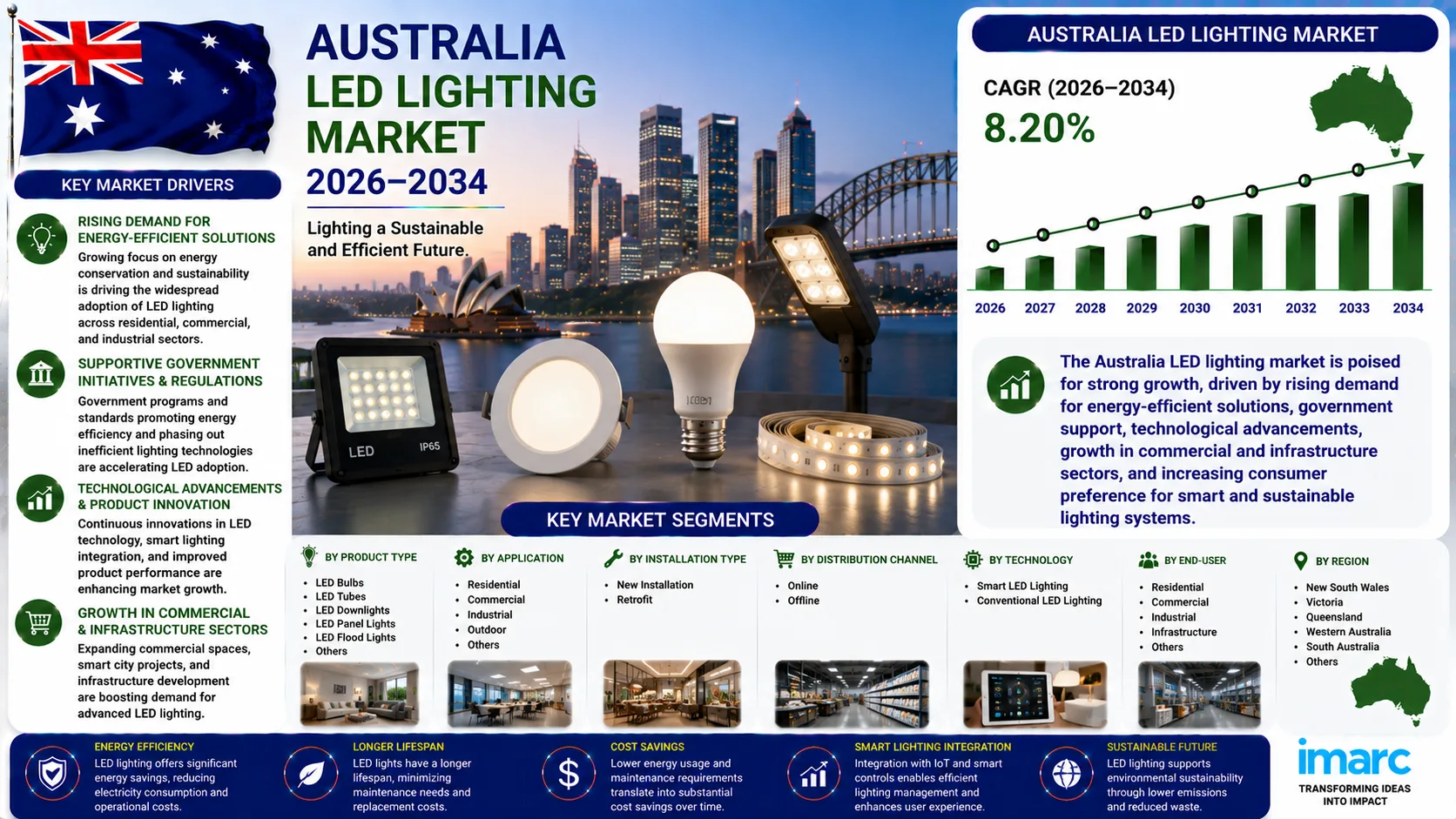
The Australia LED lighting market size reached USD 1,960.3 Million in 2025 and is projected to reach USD 4,071.0 Million by 2034, growing at a compound annual growth rate (CAGR) of 8.20% from 2026 to 2034. The integration of LEDs with smart lighting systems and IoT, which has opened up new possibilities for control, automation, and customization of lighting environments, is primarily driving the regional market. The market is strategically important to Australia's economy as it enables the nation to meet evolving lighting needs while supporting energy efficiency, sustainability, and technological innovation.
Request a Sample Report for In-Depth Market Insights:
https://www.imarcgroup.com/australia-led-lighting-market/requestsample
Australia LED Lighting Market Summary
- The Australia LED lighting market encompasses a broad range of LED lighting solutions, including retrofit, retail and hospitality, outdoor, offices, architectural, homes, and industrial applications.
- These products are valued for their role in providing energy-efficient, durable, and versatile illumination, and are used across residential, commercial, and industrial settings.
- The ecosystem includes LED manufacturers, technology providers (IoT, smart lighting), distributors, installers, architects, government agencies, and consumers.
- Major segments identified in the market include application (retrofit, retail and hospitality, outdoor, offices, architectural, homes, industrial) and region (Australia Capital Territory & New South Wales, Victoria & Tasmania, Queensland, Northern Territory & Southern Australia, Western Australia).
- The market is benefiting from a shift toward human-centric lighting design, integration of LED lighting in smart city infrastructure, and growing demand for aesthetic and architectural LED lighting.
- Rise in commercial renovation and retrofit projects, advancement in LED manufacturing and product innovation, and electrification of transport and public infrastructure projects are driving sustained expansion across all application categories.
PORTER'S FIVE FORCES ANALYSIS -- AUSTRALIA LED LIGHTING MARKET
Bargaining Power of Suppliers – Moderate
- The LED lighting supply chain includes semiconductor manufacturers, component suppliers (drivers, heat sinks), and technology providers.
- Large, established component suppliers with proprietary technologies have significant bargaining power.
- However, the presence of multiple suppliers and the ability of large lighting manufacturers to source globally reduces dependency on any single supplier.
- Technology providers offering IoT and smart lighting solutions have moderate leverage.
Bargaining Power of Buyers – Moderate to High
- Buyers in the Australia LED lighting market include commercial building owners, government agencies, industrial operators, and residential consumers with varying degrees of bargaining power.
- Large commercial and government buyers have significant bargaining power through volume purchasing and competitive tendering.
- The availability of multiple product types and suppliers gives buyers choice and leverage.
- However, the need for quality, reliability, and compliance with energy standards moderates pure price sensitivity.
Threat of New Entrants – Moderate
- The market is influenced by established global and domestic lighting manufacturers with strong brand recognition, distribution networks, and technology expertise.
- Capital requirements for R&D and manufacturing favor established players.
- Regulatory compliance, including energy efficiency standards, creates barriers to entry.
- However, the rise of smart lighting and IoT integration is creating opportunities for technology-focused entrants.
Threat of Substitutes – Low
- LED lighting faces limited substitution from traditional lighting technologies (incandescent, fluorescent) due to superior energy efficiency, lifespan, and performance.
- However, in some applications, alternative lighting technologies (e.g., OLED, laser) may emerge as competitors in the long term.
- The increasing focus on sustainability and energy efficiency reinforces the importance of LED lighting.
Competitive Rivalry – High
- The market features a competitive landscape of global lighting manufacturers, regional players, and specialized suppliers.
- Differentiation occurs through product innovation (smart features, human-centric design), energy efficiency, design, brand reputation, and pricing.
- Competition is intensifying as companies invest in IoT integration, smart city projects, and sustainable solutions.
- Strategic partnerships (e.g., Inlite with Artemide) and product innovations (e.g., Lazer Lamps' AIR LED light bar) drive competitive dynamics.
MARKET GROWTH DRIVERS
Rise in Commercial Renovation and Retrofit Projects
Australia is experiencing an uptick in commercial renovation projects, with building owners increasingly replacing outdated lighting systems to meet energy efficiency goals. LEDs are the preferred choice for retrofits due to their lower energy consumption, longer lifespan, and minimal maintenance requirements. Markets including the retail industry, hospitality industry, and office spaces are at the forefront of this change, with an interest in lighting systems and technology that increase aesthetics, cut expenditure, and help achieve sustainability goals. This trend is further reinforced by incentives made by the government (upgrading inefficient lighting). With the crisis adoption of modern energy standards in commercial real estate, the increased interest in retrofitting initiatives will quite literally fast-track the uptake of innovative LED technologies in the suburban and urban commercial regions.
Shift Toward Human-Centric Lighting Design
One of the most notable trends in the Australian LED lighting market is the growing adoption of human-centric lighting systems. These systems are designed to align with the natural human circadian rhythm by adjusting brightness and color temperature throughout the day. Educational institutions, healthcare facilities, and office environments are increasingly integrating tunable white and dynamic LED lighting to improve focus, mood, and sleep quality. As awareness of the impact of lighting on health and productivity grows, lighting designers and architects are prioritizing wellness-centric lighting solutions in building plans. This trend reflects a broader movement toward creating more responsive and adaptive interior environments that support mental and physical well-being, pushing the demand for advanced, programmable LED solutions across multiple sectors.
Integration of LED Lighting in Smart City Infrastructure
The expansion of smart city projects across Australian cities is significantly influencing the LED lighting market. Governments and municipalities are deploying smart LED street lighting systems equipped with IoT sensors, real-time monitoring, and adaptive brightness control. These systems not only reduce energy consumption but also improve public safety, enable traffic monitoring, and reduce maintenance costs through predictive analytics. Integration with centralized control platforms allows cities to remotely manage lighting networks, contributing to environmental sustainability and operational efficiency. As cities aim to meet carbon neutrality goals and digitize infrastructure, smart LED lighting is becoming a fundamental element of urban planning, making it one of the most transformative trends in the country's lighting landscape.
Browse the Full Report with TOC & List of Figures for In-Depth Market Insights:
https://www.imarcgroup.com/australia-led-lighting-market
AUSTRALIA LED LIGHTING MARKET SEGMENTATION
Application Insights:
- Retrofit
- Retail and Hospitality
- Outdoor
- Offices
- Architectural
- Homes
- Industrial
Regional Insights:
- Australia Capital Territory & New South Wales
- Victoria & Tasmania
- Queensland
- Northern Territory & Southern Australia
- Western Australia
COMPETITIVE LANDSCAPE
The Australia LED lighting market features a competitive landscape of global lighting manufacturers, regional players, and specialized suppliers. Leading players differentiate through product innovation (smart features, human-centric design), energy efficiency, design, brand reputation, and pricing. The market is dynamic, with competition intensifying as companies invest in IoT integration, smart city projects, and sustainable solutions. Strategic partnerships and product innovations drive competitive dynamics.
Key players mentioned in the report context include:
- Lazer Lamps Ltd
- Haneco Specialised Solutions (HSS)
- Inlite
- Artemide
Lazer Lamps Ltd introduced its latest innovation, the AIR LED light bar, across the Australian and New Zealand markets in April 2025. Engineered specifically for heavy trucks and commercial vehicles, the AIR combines advanced technology, robust durability, and contemporary styling in a streamlined, high-impact design.
Haneco Specialised Solutions (HSS) held an exclusive launch event at the Adelaide Marriott Hotel in August 2024. As the chosen supplier of lighting and control systems for this landmark project, HSS presented its latest range of professional luminaires and control solutions.
Inlite announced its newly formed partnership with renowned Italian lighting leader, Artemide, in June 2023, under new ownership and with a revitalized commitment to delivering innovative and eco-conscious lighting solutions to Australia's architectural, design, and engineering sectors.
REGIONAL ANALYSIS
Australia Capital Territory & New South Wales: This region features a well-established LED lighting market driven by high commercial activity, government infrastructure projects, and strong residential demand. Sydney's role as a major business and technology hub creates demand for advanced lighting solutions in offices, retail, and smart city applications. Canberra's government presence drives adoption of energy-efficient lighting in public buildings and infrastructure. The region's focus on sustainability and smart city initiatives supports market growth.
Victoria & Tasmania: Victoria's thriving commercial and residential sectors, anchored by Melbourne, drive demand for LED lighting across applications. The region's focus on architectural and human-centric lighting design supports adoption of innovative solutions. Tasmania's growing focus on sustainable infrastructure and renewable energy complements the LED market. Both regions benefit from government incentives for energy efficiency upgrades.
Queensland: Queensland's LED lighting market is marked by rapid urbanization, expanding commercial and retail sectors, and strong residential demand. Brisbane's role as a major business and events hub drives demand for outdoor, architectural, and hospitality lighting. The state's focus on smart city projects and tourism infrastructure creates opportunities for advanced LED solutions. Government programs supporting energy efficiency and sustainability further boost market growth.
Northern Territory & Southern Australia: These regions prioritize improving energy efficiency and sustainability in remote and rural areas. South Australia's focus on renewable energy and smart infrastructure, combined with the Northern Territory's remote community projects, creates demand for durable, low-maintenance LED solutions. Government programs and partnerships with lighting suppliers play a critical role in ensuring availability of energy-efficient lighting. Solar-powered LED solutions are particularly relevant in off-grid applications.
Western Australia: Western Australia's LED lighting market grows alongside its economic development and infrastructure projects. Perth's expanding commercial and residential sectors drive demand for LED lighting across applications. The state's focus on mining sector infrastructure and remote community projects creates opportunities for specialized, durable LED solutions. Investments in smart city initiatives and energy efficiency programmes support market growth.
RECENT INDUSTRY DEVELOPMENTS
June 2026: Australia's LED lighting market continued expanding as businesses and households accelerated the adoption of smart LED lighting, IoT-enabled controls, and AI-based energy management systems. Increasing retrofitting of commercial buildings and public infrastructure projects supported demand for energy-efficient lighting solutions.
May 2026: Government energy efficiency regulations and sustainability initiatives continued driving replacement of conventional incandescent and fluorescent lighting with LED systems. Compliance with the National Construction Code (NCC) and Minimum Energy Performance Standards (MEPS) further encouraged adoption across residential, commercial, and industrial sectors.
April 2026: Smart lighting solutions gained momentum as building owners increasingly deployed motion sensors, adaptive dimming, daylight harvesting, and remote lighting management to reduce electricity consumption and improve operational efficiency.
March 2026: Australia's ongoing urban development and infrastructure modernization continued boosting demand for LED lighting across transport hubs, commercial buildings, industrial facilities, public spaces, and residential projects. Smart city initiatives further supported investments in intelligent outdoor lighting networks.
January 2026: Indoor lighting remained the largest application segment, while retrofit installations continued accounting for a significant share of demand as businesses upgraded existing lighting systems to improve energy efficiency and lower operating costs.
January 2026: Commercial buildings, residential housing, industrial facilities, retail outlets, and public infrastructure continued driving LED lighting demand, while integration with building management systems (BMS) and IoT platforms accelerated the transition toward intelligent lighting ecosystems.
January 2026: Manufacturers continued investing in AI-powered lighting controls, connected LED luminaires, human-centric lighting, and predictive maintenance technologies, supporting Australia's long-term transition toward sustainable, energy-efficient, and digitally connected lighting infrastructure.
Note: If you need any specific information that is not covered currently within the scope of the report, we will provide the same as a part of customization.
Speak to an analyst: https://www.imarcgroup.com/request?type=report&id=21992&flag=C
Report Format, Delivery, and Customization Details
Report Format Mode: PPT, PDF, and Excel
Report Delivery Mode: Online Delivery, Physical Delivery
Report Delivery Time: Report delivered over email within 24 to 48 hours. If requested by the client, a physical copy will be delivered within three to ten days.
Report Confirmation Mode: Yes via Email
Report Customization Mode: Yes via Email / Call
Report Table of Content: Yes
Report List of Figures: Yes
Report Methodology Mode: Yes
Request For Sample Report: Yes
About Us
IMARC Group is a global management consulting firm that helps the world's most ambitious changemakers to create a lasting impact. The company provides a comprehensive suite of market entry and expansion services. IMARC offerings include thorough market assessment, feasibility studies, company incorporation assistance, factory setup support, regulatory approvals and licensing navigation, branding, marketing and sales strategies, competitive landscape and benchmarking analyses, pricing and cost research, and procurement research.
Contact Us
IMARC Group
134 N 4th St, Brooklyn, NY 11249, USA
Email: [email protected]
Tel. No: (D) +91 120 433 0800
United States: +1-201-971-6302