
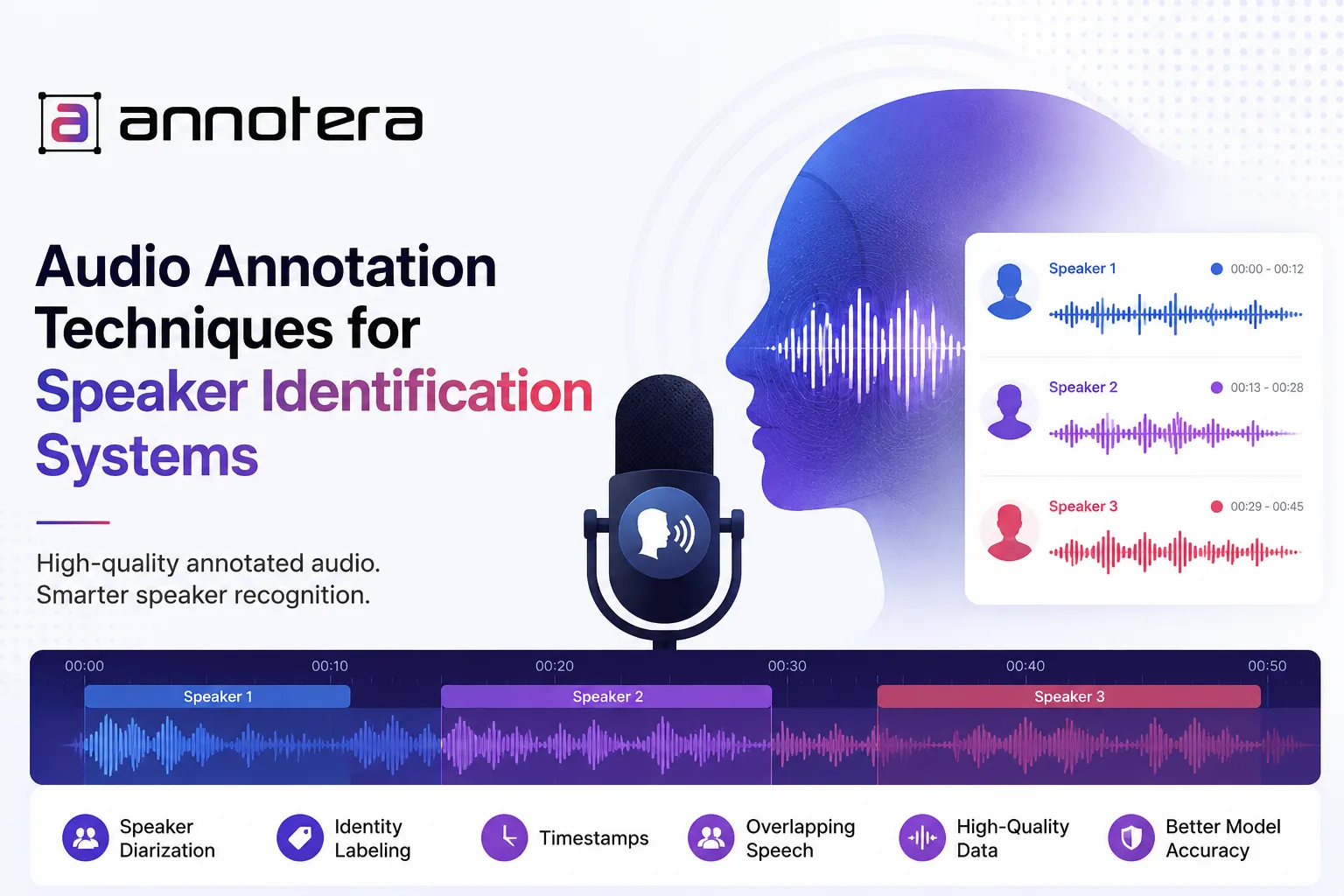
Speaker identification systems have become an essential part of modern artificial intelligence applications. From biometric authentication and contact center analytics to smart assistants and forensic investigations, AI-powered speaker identification enables systems to recognize who is speaking rather than simply understanding what is being said. However, the accuracy of these models depends heavily on one critical factor—high-quality annotated audio data.
Audio annotation provides AI models with structured, labeled speech datasets that help distinguish between different voices, accents, speaking styles, and environmental conditions. Without accurate annotations, speaker identification systems struggle to achieve reliable performance in real-world scenarios.
As organizations increasingly adopt voice-based AI solutions, partnering with an experienced data annotation company through data annotation outsourcing has become a strategic decision. Specialized audio annotation outsourcing providers deliver scalable, accurate datasets that accelerate AI development while maintaining high quality.
What Is Speaker Identification?
Speaker identification is the process of recognizing the identity of a speaker from an audio recording. Unlike speech recognition, which converts spoken words into text, speaker identification focuses on identifying the individual speaking based on unique vocal characteristics.
Applications include:
- Voice biometric authentication
- Banking security systems
- Customer service analytics
- Smart home assistants
- Criminal investigations
- Meeting transcription systems
- Personalized AI assistants
To build reliable speaker identification models, developers require extensive, accurately labeled speech datasets collected from diverse speakers and environments.
Why Audio Annotation Is Critical for Speaker Identification
Every voice carries distinctive characteristics such as pitch, tone, speaking rate, pronunciation, and vocal tract features. AI models learn these characteristics only when training datasets are correctly annotated.
High-quality audio annotation enables models to:
- Differentiate between multiple speakers
- Learn speaker-specific voiceprints
- Handle overlapping conversations
- Recognize speakers across different recording devices
- Improve robustness in noisy environments
- Reduce false acceptance and false rejection rates
Poor annotations often introduce mislabeled speakers, inconsistent timestamps, and missing metadata, significantly reducing model performance.
Essential Audio Annotation Techniques
1. Speaker Diarization Annotation
Speaker diarization answers the question:
"Who spoke when?"
Annotators divide audio recordings into speaker-specific segments and assign unique speaker IDs throughout the conversation.
For example:
- Speaker A: 00:00–00:12
- Speaker B: 00:13–00:20
- Speaker A: 00:21–00:35
This technique enables AI models to separate speakers in multi-person conversations.
2. Speaker Identity Labeling
Once speakers are segmented, each speaker is assigned a consistent identity label.
Examples include:
- Customer
- Agent
- Doctor
- Patient
- Speaker 1
- Speaker 2
When known identities exist, annotations may include actual speaker IDs for biometric model training.
Consistency is essential because even small labeling errors can confuse machine learning models.
3. Timestamp Annotation
Precise timestamps identify the beginning and end of every spoken segment.
Accurate timestamps allow AI systems to:
- Detect speech boundaries
- Align audio with transcripts
- Train speaker embedding models
- Improve conversation analytics
Frame-level precision often produces better speaker recognition accuracy.
4. Overlapping Speech Annotation
Real-world conversations rarely consist of one speaker talking at a time.
Meetings, customer support calls, interviews, and podcasts frequently contain overlapping voices.
Annotators identify:
- Primary speaker
- Secondary speaker
- Simultaneous speech duration
Training models with overlapping speech significantly improves performance in practical deployments.
5. Noise and Environment Annotation
Speaker identification systems encounter various acoustic environments.
Annotations may classify recordings as:
- Quiet room
- Office
- Vehicle
- Street
- Cafeteria
- Wind
- Traffic
- Background music
Environmental labels help AI models become more resilient under varying conditions.
6. Accent and Language Annotation
Speaker identity models benefit from exposure to diverse linguistic characteristics.
Annotations may include:
- Primary language
- Regional accent
- Dialect
- Code-switching
- Pronunciation variations
These labels improve fairness and reduce bias across multilingual speaker populations.
7. Emotion Annotation
A person's voice changes depending on emotional state.
Annotators classify emotions such as:
- Happy
- Angry
- Neutral
- Excited
- Sad
- Frustrated
- Calm
Including emotional variation helps speaker identification systems recognize individuals despite changes in speaking style.
8. Voice Quality Annotation
Voice quality affects recognition accuracy.
Common annotations include:
- Whispering
- Shouting
- Hoarse speech
- Soft speech
- Fast speaking
- Slow speaking
- Interrupted speech
These labels improve model robustness across natural communication styles.
Best Practices for High-Quality Speaker Identification Datasets
Developing reliable datasets requires standardized annotation workflows.
Key best practices include:
Use Consistent Annotation Guidelines
Clear labeling rules minimize inconsistencies between annotators and improve dataset reliability.
Employ Human Quality Assurance
Automated tools accelerate labeling, but human reviewers remain essential for verifying speaker boundaries, identity labels, and difficult recordings.
Include Diverse Speakers
Datasets should represent different:
- Age groups
- Genders
- Languages
- Dialects
- Accents
- Speaking speeds
Diversity improves model generalization.
Annotate Challenging Audio
Training data should include:
- Background noise
- Echo
- Low-quality microphones
- Telephone calls
- Multiple simultaneous speakers
Models trained on challenging conditions perform better in production environments.
Perform Multi-Level Validation
Quality assurance should include:
- Initial annotation
- Independent review
- Consensus validation
- Random sampling
- Automated consistency checks
These steps reduce annotation errors before model training.
Why Businesses Choose Audio Annotation Outsourcing
Building speaker identification datasets internally requires recruiting annotators, developing workflows, maintaining quality control, and managing infrastructure.
As AI projects scale, many organizations prefer audio annotation outsourcing to experienced specialists.
Benefits include:
- Faster project completion
- Access to trained linguistic experts
- Consistent quality assurance
- Cost-effective scaling
- Multilingual annotation capabilities
- Secure data handling
- Flexible workforce management
Similarly, data annotation outsourcing allows AI teams to focus on model development while trusted annotation experts prepare high-quality training datasets.
How Annotera Supports Speaker Identification AI
At Annotera, we understand that successful voice AI begins with accurate, consistent, and scalable annotation.
As a trusted data annotation company, we provide comprehensive audio labeling services tailored for speaker identification, speech recognition, conversational AI, and voice biometrics.
Our audio annotation capabilities include:
- Speaker diarization
- Speaker identity labeling
- Timestamp annotation
- Overlapping speech annotation
- Emotion labeling
- Accent and language tagging
- Acoustic event annotation
- Multilingual audio datasets
- Multi-stage quality assurance
Whether you're developing enterprise voice assistants, authentication platforms, or advanced conversational AI, our audio annotation outsourcing solutions deliver reliable datasets that improve model accuracy while accelerating development timelines.
Conclusion
Speaker identification systems rely on far more than sophisticated AI algorithms—they depend on carefully annotated audio datasets that capture the complexity of real-world speech. Techniques such as speaker diarization, timestamp labeling, overlapping speech annotation, emotion tagging, and acoustic environment classification provide the structured data required to train accurate, scalable models.
As voice-enabled technologies continue to expand across industries, investing in professional annotation becomes a competitive advantage. By partnering with an experienced data annotation company through data annotation outsourcing and specialized audio annotation outsourcing, organizations can build speaker identification systems that deliver greater accuracy, reliability, and real-world performance.
With expert annotation workflows, rigorous quality assurance, and scalable delivery, Annotera helps businesses transform raw audio into high-quality training data that powers the next generation of intelligent voice AI.