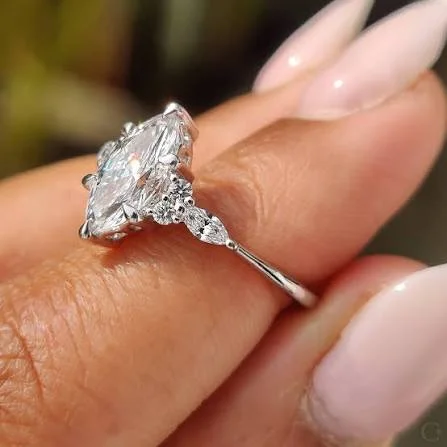
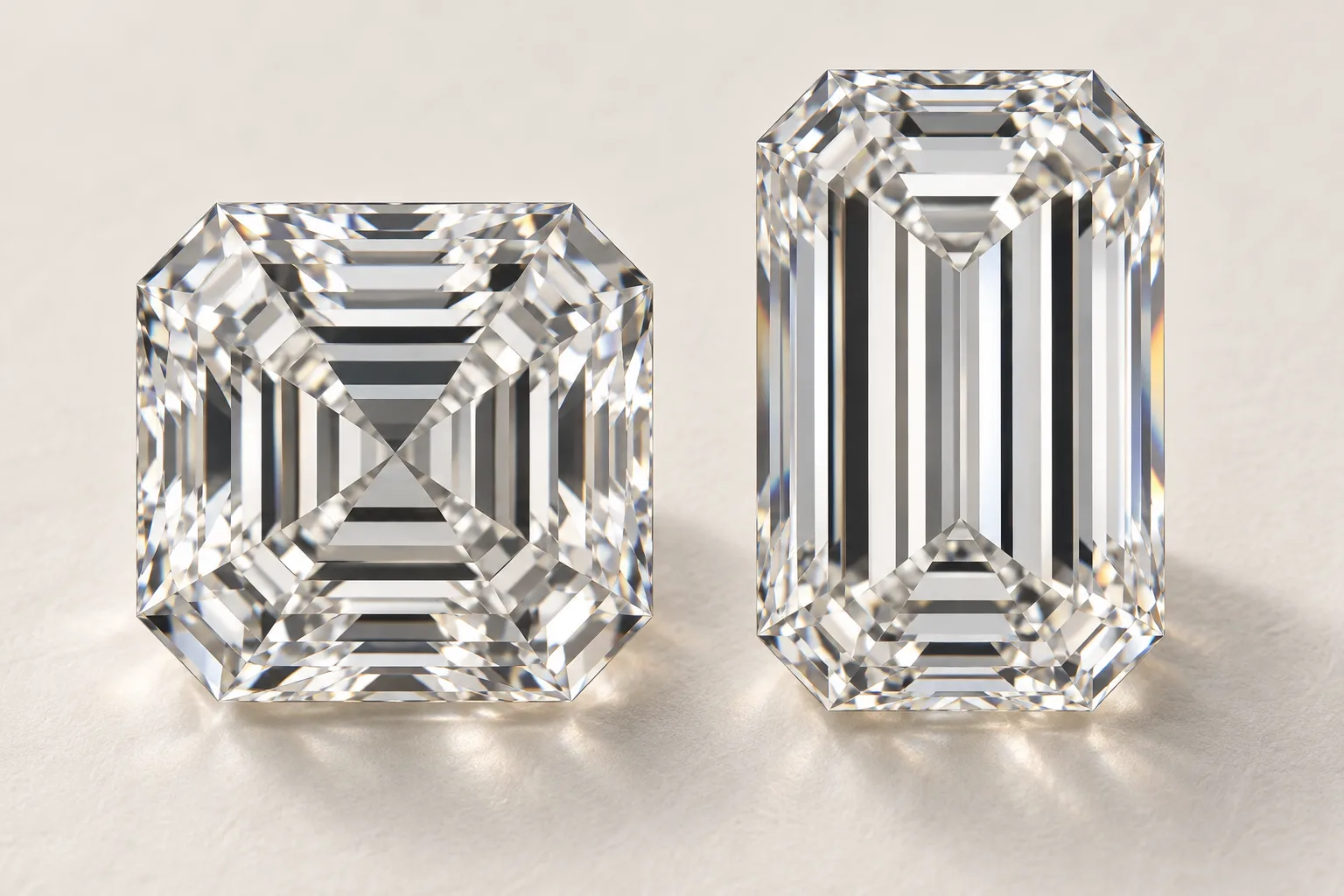
Choose an Asscher-cut lab diamond if you prefer a square outline and a strong geometric pattern. Choose an emerald-cut lab diamond if you favour an elongated rectangle and long, elegant reflections. Both belong to the step-cut family, but their proportions create distinctly different looks.
When comparing square emerald lab diamonds with rectangular emerald cuts, we recommend looking beyond the shape name. The measurements, visible clarity, facet pattern and finished setting should guide the decision.
A beautiful step-cut diamond needs to look appealing as it moves, not simply achieve impressive specifications on a product page. Here, we explain how to compare both shapes and choose a stone that suits your style.
What Is the Difference Between Asscher and Emerald-Cut Lab Diamonds?
Asscher and emerald cuts feature stepped facets that produce broad reflections. An Asscher typically has a square outline with cropped corners, while an emerald cut is usually rectangular with cropped corners.
Their visual character also differs. Asscher cuts draw attention towards the centre through a concentrated geometric pattern. Emerald cuts emphasise length, with reflections extending across their rectangular shape. Both offer the distinctive “hall of mirrors” appearance associated with step-cut diamonds. GIA’s guide to diamond shapes.
FeatureAsscher-Cut Lab DiamondEmerald-Cut Lab DiamondMain outlineSquare with cropped cornersUsually rectangular with cropped cornersVisual emphasisCentral pattern and balanced geometryLength and parallel linesSearch terminologyAsscher or square emeraldEmerald cut or rectangular emeraldDesign directionGeometric, vintage-inspired or architecturalMinimalist, classic or elongatedUseful comparisonWidth, corner shape and centre patternLength, width and overall outlineWe suggest choosing your preferred silhouette first, then comparing individual diamonds within that shape. This keeps the search focused on what you actually want to wear.
Are Square Emerald Lab Diamonds the Same as Asscher Cuts?
Square emerald is a term commonly used for Asscher-style diamonds. IGI also groups the terminology as “Asscher Cut / Square Emerald Cut” in its diamond-cut guidance. IGI.
However, we would not assume that every listing using these names looks identical. Two square step-cut diamonds can have noticeably different corner sizes, proportions and facet patterns.
When browsing square emerald lab diamonds, check:
- The outline: Does the diamond look square in the face-up image?
- The corners: Are they subtly cropped or more pronounced?
- The centre: Does the pattern look balanced and appealing?
- The measurements: Do the stated dimensions match the appearance you want?
- The report: How does the laboratory describe the shape and cutting style?
The product name helps you find the right category. The individual stone’s images and documentation help you decide whether it belongs on your shortlist.
Does Laboratory Growth Change the Choice Between These Cuts?
Laboratory-grown diamonds have essentially the same chemical, physical and optical properties as natural diamonds. Their origin does not turn an Asscher into a different style of cut or change the fundamental distinction between square and rectangular step cuts. GIA’s explanation of laboratory-grown diamonds.
We therefore recommend evaluating the finished diamond itself. Laboratory growth is not a reason to skip visual inspection or assume every stone will perform equally well.
Request the report for the exact diamond under consideration, rather than relying on a general description of the collection.
Which Step Cut Looks Better on the Hand?
We would begin with the ring’s overall proportions.
For an Asscher, consider whether you enjoy a centred, balanced shape. For an emerald cut, consider whether you prefer a longer outline running along the finger or an east-west arrangement across it.
Neither choice requires a particular hand shape. Personal preference matters more than a rule about which fingers should wear which diamonds.
Before deciding, we suggest comparing:
- A face-up image of each diamond at the same scale.
- Their actual length and width in millimetres.
- A ring photograph showing a similar stone size.
- The proposed band width and setting height.
Large product photographs can make small differences seem dramatic. A realistic view of the complete ring provides a more useful comparison.
How to Compare Length-to-Width Ratios
The length-to-width ratio describes how square or elongated a diamond is. Divide its length by its width.
For example:
- A diamond measuring 6.50 × 6.50 mm has a ratio of 1.00.
- A diamond measuring 8.40 × 6.00 mm has a ratio of 1.40.
- A diamond measuring 9.00 × 6.00 mm has a ratio of 1.50.
These examples describe outline proportions, not quality grades.
For square emerald lab diamonds, we recommend starting with measurements that are close to equal if a square appearance is your priority. For rectangular emerald cuts, compare several ratios visually before narrowing the search.
A preferred ratio is a style choice, not proof of excellent light performance. We would never select a diamond solely because its measurements fit a particular range.
Clarity: What Should We Look for in a Step-Cut Diamond?
The open facets of step cuts can make inclusions easier to notice. Colour can also be more apparent than in some brilliant-cut shapes. This makes careful inspection particularly valuable when choosing an Asscher or emerald cut. GIA’s diamond-shape guidance.
We recommend using the clarity grade to organise the search, then asking practical questions about each shortlisted stone:
- Can any inclusion be seen without magnification?
- Is there a noticeable mark beneath the centre?
- Has the seller inspected the actual diamond?
- Can the seller provide a clear video and an ordinary viewing-distance image?
Eye-clean appearance should be discussed clearly. Ask the seller what viewing distance and conditions they use when describing a diamond as eye-clean.
We would compare the visible result before paying more for a higher grade. Equally, we would avoid accepting a distracting inclusion simply to reach a larger carat weight.
Colour: Compare Stones Under Consistent Conditions
We recommend comparing colour in similar lighting and against a neutral background. A warm room, coloured surroundings or different camera settings can make online comparisons unreliable.
If you are choosing between two grades, request a side-by-side comparison where possible. Ask whether either stone shows a noticeable tint in person.
The intended setting should also be part of the discussion. View examples in your preferred metal, but avoid assuming that a metal colour will automatically conceal an unwanted tint.
Our approach is to identify the appearance you find acceptable, then compare prices within that range. The highest available colour grade is not automatically the best use of every budget.
Light Performance: Ask for More Than One Photograph
A still image records one position under one lighting arrangement. We recommend reviewing a video that shows the diamond moving slowly through several angles.
Use the footage to ask focused questions:
- Does the pattern remain attractive as the stone turns?
- Are reflections distributed in a way you enjoy?
- Does one area remain noticeably dull across several positions?
- Can you see distracting transparency through the centre?
- Is the diamond appealing in ordinary lighting as well as spotlighting?
These observations are screening tools, not a substitute for an expert inspection. If something looks unusual, ask the seller to explain it and provide additional footage.
We would be cautious about rejecting or approving a diamond based on a single dark frame. Movement and lighting context are essential to a useful comparison.
Carat Weight vs Visible Size
Carat describes weight, not a fixed set of dimensions. We recommend recording the length, width and depth of every shortlisted diamond instead of comparing carat weight alone.
For example, a buyer who wants a wider centre stone may prefer different measurements from someone who wants an elongated ring.
A simple shortlist can prevent confusion:
Comparison PointWhat We Would RecordWeightCarat weightVisible dimensionsLength and width in millimetresOutlineSquare, broad rectangle or slender rectangleAppearanceNotes from images and videoDocumentationLaboratory and report numberTotal costDiamond, setting and applicable chargesThe strongest choice is the diamond whose appearance and dimensions meet your priorities within the complete ring budget.
Choosing a Setting for Asscher or Emerald-Cut Lab Diamonds
Settings to Explore for Asscher Cuts
We suggest starting with a solitaire if you want the square outline to remain the main feature. A geometric three-stone design or a carefully proportioned surround can also be worth exploring.
Ask to see how the prongs or bezel affect the corners. The setting should preserve the outline you liked when viewing the loose diamond.
Settings to Explore for Emerald Cuts
For an emerald cut, we recommend comparing a classic north-south solitaire with an east-west setting before deciding. The same rectangular outline can feel quite different when its orientation changes.
If you prefer side stones, request a scaled design showing the complete arrangement. Consider how much finger coverage you want and whether the ring will sit comfortably beside a wedding band.
For either shape, ask the jeweller about security, setting height and everyday practicality before approving the design.
Which Cut Offers Better Value?
We would compare actual quotations rather than assume one shape always costs less.
Create a shortlist with similar grading, measurements and documentation, then review the complete purchase terms. Include the setting price, any resizing charges, delivery arrangements and return conditions.
Our preferred order of priorities is:
- An outline you genuinely prefer.
- An attractive appearance in motion.
- Acceptable visible clarity and colour.
- Suitable dimensions for the ring.
- A complete price within budget.
A small saving offers limited value if the diamond’s appearance leaves you uncertain.
Frequently Asked Questions About Square Emerald Lab Diamonds
Should We Search for Asscher or Square Emerald?
We recommend searching both terms. Retailers may organise similar square step-cut diamonds under different category names. Confirm the individual stone’s outline and report description before purchasing.
Can We Choose a Diamond From Its Report Alone?
We would use the report to check the documented characteristics, then review images, video and the seller’s inspection. A report does not replace seeing whether you like the diamond.
Is Asscher or Emerald Better for an Engagement Ring?
Both are options worth considering. We favour Asscher for buyers seeking a square centre and emerald for those wanting a rectangular outline. The final decision should include the complete setting and how it feels on the hand.
What Should We Check Before Ordering Online?
We recommend confirming the exact diamond, report number, measurements, final price and return policy in writing. Ask whether setting the stone changes its eligibility for return.
Choosing Your Asscher or Emerald-Cut Lab Diamond
For buyers drawn to square geometry, square emerald lab diamonds provide a focused starting point. For those who prefer a longer outline, rectangular emerald cuts deserve a closer look.
We recommend shortlisting a few stones, comparing them at a consistent scale and requesting clear videos before committing. Choose the diamond whose shape, appearance and finished setting satisfy your priorities, with documentation and purchase terms you understand.