
Most water problems announce themselves. Iron leaves orange stains in the sink. Sulfur smells like rotten eggs. Hard water crusts up the kettle. Arsenic does none of that. Water carrying several times the legal limit looks, smells, and tastes exactly like water with none at all.
That's what makes it a hard problem for people on private wells. Nobody tests a private well unless the owner does, and arsenic gives you no reason to suspect anything. If you've had a high test result, or you live in an area known for it, this guide explains what the numbers mean and how to choose an arsenic water filter that will actually work for your water.
Where arsenic comes from, and why it matters
In most wells, arsenic isn't pollution. It's geology. The element occurs naturally in certain rock formations and dissolves slowly into groundwater. That's why neighbors on the same road can get very different results, depending on how deep each well goes and which rock it draws from.
The EPA limit for public water supplies is 10 micrograms per liter, or 10 parts per billion (ppb). Private wells aren't held to that limit by law, but it's the benchmark every lab report uses. Researchers at the U.S. Geological Survey and CDC estimate that about 2.1 million Americans drink from private wells above it.
The risk comes from years of exposure, not from one glass. The Minnesota Department of Health links long-term consumption, even at low levels, to diabetes and to cancers of the bladder, lungs, liver and other organs. Massachusetts health officials add skin cancer and skin changes, such as dark patches and thickened growths on the hands and feet, to that list.
Start with the right test
Use a state-certified lab, not a guess. A basic test reports total arsenic, and that number tells you whether you have a problem. If it comes back above 10 ppb, switch to bottled water for drinking and cooking while you sort out treatment.
If you can, ask the lab for two more things.
Speciation. Arsenic in groundwater comes in two forms, usually written As(III) and As(V). The difference is electrical charge. As(V) carries a negative charge, which gives filter media something to grab. As(III) is neutral at normal pH and slips past many treatment methods. According to the Water Systems Council, As(III) is also the more toxic form and the more common one in groundwater.
Water chemistry. Ask for pH, iron and manganese at minimum. Other dissolved minerals compete with arsenic for space on filter media, and iron can foul the media outright. A filter sized without these numbers is sized on hope.
How arsenic filters actually work
Several technologies have a real track record. They differ mainly in where they sit in the house and which form of arsenic they handle.
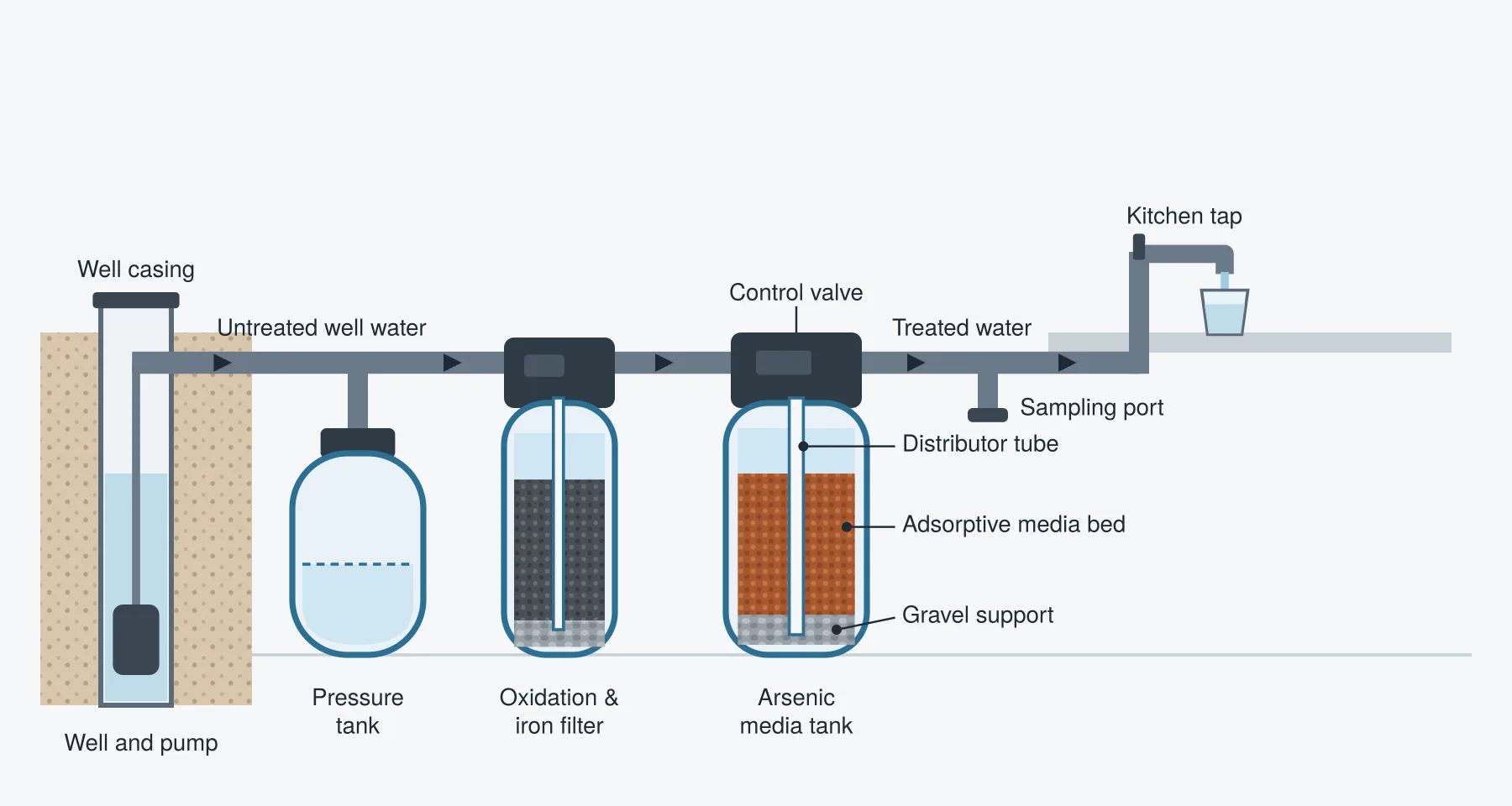
MethodHow it worksTypical useWatch out forAdsorptive media (iron oxide, titanium, activated alumina)Arsenic sticks to the media's surface as water passes throughWhole house or single tapMedia is used up over time and must be replaced. Iron-based media can handle both forms of arsenicReverse osmosisPressure pushes water through a membrane that holds back dissolved contaminantsOne tap, usually the kitchenWorks best on As(V). Produces some wastewaterAnion exchangeResin swaps arsenic for chloride, similar to how a softener worksWhole houseOnly removes As(V). Other ions compete for space on the resinDistillationWater is boiled and the steam is collected, leaving arsenic behindCountertop, small volumesSlow and energy-hungryIf your water is mostly As(III), many of these need help. The usual fix is an oxidation step ahead of the filter that converts As(III) into the easier As(V). Research on this is clear about which oxidants work: chlorine, permanganate and ozone all convert it readily, while simple aeration does not. That surprises people who assume an air-injection iron filter will take care of it.
One tap or the whole house?
Because drinking and cooking are the main exposure, many households only need to treat one tap. A point-of-use system at the kitchen sink is cheaper to buy and maintain. Dartmouth's arsenic research program recommends point-of-use treatment for levels below 250 ppb and whole-house treatment at 250 ppb or higher.
Some families choose whole-house treatment at lower levels anyway. It covers every tap, including the bathroom sink where kids fill a cup at night, and it removes the need to remember which faucet is the safe one.
For a rough sense of cost, Massachusetts estimates about $1,200 to install an under-sink system and around $343 a year to maintain it. Whole-house systems average about $3,000 installed and $550 a year. Your numbers will vary with your water chemistry and how much water you use.
Match the filter to your water
Once you have your lab results, choosing a filter for arsenic in water comes down to five questions:
- How much arsenic, and which form? This decides the technology and whether you need an oxidation step.
- What else is in the water? Iron, manganese and sediment usually need to be removed first, or they'll shorten the life of the arsenic media.
- How much water moves through, and how fast? Arsenic media needs contact time. A system pushed past its rated flow lets arsenic through, so size it to your busiest hour.
- Is it certified? Look for NSF certification for arsenic reduction, and check which form of arsenic the claim covers.
- What does upkeep involve? Find out how long the media or membrane lasts, what a replacement costs, and whether you can change it yourself.
Don't skip the retest
Arsenic filters fail quietly. The media fills up, arsenic starts slipping through, and the water still tastes fine. The only way to know the system is working is to test the treated water.
Test right after installation to confirm it's doing the job, then at least once a year. Test again whenever something changes: a new well pump, a deepened well, or a long drought that shifts the water table. Keep the results in one place so you can see the trend, and replace media on the schedule the manufacturer gives, not when you get around to it.
The short version
Test your well through a certified lab, even if the water seems perfect. If arsenic is above 10 ppb, stop drinking it and get the fuller picture: which form, plus pH and iron. Then choose from the arsenic filters built for that chemistry, sized for your flow, and certified for the job. And retest every year, because with arsenic, a lab report is the only warning you'll ever get.