
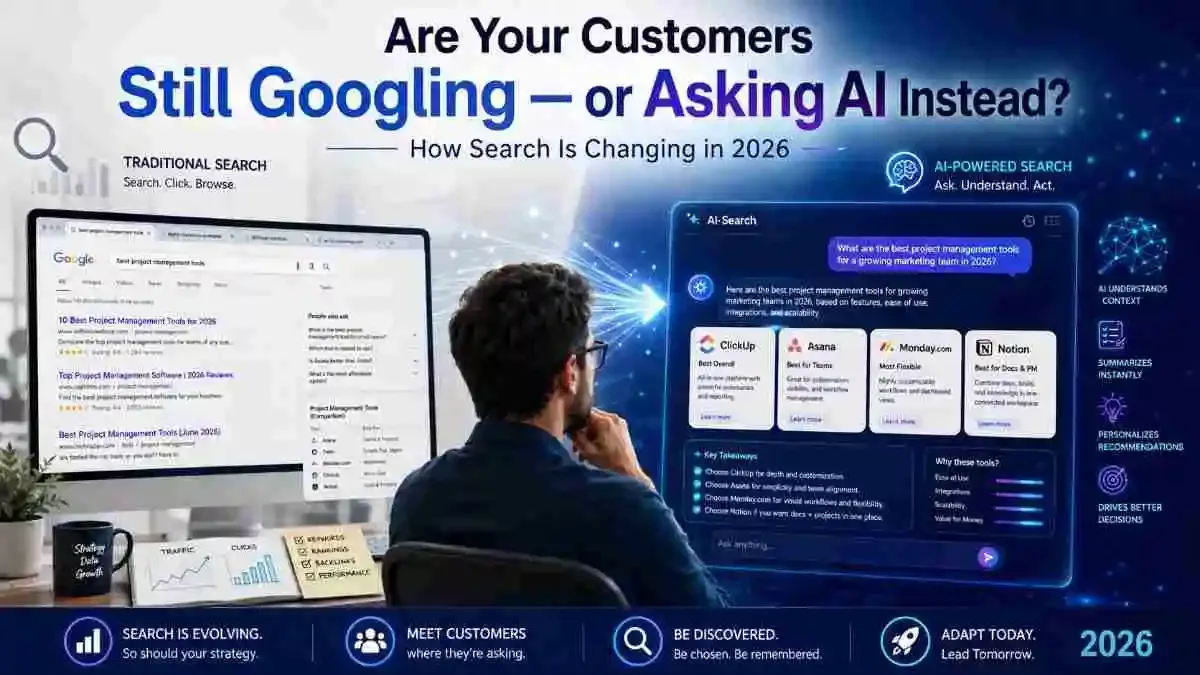
For more than two decades, online shopping followed a predictable pattern. You searched for a product, opened several results, compared specifications, read reviews, checked prices, visited retailer websites, and eventually decided what to buy.
AI shopping agents are beginning to compress that journey.
Instead of searching “best running shoes for flat feet under ₹10,000,” opening several buying guides, comparing individual product pages and checking availability manually, a shopper can increasingly describe the entire requirement to an AI shopping assistant.
The assistant can interpret the constraints, research products, compare alternatives, explain trade-offs and, on supported platforms, help move the shopper toward checkout.
The behavioural shift is already measurable.
Adobe Digital Insights reported that traffic from AI sources to U.S. retail websites grew 393% year over year during January–March 2026. In March 2026, AI-referred retail visitors converted 42% better than non-AI traffic in Adobe's dataset. Yet Adobe also makes an important qualification: the absolute volume of AI traffic remains modest compared with established major channels.
That distinction matters.
AI shopping agents are not simply replacing search engines. They are replacing parts of the traditional search, research and comparison workflow while search engines themselves become increasingly agentic.
Google Search is perhaps the strongest evidence. Google is building agentic shopping functions directly into Search and Gemini through technologies including Universal Cart and the Universal Commerce Protocol.
Meanwhile, ChatGPT, Perplexity and Amazon are developing their own approaches to conversational product discovery, comparison and transaction assistance.
The real transformation is therefore larger than “AI versus Google.”
Online shopping is moving from a search-and-click model toward an intent-to-action model.
The Shopping Journey Is Moving From Search Results to AI-Mediated Decisions
Traditional ecommerce discovery places most of the cognitive work on the shopper.
Imagine someone who wants a laptop for video editing.
A conventional search journey might look like this:
Search → buying guides → retailer pages → specifications → reviews → YouTube comparisons → price checking → shortlist → retailer → checkout
The search engine helps locate information, but the shopper has to assemble the answer.
Which processor is sufficient?
How much RAM is necessary?
Does the display cover the required colour gamut?
Is the cheaper laptop actually worse?
Are the reviews trustworthy?
Is the current price competitive?
Would a different model deliver better value?
That fragmentation created an entire ecosystem of comparison websites, affiliate articles, review sites, shopping tabs and product-search platforms.
AI shopping changes where that synthesis occurs.
A shopper can instead ask:
“I need a lightweight laptop under ₹1.2 lakh for Premiere Pro and occasional After Effects work. Battery life matters more than gaming performance, and I want at least 1TB of storage. Compare the strongest options and explain the trade-offs.”
The interface is no longer simply retrieving documents matching keywords.
It is attempting to understand a shopping objective.
An AI system may then gather information, filter options, compare specifications, incorporate preferences and return a smaller decision set.
OpenAI's shopping research experience illustrates this approach. It is designed for purchases involving multiple constraints and trade-offs and can ask follow-up questions about budget, features, brands and preferences before producing recommendations.
That changes the role of search.
Instead of the user manually navigating information, the AI increasingly performs part of the navigation, filtering and synthesis.
Traditional ecommerce discovery
A simplified traditional journey is:
Query → search results → websites → evaluation → decision → checkout
The search engine primarily helps the shopper find destinations.
AI-mediated ecommerce discovery
A more agentic journey can become:
Intent → reasoning → shortlist → comparison → recommendation → action
The shopper may still visit a retailer.
They may still use Google.
They may still read reviews.
But fewer intermediate steps may require direct human navigation.
Why this does not mean Search is disappearing
The assumption that AI shopping automatically means the end of search engines ignores what Google itself is doing.
Google is integrating agentic commerce into its existing ecosystem.
Its Universal Cart can work across services including Search and Gemini, while the Universal Commerce Protocol is designed to connect AI surfaces to merchant commerce systems.
So the competitive landscape is not:
Search engines vs AI shopping agents
It increasingly looks like:
Search engines becoming AI agents + AI assistants becoming search and commerce platforms + marketplaces becoming conversational assistants.
That convergence is one of the defining changes in ecommerce discovery.
What Makes an AI Shopping Agent Different From a Search Engine?
The term AI shopping agent is often used too loosely.
A product recommendation chatbot is not automatically a fully autonomous shopping agent.
Neither is a traditional search engine that generates an AI summary.
The difference becomes clearer when we examine what each system is expected to accomplish.
CapabilityTraditional Search EngineAI Shopping AssistantAdvanced Shopping AgentUnderstand keywordsYesYesYesUnderstand conversational constraintsLimited to strongStrongStrongCompare multiple productsUsually through resultsYesYesMaintain context during conversationLimitedYesYesExplain trade-offsIndirectlyYesYesPersonalize recommendationsSomewhatOftenOftenTrack changing conditionsSometimesSometimesOften possibleBuild a cartUsually through commerce integrationsSometimesYes on supported systemsInitiate transaction stepsLimitedSometimesYesComplete delegated actionsRareLimitedPossible on supported platformsThe important distinction is action.
Search engines historically answered:
“Where can I find this?”
AI shopping assistants increasingly answer:
“Which one fits my requirements?”
Agentic commerce pushes toward:
“What should I buy, and can you help me complete the task?”
What is agentic commerce?
Agentic commerce refers to commerce in which AI systems participate actively in parts of the transaction journey rather than only returning information.
That participation may include:
- interpreting shopping intent;
- discovering relevant products;
- applying constraints;
- comparing alternatives;
- checking price or inventory;
- managing shopping lists;
- monitoring deals;
- adding items to carts;
- preparing checkout;
- and, where supported and authorized, taking transactional actions.
The level of autonomy varies significantly between platforms.
That qualification is crucial because much of the hype around agentic shopping treats all AI commerce as if consumers were already handing unrestricted purchasing control to software.
Current implementations are generally more controlled.
OpenAI's initial Instant Checkout implementation, for example, emphasized that users explicitly confirm actions, while merchants remain responsible for payment processing, fulfillment, returns and customer relationships.
Agentic commerce is therefore better understood as a spectrum of delegated assistance rather than a single switch from human shopping to autonomous machine purchasing.
The Four Levels of AI Shopping Autonomy
A useful way to understand the market is to divide AI shopping into four levels.
This helps separate genuine agentic commerce from ordinary recommendation technology.
Level 1: Product Discovery
At the first level, AI helps users identify products.
A shopper might ask:
“Show me waterproof hiking shoes under ₹8,000 suitable for monsoon trekking.”
The AI interprets several attributes:
- product category;
- price ceiling;
- waterproofing;
- activity;
- weather context.
This is more sophisticated than a simple keyword query, but the AI is primarily helping with discovery.
The user still evaluates the products and completes the rest of the journey.
Search engines, ChatGPT, Perplexity, marketplaces and retailer chatbots can all operate at this level.
Level 2: Comparison and Decision Support
The second level moves beyond finding products.
The AI actively helps decide among them.
For example:
“Compare these three shoes for someone who walks 10 kilometres daily and has wide feet. Ignore colour and focus on comfort, durability and grip.”
A useful AI shopping assistant should identify the attributes relevant to the request instead of merely listing product specifications.
It may explain:
- which shoe has the widest fit;
- which has stronger wet-surface traction;
- which sacrifices durability for lower weight;
- which offers better value.
OpenAI's shopping research feature is explicitly designed around these kinds of multi-constraint comparison tasks. Users can refine recommendations during the research process and receive a buyer's guide covering options and trade-offs.
This is where AI may begin replacing significant amounts of manual “best product” searching.
Level 3: Transaction Assistance
At Level 3, the system begins interacting with the commerce workflow.
It might:
- add products to a cart;
- monitor prices;
- alert the shopper when inventory returns;
- transfer items into a merchant checkout;
- identify compatible products;
- prepare payment;
- or facilitate checkout within the AI interface.
Google's Universal Cart demonstrates this model.
Google says users will be able to add items while using Search or Gemini, while the cart can monitor price changes, stock availability and product compatibility. UCP can then facilitate checkout with participating retailers.
The shopper remains involved, but considerably more of the transaction workflow can be orchestrated by the system.
Level 4: Delegated Commerce
Level 4 is the version that most closely matches the popular idea of an autonomous shopping agent.
Here, a user defines a rule or objective and authorizes the agent to take action when conditions are satisfied.
Examples could include:
“Buy this item if its price falls below ₹5,000.”
or:
“Keep our office kitchen stocked with these supplies and reorder when required, subject to a monthly budget.”
Amazon has already introduced examples of agentic purchasing behaviour. Amazon's corporate disclosures describe Buy For Me capabilities where its shopping agent can make purchases on customers' behalf from outside stores. Amazon also reported that Rufus—renamed Alexa for Shopping in May 2026—had been used by more than 300 million customers during 2025.
But Level 4 should not be mistaken for unrestricted autonomous spending.
Payments, authorization, identity and merchant acceptance remain important boundaries.
Google's UCP implementation documentation, for example, includes defined checkout flows, payment handlers and user identification rather than an assumption that agents should transact invisibly.
The practical future of agentic commerce is more likely to involve controlled delegation than unlimited autonomy.
Google Is Turning Search Itself Into an Agentic Shopping Platform
If AI shopping agents were simply replacing search engines, Google would theoretically be defending the traditional search interface.
Instead, Google is redesigning it.
This is one of the strongest reasons the “AI will replace Google” framing is incomplete.
Google AI Mode changes the shopping interface
Conversational AI allows shoppers to express requirements in ways that are awkward as conventional keyword queries.
Instead of searching:
office chair ergonomic under 20000 best lumbar support India
a shopper can describe:
“I work from home about nine hours per day, I'm 6 feet tall, I frequently get uncomfortable around my lower back, and I want an ergonomic chair under ₹20,000. Compare options based on adjustability and warranty rather than looks.”
That is a fundamentally different query structure.
The system needs to interpret requirements, infer which product attributes matter and connect those needs with available products.
Google is now explicitly measuring this shift inside Merchant Center.
Its AI performance insights describe consumers moving from keyword searches toward longer conversational shopping queries. Merchants can examine AI visibility across stages such as discovery, evaluation and ready-to-buy intent.
That is a significant development for ecommerce marketers.
Google is effectively acknowledging that the unit marketers need to understand is no longer only:
keyword → impression → click
It is increasingly:
intent → conversational interaction → product consideration → purchase.
What is Google Universal Commerce Protocol?
The Google Universal Commerce Protocol (UCP) is infrastructure designed to allow AI interfaces and merchant systems to communicate during commerce interactions.
According to Google's current developer documentation, UCP integrations can support transactions directly through Google's AI surfaces, including Search and Gemini.
A merchant implementation can involve:
- Merchant Center;
- shipping information;
- return policies;
- product feeds;
- Google Pay;
- checkout APIs;
- account identification;
- and order-status synchronization.
This matters because AI recommendations alone do not create agentic commerce.
An agent needs structured ways to communicate with merchants.
It must understand whether a product is available.
It needs to know pricing.
It may need shipping rules.
The merchant needs to receive the order.
Payment authorization needs to occur.
Order status must return to the relevant system.
UCP attempts to provide common infrastructure for that interaction.
Google also warns developers that UCP is an evolving standard and that not every capability defined within the specification is necessarily available on Google's surfaces today.
That caveat should temper predictions about fully autonomous shopping.
Universal Cart changes the ecommerce funnel
Google announced Universal Cart in May 2026.
Rather than treating carts as something belonging only to an individual retailer, Google describes Universal Cart as a shopping hub capable of operating across merchants and Google services.
Products can be added while using services such as Search and Gemini.
The cart can then help with tasks such as:
- identifying deals;
- monitoring price drops;
- showing price history;
- watching for restocks;
- and identifying compatibility problems.
Google says its Shopping Graph contains more than 60 billion product listings, and people conduct shopping activity across Google more than a billion times per day. Those numbers are Google's own platform figures and should be treated as such, but they illustrate the scale of the commerce infrastructure behind Google's agentic ambitions.
This is not Google abandoning shopping search.
It is Google trying to reduce friction between searching, deciding and buying.
ChatGPT Is Becoming a Product Research and Commerce Destination
ChatGPT represents a different path into agentic commerce.
Google began with Search and is making Search more conversational.
ChatGPT began with conversation and is making conversation more transactional.
That distinction matters.
A user already discussing fitness, travel, home renovation or photography can naturally turn the conversation into a product decision.
For example:
“Based on everything we discussed about my home office, which monitor should I buy?”
The shopping interaction can emerge from a broader context rather than from a dedicated product query.
ChatGPT Shopping
Current ChatGPT shopping experiences can display product options with product information and links to merchant sites when a conversation indicates shopping intent.
For eligible products and merchants, Instant Checkout may also allow checkout without leaving ChatGPT.
The product-discovery layer has also become more visual.
OpenAI expanded shopping functionality in March 2026 to support richer product browsing, side-by-side comparisons and detailed product information within conversational shopping experiences.
The important behavioural difference is that users can progressively refine the recommendation.
Instead of issuing five separate searches, they can say:
“Those are too expensive.”
then:
“Remove models without USB-C.”
then:
“Prioritize battery life.”
then:
“Which two would you personally compare based on these constraints?”
The conversation itself becomes the filtering mechanism.
Shopping Research
Simple purchases do not always require extensive analysis.
But complex purchases often involve multiple trade-offs.
OpenAI's shopping research capability is specifically designed for those situations.
It can ask questions about:
- budget;
- size;
- preferred brands;
- intended use;
- comfort;
- performance;
- style;
- and other constraints.
The result is intended to resemble a personalized buyer's guide rather than a conventional page of product results.
This is precisely the part of ecommerce search that is most vulnerable to AI disruption.
A considerable amount of commercial search behaviour historically consisted of queries such as:
- best laptop for students;
- best shampoo for oily scalp;
- iPhone vs Samsung;
- top office chairs under ₹20,000;
- best camera for travel;
- running shoes for beginners.
These queries exist because shoppers need help reducing choices.
When an AI system can perform that reduction interactively, some of the need to click through several comparison pages naturally declines.
Agentic Commerce Protocol
OpenAI's Agentic Commerce Protocol (ACP) moves the experience from product research toward transactions.
OpenAI introduced Instant Checkout and ACP in September 2025, describing ACP as an open standard allowing AI agents, users and businesses to work together during purchases.
The merchant remains merchant of record and continues to handle core responsibilities such as fulfillment, returns and customer support.
That design choice is important.
Agentic commerce does not necessarily require ecommerce platforms to surrender the customer relationship to an AI provider.
The AI can act as an interface or intermediary while merchant infrastructure continues handling the transaction.
This architecture may prove important to adoption because it allows businesses to participate without rebuilding their entire commerce stack.
Amazon Is Rebuilding Marketplace Search Around AI
Amazon occupies a different position again.
Google controls a major discovery layer.
ChatGPT is building shopping into a general-purpose AI assistant.
Amazon already controls a massive commerce marketplace.
Its challenge is therefore not primarily to send shoppers elsewhere.
It is to make its existing product catalog easier to navigate.
Amazon's Rufus began as a conversational shopping assistant and was renamed Alexa for Shopping on May 13, 2026.
The system can assist with activities including:
- conversational product recommendations;
- product comparisons;
- price evaluation;
- deal discovery;
- shopping-list processing;
- cart management;
- and certain agentic purchasing actions.
Amazon's Q4 2025 results stated that Rufus had been used by more than 300 million customers and associated the assistant with nearly $12 billion in incremental annualized sales during the year. These figures are Amazon's own corporate disclosures rather than independent measurements, but they show that AI shopping has moved well beyond experimental demos inside major ecommerce platforms.
Amazon also illustrates why shopping agents are unlikely to exist as one universal category.
Alexa for Shopping has access to Amazon's marketplace context, product catalog, customer shopping signals and transaction ecosystem.
That gives it different advantages from an open-web answer engine.
The “best AI for shopping” may therefore depend heavily on where the shopper wants to buy and how much of the transaction they want the AI to manage.
Where Perplexity Shopping Fits
Perplexity represents another path: an AI-first search engine becoming transactional.
Perplexity describes itself as an AI-powered search engine that searches the web and returns conversational answers backed by sources.
That means its starting point is closer to research than marketplace commerce.
But the distinction has narrowed.
Perplexity's current Instant Buy documentation states that U.S.-based users can search for and purchase eligible products directly within Perplexity.
Its product recommendations may take into account information including:
- availability;
- reviews;
- pricing;
- specifications;
- user searches;
- previous interactions;
- and saved preferences.
Perplexity also states that organic product listings are not pay-to-rank placements.
For shoppers, the appeal is straightforward:
research and transaction can occur inside the same answer-oriented environment.
A shopper might begin with:
“What type of coffee grinder should I buy for espresso?”
Then move to:
“Compare three models under $300.”
Then:
“Which is easiest to maintain?”
Then, for eligible products:
purchase.
That trajectory demonstrates how answer engines can evolve into agentic commerce platforms.
It also reinforces the central thesis: commerce interfaces are converging.
Are Consumers Actually Moving From Search Engines to AI for Shopping?
The technology is clearly advancing.
The more difficult question is whether consumers are actually changing their behaviour.
Available evidence suggests they are—but the scale needs careful interpretation.
AI referral traffic is growing rapidly
Adobe Digital Insights reported that traffic from AI sources to U.S. retail sites increased 393% year over year during the first three months of 2026.
Adobe's consumer survey also found that 39% of respondents had used AI for online shopping, with 85% of those users saying AI improved their shopping experience.
The 2025 holiday season produced an even larger growth figure.
Adobe reported that traffic from generative AI tools to U.S. retail websites increased 693.4% year over year from November 1 through December 31, 2025.
Those figures clearly demonstrate momentum.
They do not demonstrate dominance.
Why growth percentages can be misleading
Suppose a small channel grows from 1 visitor to 5 visitors.
That is 400% growth.
Another channel might remain at 500 visitors.
The small channel is growing far faster but still represents a fraction of total traffic.
The same principle applies to AI referrals.
Adobe explicitly noted during its 2026 Prime Day analysis that AI traffic volume remained modest compared with other major channels.
Therefore a headline claiming that AI shopping has already replaced Google based purely on triple-digit referral growth would be analytically weak.
The better conclusion is:
AI is becoming a meaningful shopping-discovery channel much faster than its current share alone might suggest.
The quality of AI traffic may matter as much as volume
Traffic growth is only part of the story.
Adobe reported that in March 2026, AI-referred retail visitors converted 42% better than non-AI traffic.
The same research found AI visitors spent 48% longer on retail sites and viewed 13% more pages per visit.
During the 2026 Prime Day period, Adobe reported AI-referred traffic converted 40% better than non-AI channels.
There is an intuitive explanation.
A visitor who reaches a store after asking an AI assistant:
“Which cordless vacuum is best for pet hair in a small apartment under $400?”
may already have completed significant product evaluation before arriving.
The merchant receives a visitor who is further down the decision funnel.
That possibility has major implications for ecommerce analytics.
A lower volume of highly qualified AI referrals may deliver more commercial value than a much larger pool of loosely qualified informational traffic.
What AI Shopping Agents Are Most Likely to Replace First
It is easier to predict which shopping behaviours AI will reduce than whether it will “replace search engines.”
Several activities are particularly vulnerable.
1. Generic “best product” research
Queries such as:
- best laptop under ₹70,000;
- best sunscreen for oily skin;
- best luggage for international travel;
- best headphones for working out;
exist because users need someone to narrow a large category.
AI assistants are naturally suited to this task because users can explain context and constraints.
2. Repetitive product comparison
A shopper comparing four smartphones often opens several pages simply to answer:
- Which has better battery life?
- Which receives longer software support?
- Which camera performs better?
- Which is lighter?
- Which gives better value?
AI can consolidate those dimensions into one comparison.
The user may still verify important details, but much of the repetitive information gathering can disappear.
3. Specification filtering
Product catalogs often contain dozens of filters.
A conversational system can translate natural language into those constraints.
Instead of manually selecting:
₹40,000–₹60,000 → 16GB RAM → 1TB SSD → 14-inch → under 1.5kg
the user can state the requirement in a sentence.
4. Manual deal monitoring
Shopping agents are well suited to tasks such as:
- alert me if the price falls;
- tell me when the product returns to stock;
- compare this price with recent pricing;
- identify a better deal.
Google's Universal Cart and Amazon's shopping AI demonstrate this direction.
5. Opening ten tabs before making a decision
This may be one of the biggest behavioural changes.
The browser-tab problem exists because conventional search returns destinations rather than decisions.
AI attempts to synthesize the destinations into an answer.
That does not remove the underlying websites.
It potentially removes some of the need for users to visit all of them.
What AI Shopping Agents Are Less Likely to Replace Soon
Not every shopping activity benefits equally from delegation.
Experiential research
A buyer choosing furniture may want:
- room photography;
- customer photos;
- videos;
- detailed material information;
- showroom visits.
A short AI recommendation cannot completely replicate experience.
High-consideration purchases
Cars, luxury goods, enterprise software and expensive electronics involve complicated financial and emotional decisions.
AI may help narrow options without becoming the final decision maker.
Brand discovery
Strong brands are more than product attributes.
Identity, aspiration, community, design and cultural relevance affect purchases.
Those signals cannot always be reduced to specifications.
First-hand reviews
Consumers frequently want human experiences:
Does it actually last after six months?
Is customer support good?
Does this fabric feel cheap?
AI can summarize those experiences, but the underlying human evidence remains valuable.
Post-purchase relationships
Returns, warranties, service, loyalty programs and support still connect customers with merchants and brands.
Agentic commerce may mediate those interactions later, but merchant relationships remain important.
What Agentic Commerce Means for Ecommerce SEO
For SEO professionals, the wrong response to AI shopping is panic.
The equally wrong response is assuming nothing changes.
The objective is evolving.
Traditional ecommerce SEO often asks:
“How do we rank this category or product page for the target keyword?”
Agentic commerce adds another question:
“How do we make this product sufficiently understandable, trustworthy and eligible to be selected by an AI shopping system?”
That does not eliminate SEO.
It expands the visibility problem.
Ranking a page may no longer be the only objective
Historically, visibility often meant ranking a URL.
In AI-mediated commerce, the system may surface the product itself.
The user may interact with:
- product name;
- image;
- price;
- attributes;
- reviews;
- availability;
- merchant information;
before deciding whether to visit the website.
The visibility unit increasingly becomes:
brand + entity + product + attributes + merchant data
rather than just:
URL + keyword ranking.
Product data becomes marketing infrastructure
Merchant feeds used to feel primarily operational.
In an AI-shopping ecosystem, they become strategic.
If a customer asks:
“Find a formal black linen shirt available in XL for under ₹3,500.”
the system needs reliable structured information about:
- category;
- colour;
- material;
- size;
- price;
- stock.
If those attributes are incomplete, the product may be difficult for the system to select confidently.
Google's Merchant Center AI performance reporting now explicitly identifies popular product attributes consumers reference in conversational queries and highlights products missing those attributes.
That connects product-feed quality directly with AI visibility.
Feeds and websites must agree
AI commerce creates another challenge: consistency.
Suppose a product feed says:
₹4,999 — in stock
while the website says:
₹5,499 — out of stock
The user experience deteriorates.
The same applies to:
- shipping information;
- return policies;
- specifications;
- variants;
- product identifiers.
OpenAI explicitly warns that shopping research can occasionally make mistakes around current price and availability and encourages users to verify final information with merchants.
For retailers, that means data freshness becomes increasingly important.
SEO and AI visibility are complementary
There is a temptation to rename everything “GEO,” “AEO” or “LLMO” and declare SEO obsolete.
That is premature.
AI shopping systems still rely on information from:
- websites;
- merchant feeds;
- catalogs;
- product databases;
- structured information;
- reviews;
- trusted publishers;
- and other web sources.
Strong ecommerce fundamentals remain useful.
The difference is that marketers need to optimize for two related outcomes:
1. Help humans discover and evaluate the product.
2. Help machines accurately understand and select the product.
The strongest strategy supports both.
How Retailers Can Prepare for AI Shopping Agents
Retailers do not need to rebuild their entire technology stack because agentic commerce is growing.
They should first improve the information AI systems need to make good decisions.
1. Improve product titles
A product title should communicate useful identifying information.
Avoid titles so creative that the system cannot understand what the product is.
Include relevant attributes where natural:
- product type;
- model;
- key variation;
- important distinguishing attribute.
2. Complete structured product attributes
If shoppers compare products by:
- size;
- colour;
- material;
- compatibility;
- dimensions;
- capacity;
- gender;
- technical specification;
those attributes should exist consistently in structured product data.
Google's AI performance insights specifically surfaces popular attributes and identifies missing attribute information as an optimization opportunity.
3. Keep pricing current
Incorrect pricing destroys trust.
Ensure consistency between:
- product feeds;
- landing pages;
- APIs;
- merchant integrations.
Dynamic pricing businesses should pay particular attention to synchronization.
4. Maintain accurate inventory
Recommendation quality collapses when suggested products cannot be purchased.
Availability should update quickly across merchant systems.
5. Use correct product identifiers
Where relevant, maintain reliable identifiers such as:
- GTIN;
- brand;
- MPN;
- SKU.
These help platforms reconcile products across catalogs.
6. Make shipping information explicit
Users increasingly ask complex transactional questions.
For example:
“Which of these will arrive before Friday?”
If shipping expectations cannot be determined, the product may become less useful to an agent.
7. Maintain clear return policies
Return conditions are part of the purchasing decision, particularly in categories such as:
- fashion;
- footwear;
- electronics;
- beauty devices;
- furniture.
Do not bury these terms behind vague pages.
8. Invest in product imagery
AI shopping may be conversational, but shopping remains visual.
OpenAI's richer shopping experience emphasizes visual browsing and side-by-side comparison.
Use:
- clear primary images;
- multiple angles;
- useful detail shots;
- contextual imagery;
- consistent variant photography.
9. Build trustworthy review signals
Users still want evidence from other buyers.
Reviews help answer questions specifications cannot:
- durability;
- fit;
- comfort;
- ease of use;
- customer service;
- real-world performance.
Avoid manufactured or low-quality review programs.
Trust becomes more important when an AI system summarizes evidence on the shopper's behalf.
10. Keep Merchant Center healthy
For businesses selling through Google's ecosystem, Merchant Center becomes increasingly important.
Google's current AI performance insights can report organic visibility across conversational shopping experiences in markets including India, the United States, Canada, Australia and New Zealand.
Retailers should monitor:
- product approvals;
- missing attributes;
- feed errors;
- price mismatches;
- product visibility;
- AI share of voice where available.
11. Monitor AI referral traffic
Analytics teams should start separating AI-originated traffic where technically possible.
Track:
- sessions;
- landing pages;
- conversion rate;
- average order value;
- revenue per session;
- assisted conversions;
- category performance.
Do not evaluate the channel based solely on traffic volume.
Adobe's research suggests AI referrals can behave differently from other channels, making conversion quality particularly important.
12. Track visibility without clicks
A major challenge will be measuring influence when the AI provides recommendations without generating a website visit.
Useful metrics may increasingly include:
- brand mentions;
- product appearance;
- AI share of voice;
- recommendation frequency;
- product coverage;
- purchase influence.
Google's Merchant Center AI reporting already includes concepts such as AI impressions, share of voice and shopping-stage visibility.
That is an early signal of how ecommerce measurement may evolve.
13. Evaluate commerce protocols selectively
Not every retailer needs immediate ACP or UCP integration.
Prioritize fundamentals first.
Then evaluate integrations based on:
- platform demand;
- supported regions;
- merchant eligibility;
- technical cost;
- transaction volume;
- control of customer relationship;
- payment requirements;
- expected incremental revenue.
Agentic commerce infrastructure is still evolving.
Google explicitly describes UCP as an evolving standard.
SEO vs Agentic Commerce Visibility
Traditional Ecommerce SEOAgentic Commerce VisibilityRank pages for queriesBecome relevant to conversational intentOptimize page titlesOptimize product entities and attributesEarn SERP clicksEarn recommendation inclusionFocus heavily on URLsFocus on products, brands and merchant dataOptimize keyword relevanceOptimize intent and constraint matchingBuild internal linksBuild clear entity relationshipsTrack ranking positionsTrack AI visibility/share where availableImprove CTRImprove product selection likelihoodOptimize landing pagesMaintain product-feed accuracyMeasure sessionsMeasure sessions plus AI-assisted influenceThese disciplines should not be treated as competitors.
The best ecommerce strategy connects them.
Risks That Could Slow Agentic Shopping Adoption
The potential is substantial, but agentic commerce still has meaningful limitations.
Product-information errors
Shopping is unforgiving of hallucination.
An incorrect historical fact in a casual conversation is undesirable.
An incorrect voltage specification, shoe size, price or compatibility recommendation can lead directly to a bad purchase.
OpenAI acknowledges that its shopping research experience may occasionally make errors around product details such as price and availability.
Retailer verification therefore remains important.
Price and availability volatility
Commerce data changes constantly.
Products sell out.
Prices change.
Discounts expire.
Sizes disappear.
Shipping estimates move.
AI systems need fresh information rather than periodically indexed snapshots.
This makes real-time or frequently synchronized merchant data increasingly important.
Authorization
Consumers may be comfortable allowing an agent to recommend a ₹1,000 pair of headphones.
They may feel differently about authorizing a ₹1 lakh purchase.
Delegated commerce requires clear boundaries.
Questions include:
- What is the spending limit?
- Which merchant is authorized?
- Can the agent substitute products?
- Can the agent choose a payment method?
- Does the user need final approval?
Current systems frequently preserve explicit user confirmation for sensitive transaction steps.
Privacy
Personalization can dramatically improve shopping recommendations.
But personalization may involve sensitive context such as:
- purchase history;
- browsing behaviour;
- preferences;
- location;
- budgets;
- previous conversations.
Platforms will need to balance convenience with transparent user control.
Merchant control
Retailers need clarity about:
- who owns the customer relationship;
- who handles returns;
- what customer data is shared;
- who processes the payment;
- how disputes work;
- how recommendations are ranked.
OpenAI's ACP model emphasizes that participating merchants remain merchant of record.
Such safeguards may be critical for broad merchant adoption.
Measurement and attribution
Suppose a shopper spends 20 minutes researching a product in an AI assistant and then visits the retailer directly tomorrow.
What receives credit?
The AI assistant?
Organic search?
Direct traffic?
The brand?
A previous advertisement?
Traditional last-click attribution becomes increasingly inadequate when decision-making happens inside an external AI interface.
Marketing teams will need better models for measuring assisted discovery.
So, Are AI Shopping Agents Replacing Search Engines?
Not outright.
AI shopping agents are replacing portions of what shoppers previously used search engines to do manually.
They are especially well positioned to reduce:
- repetitive product research;
- generic comparison searches;
- specification filtering;
- tab-hopping;
- price checking;
- and parts of transaction preparation.
But search engines are not standing still.
Google is bringing agentic commerce directly into Search and Gemini through systems including Universal Cart and UCP.
ChatGPT is moving from conversational product discovery toward integrated commerce.
Perplexity is combining AI search with Instant Buy.
Amazon is turning marketplace search into an agentic assistant.
So the emerging market is not best described as:
AI shopping agents replacing search engines.
It is better described as:
search engines, AI assistants and ecommerce platforms converging around agent-mediated commerce.
The interface is changing from:
“Give me links related to these keywords.”
toward:
“Understand what I need, evaluate the options, help me decide and assist me in completing the purchase.”
Adobe's data shows that consumers are already experimenting with this behaviour at meaningful scale, while also making clear that AI referral volumes remain smaller than major established acquisition channels.
That makes predictions of search's immediate death premature.
But ignoring the transition would be equally shortsighted.
For ecommerce businesses, the practical implication is straightforward:
Keep optimizing for search, but start optimizing for selection.
Make your products easy for humans to evaluate and easy for machines to understand.
Maintain accurate product data.
Strengthen merchant feeds.
Expose meaningful attributes.
Monitor AI-driven discovery.
Measure AI-assisted customers separately where possible.
And treat agentic commerce as an emerging extension of ecommerce infrastructure—not a replacement for every marketing discipline that came before it.
The retailers that adapt successfully will not be the ones chasing a new acronym every six months.
They will be the ones whose products remain understandable, trustworthy, available and competitive regardless of whether the shopper discovers them through Google Search, Gemini, ChatGPT, Perplexity, Amazon or the next AI shopping interface.
Frequently Asked Questions
What is an AI shopping agent?
An AI shopping agent is an AI system that assists with one or more stages of shopping, such as understanding requirements, discovering products, comparing alternatives, monitoring prices, adding products to a cart or facilitating transactions.
More advanced agents may take authorized actions on behalf of shoppers rather than only providing recommendations.
What is agentic commerce?
Agentic commerce is a model in which AI agents actively participate in commerce workflows.
Instead of merely showing information, an agent may help discover products, evaluate choices, interact with merchant systems, prepare checkout or complete authorized actions.
The level of autonomy depends on the platform and transaction.
What is agentic shopping?
Agentic shopping is the consumer-facing application of agentic commerce.
The shopper gives an AI system an objective such as:
“Find the best noise-cancelling headphones under ₹20,000 for frequent flights.”
The agent can then interpret the requirement, research options and potentially assist with purchasing.
What is the best AI for shopping?
There is no single best AI shopping assistant for every situation.
ChatGPT is well suited to conversational research and multi-constraint comparisons.
Google Search/Gemini combines conversational shopping with Google's large shopping ecosystem and merchant infrastructure.
Amazon Alexa for Shopping benefits from direct integration with Amazon's marketplace and customer shopping context.
Perplexity combines AI-powered web research with direct shopping capabilities such as Instant Buy for eligible U.S. users.
The best option depends on whether the shopper prioritizes open-web research, marketplace shopping, personalized comparisons or transaction convenience.
Can AI shopping agents actually buy products for you?
Yes, in some situations.
Current systems can already support various transaction-related actions, including checkout assistance and certain delegated purchases.
However, capabilities vary by platform, merchant, product and region.
Many current implementations still require explicit user confirmation before payment or final transaction steps.
What is Google Universal Commerce Protocol?
The Universal Commerce Protocol (UCP) is an open commerce standard used to connect AI experiences with merchant commerce systems.
Google's current implementation documentation describes UCP integrations supporting transactions on AI surfaces including Search and Gemini.
UCP can connect product discovery with merchant checkout, payment and order-management infrastructure.
Is Perplexity an AI shopping agent?
Perplexity began primarily as an AI-powered answer and search engine, but it now includes shopping functionality.
Its official documentation confirms that eligible U.S. users can use Instant Buy to purchase supported products directly within Perplexity.
It therefore increasingly overlaps with AI shopping-agent functionality.
Will AI shopping agents replace ecommerce SEO?
No evidence currently supports abandoning ecommerce SEO.
AI assistants still depend heavily on reliable information about products, brands and merchants.
Instead of replacing SEO, agentic commerce adds another visibility layer.
Retailers should continue improving:
- crawlable websites;
- product pages;
- useful content;
- technical SEO;
- structured product information;
- product feeds;
- merchant data;
- brand authority;
- reviews;
- and overall customer experience.
The strategic change is that success may increasingly depend not only on ranking a webpage, but also on having the right product selected by an AI system for the shopper's specific intent.