
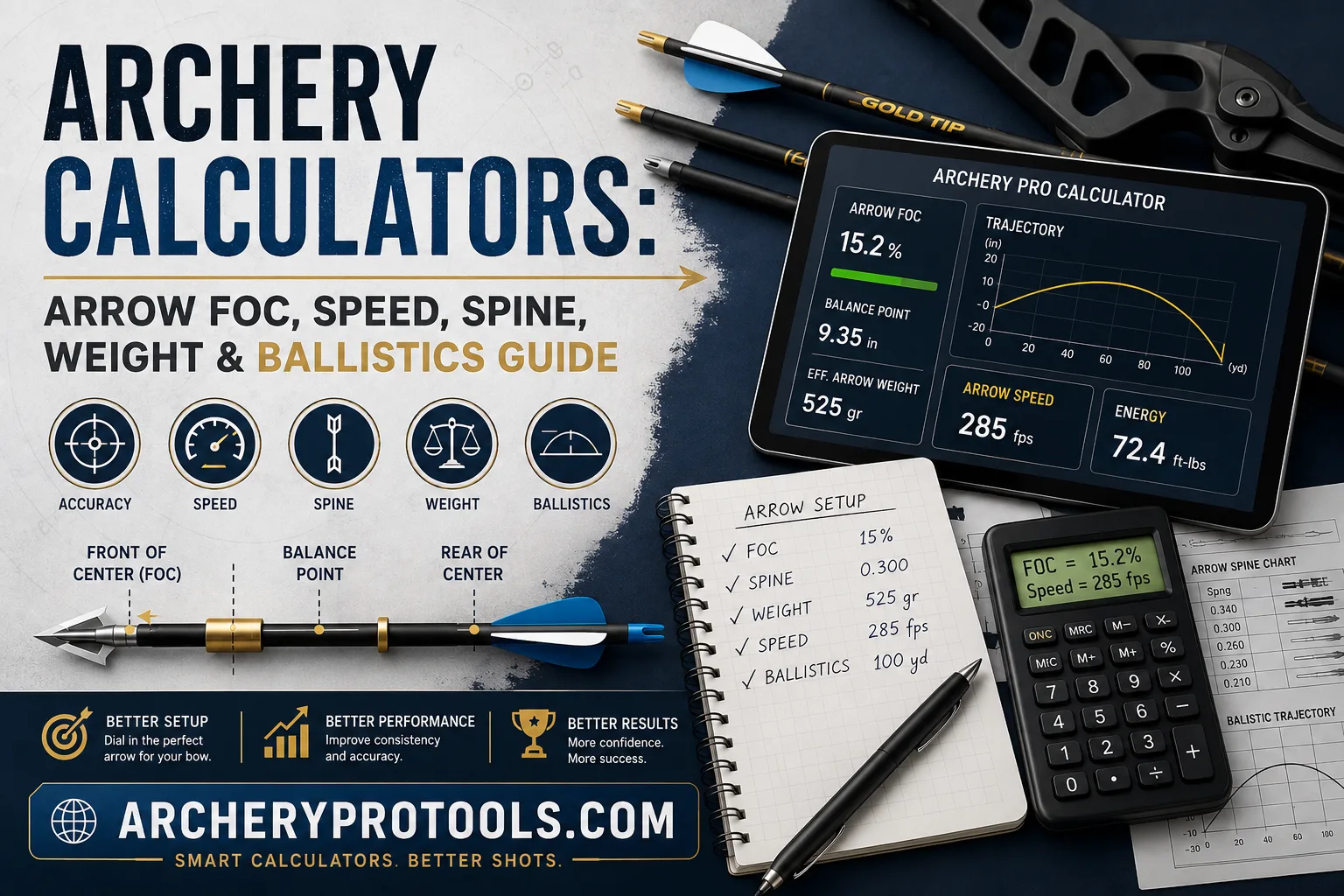
Choosing the right arrow setup involves more than selecting a shaft and point. Archery calculators can help archers evaluate arrow weight, front-of-center (FOC), spine, speed, kinetic energy, momentum, and trajectory before making changes to a bow or arrow build. Whether you shoot a compound, recurve, or crossbow, accurate inputs make these calculations far more useful.
From an arrow speed calculator and arrow spine calculator to an arrow weight calculator, each tool answers a different part of the equipment-selection process. Understanding what the numbers mean is just as important as calculating them.
What Is an Archery Calculator?
An archery calculator uses measurements such as draw weight, draw length, arrow length, shaft weight, point weight, and bow speed to estimate performance characteristics.
Common calculations include:
- Arrow weight and GPI
- FOC and balance point
- Arrow spine and stiffness
- Arrow speed and velocity
- Kinetic energy and momentum
- Trajectory and arrow drop
- Crossbow bolt speed and ballistics
For example, a gold tip arrow calculator, Easton FOC calculator, or Gold Tip spine calculator can be useful when building arrows around a particular shaft system. Brand-specific calculators may use manufacturer specifications, so always enter the correct shaft model and components.
How to Calculate FOC on an Arrow
FOC, or front of center, describes how far the arrow's balance point is positioned toward the front of the shaft. It is an important part of archery FOC because changing point weight, shaft length, insert weight, or nock weight can shift the balance point.
The basic FOC formula is:
FOC % = [(Balance Point − Arrow Length ÷ 2) ÷ Arrow Length] × 100
Measure the complete arrow first, then find its balance point. This process is known as FOC measurement.
If you're wondering how to calculate FOC on an arrow, a front of center calculator or arrow FOC calculator can perform the calculation quickly. Tools such as an Easton FOC calculator, Gold Tip FOC calculator, or Podium Archery FOC calculator may also simplify arrow-building decisions.
Why FOC Matters
FOC is only one part of arrow performance. Changing the balance point also changes total arrow weight and dynamic behavior. Instead of chasing a particular FOC percentage, consider the complete setup, including shaft stiffness, point weight, draw weight, and intended use.
How to Calculate Arrow Weight
Total arrow weight is the combined weight of the shaft and all installed components. These can include:
- Shaft
- Point or broadhead
- Insert
- Nock
- Fletching
- Wraps or other components
Shaft weight is commonly expressed as GPI (grains per inch). An arrow GPI calculator can help estimate shaft weight from GPI and shaft length.
For example:
Shaft weight = GPI × shaft length
The complete arrow will weigh more because components must be added separately. An arrow weight calculator, Easton arrow weight calculator, or arrow build calculator can make this process easier.
If you're asking how to calculate arrow weight, start with the manufacturer's actual shaft specification rather than relying on a generic estimate.
How to Calculate Arrow Spine
Arrow spine refers to shaft stiffness. Selecting an appropriate spine depends on several variables, including bow type, draw weight, draw length, arrow length, and point weight.
A basic arrow spine calculator considers these factors to recommend an appropriate shaft stiffness range. Compound bows and traditional bows can require different approaches, so use a calculator designed for the bow type you're shooting.
Useful tools include a Gold Tip arrow spine calculator, Victory arrow spine calculator, Easton spine calculator, recurve spine calculator, and dynamic spine calculator.
It's important to distinguish static spine from dynamic spine. Static spine is a standardized measurement of shaft stiffness, while dynamic spine describes how the arrow behaves under the actual shooting conditions created by the bow and arrow components.
How to Calculate Arrow Speed
Arrow speed is commonly measured in feet per second (FPS). A bow speed calculator, arrow velocity calculator, or archery FPS calculator can estimate speed from bow and arrow specifications.
Actual speed depends on factors such as:
- Draw weight
- Draw length
- Arrow mass
- Bow design and efficiency
- Cam system
- Release technique
- Manufacturer testing conditions
An IBO speed calculator or IBO speed calculator should not be treated as a guarantee of real-world velocity because standardized test conditions can differ substantially from an individual setup.
If you want to calculate arrow speed, a chronograph is the best way to measure the speed of your actual equipment. Calculators are most useful for estimating how changes in arrow mass or bow specifications may affect performance.
Arrow Kinetic Energy and Momentum
Speed alone does not describe the complete performance of an arrow. Arrow kinetic energy depends on both mass and velocity.
The basic kinetic-energy relationship is:
KE = ½mv²
where m is mass and v is velocity. Archery calculators generally convert the units into grains and FPS for practical use.
An arrow kinetic energy calculator, kinetic energy calculator for arrows, or archery KE calculator can help compare different setups.
Momentum is another useful measurement because it accounts for mass and velocity:
Momentum = mass × velocity
An arrow momentum calculator can therefore provide another perspective when comparing arrow configurations. Neither number alone determines actual field performance; broadhead design, arrow construction, target material, and shot conditions also matter.
Arrow Trajectory and Drop Calculators
An arrow trajectory calculator estimates how an arrow travels through the air and how much it drops over distance. These calculations can be useful for understanding sight marks and trajectory differences between arrow setups.
An arrow drop calculator may use:
- Arrow velocity
- Distance
- Launch angle
- Gravity
- Drag assumptions
Real arrows experience aerodynamic drag, so calculator results are estimates rather than exact predictions. A sight tape calculator or archery sight tape calculator can also help archers translate trajectory information into practical sight settings.
Crossbow Ballistics and Bolt Calculations
Crossbow setups have their own performance considerations. A crossbow speed calculator can estimate bolt velocity, while a crossbow ballistics calculator can model trajectory and drop.
Other useful tools include a crossbow arrow speed calculator, crossbow bolt drop calculator, crossbow bolt weight calculator, and crossbow kinetic energy calculator.
Bolt weight is particularly important because changing it affects velocity and energy. Use the actual finished bolt weight whenever possible rather than estimating from shaft weight alone.
Choosing the Right Calculator
The best calculator depends on what you're trying to solve.
GoalUseful calculatorFind arrow balanceFOC calculatorCompare shaft stiffnessArrow spine calculatorEstimate finished arrow massArrow weight calculatorEstimate velocityArrow speed calculatorCompare energyKinetic energy arrow calculatorStudy trajectoryArrow ballistics calculatorEstimate dropArrow drop calculatorBuild an arrowArrow builder calculatorEvaluate crossbow performanceCrossbow ballistics calculator
Tools such as a Podium Archery arrow calculator, Podium arrow calculator, 3 Rivers Archery spine calculator, or manufacturer-specific calculators can be helpful when their inputs match your equipment.
Final Thoughts
A good Podium Archery foc calculator is most useful when it complements real measurements. Start with accurate draw weight, draw length, arrow length, shaft GPI, point weight, and finished arrow or bolt weight. Then use FOC, spine, speed, energy, momentum, and trajectory calculations to understand how those variables interact.
Rather than relying on a single number, evaluate the entire arrow system. A properly measured and consistently built setup gives you much more meaningful results than any calculator estimate alone.