A dentist's office had ranked comfortably on page one of Google for years, right up until patients started asking ChatGPT for recommendations instead of searching directly. Within a matter of months, new patient inquiries coming from search quietly dropped, even though their actual Google ranking never moved an inch.
That's the reality AI search optimization exists to address. It's the practice of structuring content, schema, and online presence so AI platforms like ChatGPT, Gemini, and Perplexity can find, verify, and cite your brand directly inside the answers they generate, rather than requiring someone to click through a results page first. Rankings alone no longer guarantee that outcome.
Getting found through AI search optimization has quickly become just as important as traditional rankings once were, sometimes noticeably more so, depending on how your specific audience actually searches today.
What Is AI Search Optimization?
AI search optimization means carefully and deliberately restructuring your brand's content and data so generative AI models can confidently extract, verify, and cite it when forming an answer to a relevant question.
This goes well beyond simple keyword placement. It involves entity clarity, direct-answer formatting, schema markup, and consistency across every single platform where your business is mentioned online.
A well-ranked page can still be completely ignored by an AI model if the information isn't structured clearly enough for the system to trust and quote confidently, regardless of how much traffic that page currently gets.
How Does AI Search Optimization Get You Found Inside AI Answers?
AI models build their responses from sources they consider clear and genuinely trustworthy, then synthesize a single answer rather than presenting a long list of options the way a traditional search engine does.
Getting found inside that answer requires meeting three conditions simultaneously: your information must be accurate, it must be consistent across multiple sources, and it must be structured in a way the model can extract without ambiguity.
Miss any one of these three, and even genuinely excellent, well-written content risks being skipped in favor of a competitor whose information checks all three boxes cleanly.
Why Is AI Search Optimization Different From Ranking-Based SEO?
Ranking-based SEO rewards relevance signals accumulated slowly over time, backlinks, keyword density, page authority. AI search optimization rewards something far more immediate: whether the AI model trusts your content enough to cite it right now, today.
Here's a point worth being honest about: a lot of businesses assume strong existing SEO will automatically carry over into strong AI visibility. It often doesn't, because the two systems are evaluating fundamentally different signals when they each decide what to surface and cite.
Roughly 63% of all searches now happen inside AI tools rather than traditional search engines, and that share keeps growing month over month as more people default to asking an assistant instead of typing a query into a search bar.
What Mistakes Undermine AI Search Optimization Efforts?
The most common mistake is treating this as a one-time content refresh instead of an ongoing, continuous discipline. AI models retrain and update constantly, so a strategy that worked six months ago can quietly lose effectiveness without anyone on the team noticing.
Inconsistent information across the web is another frequent problem. If your hours, services, or pricing differ between your website and third-party listings, AI systems often hedge their recommendation rather than commit to citing you confidently at all.
What Are the Key Components of AI Search Optimization?
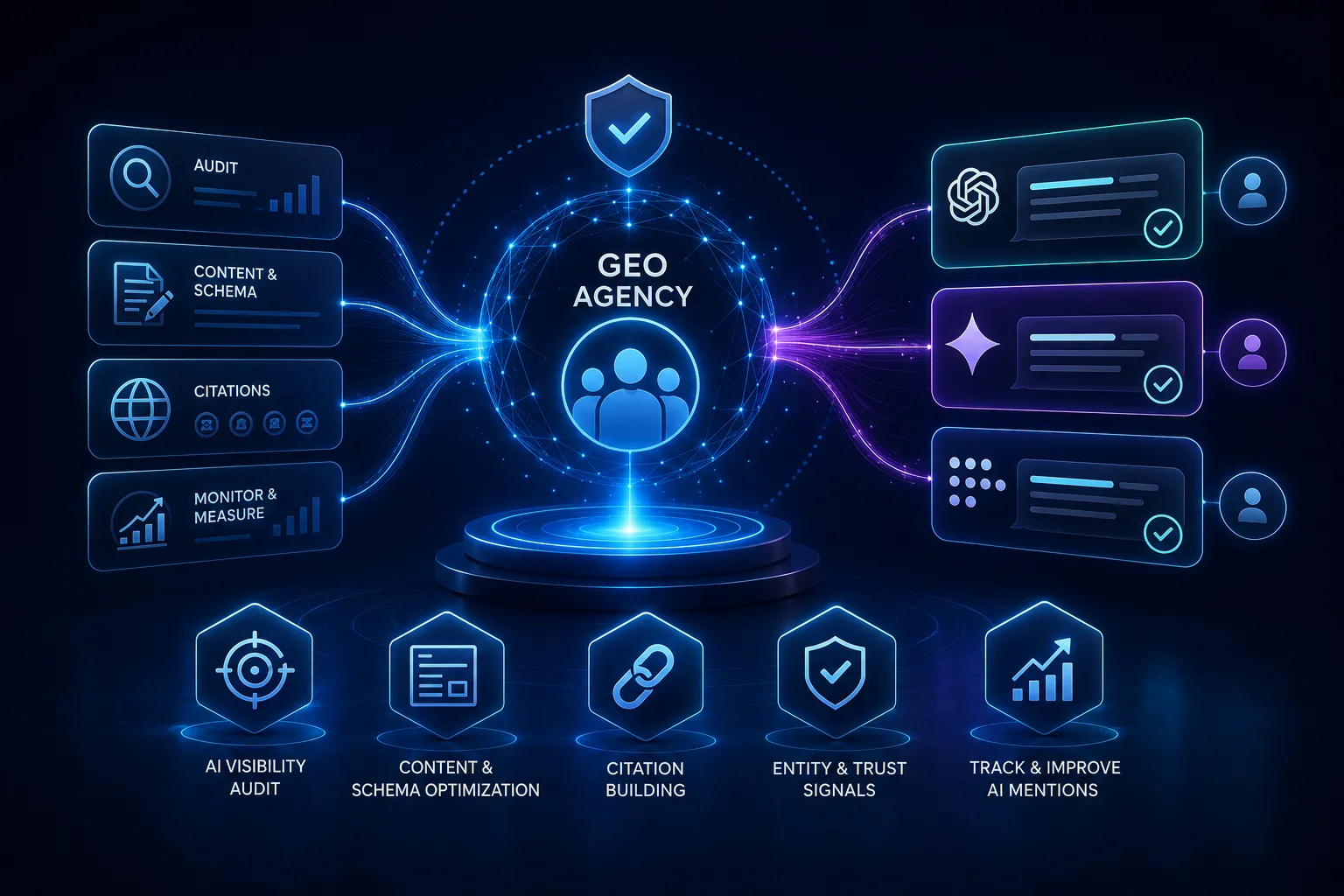
A complete, well-rounded approach typically includes:
- AI visibility audits that clearly reveal where your brand currently appears, or doesn't, across major AI platforms
- Content restructuring around clear, direct answers placed immediately after each individual heading
- Schema markup that gives AI systems explicit signals about entities, relationships, and facts
- Citation building that consistently reinforces the same accurate story about your brand across multiple trusted sources
- Ongoing monitoring since AI models update constantly and yesterday's strategy can quietly lose effectiveness
This work overlaps closely with two related disciplines: GEO, or Generative Engine Optimization, and AEO, or Answer Engine Optimization, both of which share the same underlying goal of making content genuinely machine-readable, verifiable, and trustworthy at scale.
How Long Does AI Search Optimization Take to Show Results?
Early visibility signals typically appear within 60 to 90 days of proper restructuring, considerably faster than the 6 to 12 months traditional SEO campaigns usually need before meaningful movement shows up.
Real numbers support this timeline. An Ohio auto dealership saw 87% growth in AI mentions within two months, an education-sector client grew AI Overview mentions to 579 over roughly six months, and an architecture firm reached 110 AI Overview appearances in about 3.5 months of sustained, consistent work.
Full, sustained visibility across multiple AI platforms simultaneously tends to build over three to four months, since trust compounds gradually as consistent citations accumulate across the web rather than spiking overnight.
Does AI Search Optimization Replace Traditional SEO Entirely?
No, and treating it that way is a mistake in the other direction. Traditional SEO still drives organic traffic, supports domain authority, and feeds some of the same signals AI models eventually rely on.
The smartest approach runs both simultaneously, letting traditional SEO handle click-through traffic while AI search optimization handles direct citations and recommendations, two genuinely different but complementary outcomes.
Who Should Prioritize AI Search Optimization First?
Businesses in high-trust categories, finance, healthcare, legal services, real estate, should move on this immediately and deliberately, since these are exactly the categories where a single AI recommendation carries outsized weight in a customer's decision.
Local service businesses shouldn't wait either. Conversational AI queries like "who's the best plumber near me" already carry real buying intent, and typically only one or two names get mentioned back at all, not the long list a search engine once returned.
Getting found inside AI-generated answers isn't a bonus channel anymore, it's quickly becoming the primary way many customers discover businesses in the first place. Brands treating AI search optimization seriously now are the ones that will still be getting mentioned two years from now, while competitors wonder where their traffic quietly went without any obvious explanation.