For years, enterprise security was built around a simple idea: protect the systems people use.
That model is getting harder to maintain.
AI systems are no longer limited to answering questions or generating content. They are being connected to databases, business applications, customer platforms, development environments, and internal workflows. Some AI agents can now take actions with limited human intervention.
That creates a new security problem.
What happens when the thing making decisions inside your business can also become an attack surface?
AI Changes the Security Equation
Generative AI and autonomous agents bring a different kind of risk because the model itself becomes part of the security environment.
A traditional application generally follows rules written by developers. An AI system can interpret instructions, process unstructured information, and generate responses based on context.
That flexibility is useful. It is also difficult to control.
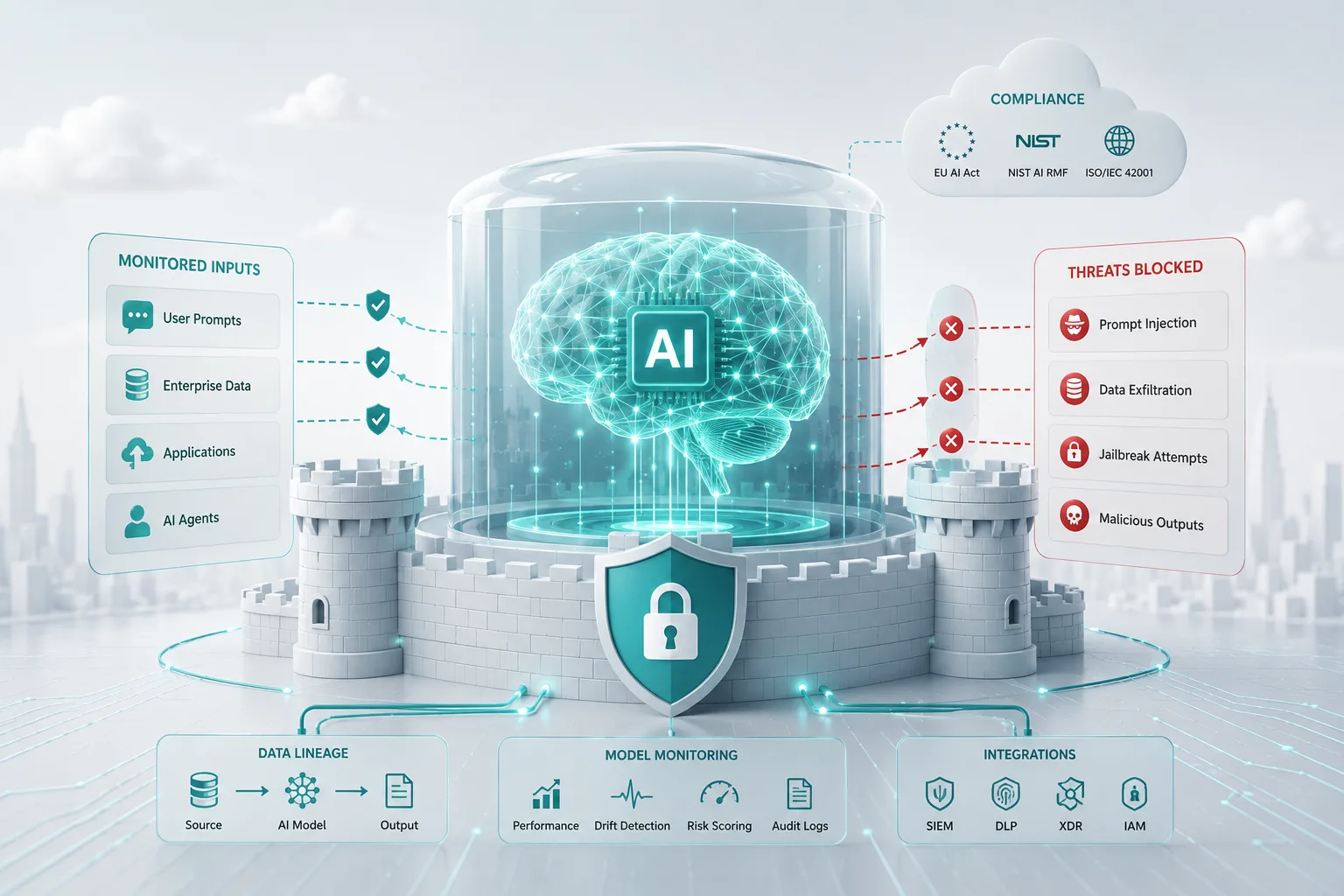
An attacker could manipulate an AI system through prompt injection, attempt to extract sensitive information, influence its output, or exploit the tools connected to an autonomous agent.
The risk does not necessarily come from the model alone. It can emerge from the interaction between the model, its data, its users, and the systems it can access.
The Hidden Problem: Shadow AI
There is another challenge that many organizations may already be facing.
Employees do not always wait for IT teams to approve a new AI tool.
They find a tool that helps them write faster, analyse information, summarize documents, or generate code—and start using it.
This is commonly referred to as Shadow AI: the use of AI applications that have not been formally approved or assessed by an organization.
The security concern is obvious.
An employee may unknowingly paste confidential business information into an external AI service. A developer might submit proprietary code to a public model. A team may start using an AI application without knowing where its data is stored or how it is processed.
The technology may be useful.
The organization simply may not know it is being used.
Why Traditional Security Tools Are Not Enough
This does not mean traditional cybersecurity tools have become irrelevant.
Firewalls, endpoint protection, SIEM platforms, identity controls, and data-loss prevention systems still play an important role.
But AI adds another layer that security teams need to understand: the prompts, responses, model behavior, data flows, and actions surrounding AI systems.
This is why AI security platforms are emerging as a distinct category.
Their purpose is to give organizations greater visibility and control over AI use. Depending on the platform, this can include discovering AI assets, tracking sensitive data, testing models for weaknesses, monitoring AI activity in real time, and enforcing security policies.
The important point is that AI security should not operate in isolation.
It needs to become part of the broader security architecture.
Seven Risks Security Teams Cannot Ignore
AI security is not one problem. It is a collection of risks that can affect different parts of the AI lifecycle.
1. Prompt Injection
An attacker can create instructions designed to manipulate an AI system into ignoring its intended rules or revealing information it should not provide.
2. Data Poisoning
If malicious or inaccurate information enters training or fine-tuning data, it can influence how a model behaves later.
3. Model Theft
Proprietary models can represent significant intellectual property. Attackers may attempt to reproduce them through repeated queries or obtain model files directly.
4. Adversarial Attacks
Carefully manipulated inputs can cause an AI system to produce incorrect or dangerous results.
5. Privacy Attacks
Repeatedly probing a model may expose information that was present in its training data or connected sources.
6. Supply-Chain Risks
Third-party models, libraries, datasets, and other components can introduce vulnerabilities into an AI application.
7. Shadow AI
Unapproved AI applications can create data and compliance risks outside the organization's normal security controls.
These threats do not all require the same defense.
That is why simply adding an “AI security” checkbox to an existing security strategy is unlikely to be enough.
The Bigger Challenge Is Autonomous AI
The security conversation becomes even more complicated when AI agents enter the picture.
Consider the difference between an AI assistant that drafts an email and an AI agent that can read a customer database, access internal tools, create a support ticket, and send a response without waiting for a person.
The second system has more capability.
It also has more potential impact if something goes wrong.
This creates a difficult question for business and security leaders:
How much autonomy should an AI agent have?
One approach is to require human approval for sensitive actions.
Another is to allow AI to operate independently while monitoring its activity.
A third approach is to give agents limited permissions and allow greater autonomy only after they demonstrate reliable behavior.
There is no single answer that fits every organization.
A low-risk marketing workflow and a financial transaction should not necessarily have the same level of AI autonomy.
Security Needs to Start Before Deployment
One of the biggest mistakes organizations can make is treating AI security as something to address after an AI system goes live.
Security decisions should begin earlier.
Organizations need to know:
- Which AI models and tools are being used?
- What data can each system access?
- Which employees or agents have access?
- What actions can an AI agent perform?
- What happens when the model produces an unexpected result?
- Can the organization stop or restrict the system quickly?
- How will AI activity be monitored and audited?
These questions create a foundation for responsible AI adoption.
They also help security teams move from reacting to incidents toward preventing them.
What Should Enterprises Do Now?
Organizations do not need to solve every AI security challenge at once.
A practical starting point is visibility.
First, identify the AI tools, models, agents, and data pipelines already being used. This includes approved systems as well as Shadow AI.
Next, classify the data involved and determine which systems require stronger controls.
From there, organizations can introduce AI-specific monitoring, data protection, access policies, adversarial testing, employee training, and continuous validation.
AI systems should also be connected to existing security operations where possible. AI-related activity can provide useful signals for broader security monitoring rather than becoming another isolated technology stack.
The Real Goal Is Not to Slow AI Down
Security teams sometimes face an uncomfortable position.
The business wants to move quickly with AI.
Security wants more controls.
It can look like these goals are in conflict.
They do not have to be.
Good AI security should make it possible for organizations to experiment, deploy, and scale AI with greater confidence.
The objective is not to prevent employees from using AI.
It is to make sure they can use it without unknowingly creating a new path for sensitive information to leave the organization—or giving an autonomous system more authority than it can safely handle.
The Question Leaders Should Be Asking
AI adoption will continue to expand. More models will become capable of reasoning, more tools will become connected to them, and more business processes will involve autonomous agents.
That means the security question is changing.
It is no longer enough to ask:
“Is our AI system secure?”
Organizations should also ask:
“What can this AI system access, what can it change, and what happens if it behaves exactly as an attacker wants it to?”
That shift in thinking may be one of the most important parts of building a secure AI-powered enterprise.
AI can make businesses faster and more capable.
But the organizations that benefit most may be the ones that treat security, visibility, and accountability as part of AI adoption—not obstacles to it.