
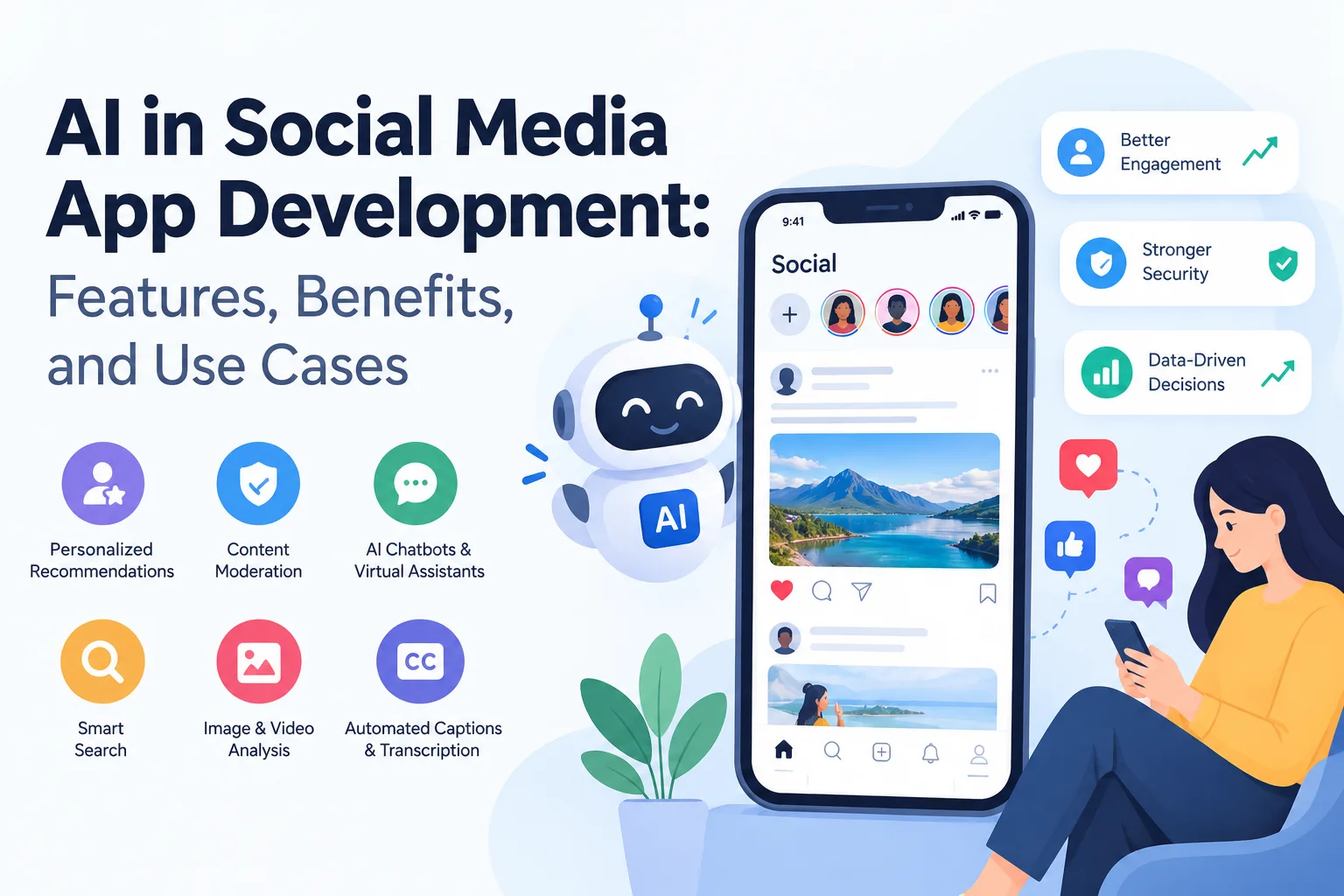
Artificial intelligence has become an important part of modern social media platforms. From personalized content feeds and automated moderation to intelligent chatbots and recommendation systems, AI helps social apps understand user behavior and deliver more relevant experiences.
For businesses planning to launch a social networking platform, AI can provide more than just advanced features. It can improve engagement, automate repetitive operations, strengthen platform security, and help teams make better product decisions using real-time data.
However, adding AI to a social media application requires careful planning. Businesses need to identify where AI can create genuine value instead of adding technology simply because it is trending. This Guide to Develop a Social Media App explains the major AI features, benefits, and practical use cases businesses should consider when planning a new platform.
Why Is AI Important in Social Media App Development?
Traditional social applications rely heavily on predefined rules and manual processes. AI allows applications to analyze large amounts of information and respond more intelligently to individual users.
For example, an AI-powered recommendation system can analyze the content a user interacts with and identify patterns in their interests. The platform can then use those insights to recommend relevant posts, accounts, videos, or communities.
AI can also help social platforms deal with challenges that become increasingly difficult as the user base grows. Content moderation, spam detection, customer support, and personalized recommendations can require significant human resources without automation.
An experienced social media app development company can help determine which AI capabilities are appropriate for the application's audience, business model, and technical architecture.
Key AI Features for Social Media Apps
AI can be integrated into different parts of a social media platform. The right features depend on the type of community being built and the problems the platform needs to solve.
1. Personalized Content Recommendations
Personalization is one of the most common applications of AI in social media.
Machine learning models can analyze signals such as:
- Posts users view
- Accounts they follow
- Content they like or share
- Search activity
- Video watch time
Comments and interactions
Topics users frequently engage with These signals can help generate personalized feeds and recommendations.
Instead of showing exactly the same content to every user, the platform can prioritize content that is more likely to match individual interests.
2. AI-Powered Content Moderation
Managing user-generated content is one of the biggest challenges for social platforms.
AI systems can help identify potentially harmful content, spam, fake accounts, inappropriate images, abusive language, and suspicious activity.
Automated moderation doesn't necessarily replace human moderators. In many cases, AI can identify potentially problematic content and send uncertain cases to human reviewers.
This combination can improve moderation efficiency while allowing human teams to handle sensitive or complicated decisions.
3. AI Chatbots and Virtual Assistants
AI-powered chatbots can provide users with immediate assistance for common questions.
For example, a social platform could use an AI assistant to help users:
- Understand platform features
- Resolve common account issues
- Find communities
- Report content
Navigate settings
Get answers to frequently asked questions
For businesses, this can reduce the workload on customer support teams while providing assistance around the clock.
4. Smart Search
Traditional search systems primarily depend on keywords. AI can make social media search more contextual.
Users could search for concepts rather than exact phrases. For example, someone might search for "fitness communities for beginners" rather than entering the name of a specific group.
AI can interpret the intent behind the search and provide more relevant accounts, posts, videos, groups, or discussions.
5. Automated Captions and Transcription
AI-powered speech recognition can automatically convert spoken content into text.
This can be useful for video creators who want captions without manually creating them. It can also make content more accessible to users who are deaf or hard of hearing or who prefer watching videos without sound.
Automatic transcription can additionally improve the discoverability of video and audio content.
6. AI Image and Video Analysis
Computer vision technology can analyze images and videos uploaded by users.
Depending on the platform's requirements, AI can help identify objects, categorize media, detect potentially inappropriate content, generate tags, or improve search functionality.
These capabilities can be especially useful for platforms where visual content represents a large portion of user activity.
Benefits of AI in Social Media Applications
AI can provide several practical benefits when implemented correctly.
Better User Engagement
Personalized recommendations can help users discover content that matches their interests. More relevant content can increase meaningful interactions and encourage users to spend more time on the platform.
Improved Operational Efficiency
Automation can reduce repetitive manual work. Tasks such as basic customer support, spam detection, content categorization, and initial moderation can be handled with AI-assisted systems.
This allows human teams to focus on more complex problems.
Stronger Platform Security
AI can identify unusual patterns in user behavior and help detect suspicious activities. For example, machine learning systems can analyze login patterns, account behavior, and interaction signals to identify potentially fraudulent or automated accounts.
Security systems should still use appropriate human oversight and conventional security controls rather than depending entirely on AI.
Better Content Discovery
AI can connect users with relevant creators, communities, products, or discussions. This is particularly valuable for platforms with large amounts of user-generated content where manually finding relevant information can become difficult.
Data-Driven Product Decisions
AI and analytics can help businesses understand how users interact with different features.
Teams can identify trends, measure engagement, discover drop-off points, and understand which types of content perform well. These insights can inform future product improvements.
Practical AI Use Cases in Social Media
AI can be applied across several social media business models.
For a creator-focused platform, AI could provide automated captions, content recommendations, audience insights, and editing assistance.
For a professional networking platform, AI could recommend connections, job opportunities, communities, and relevant industry content.
For a community platform, AI could help categorize discussions, recommend groups, identify duplicate questions, and support moderation.
For a video-focused application, AI could support content recommendations, automatic subtitles, video categorization, moderation, and personalized discovery.
These examples demonstrate why AI should be selected according to the platform's purpose rather than treated as a collection of generic features.
How to Integrate AI Into a Social Media App
AI development should ideally begin during the product planning stage.
First, identify a specific problem that AI needs to solve. Then determine what data is required and whether the business can legally and responsibly collect and use that data.
The development team also needs to select an appropriate AI approach. Some features may be possible using established third-party APIs, while others may require custom machine learning models.
The infrastructure should also be designed with scalability in mind. AI workloads can require significant computing resources, particularly when processing large volumes of images, videos, or real-time interactions.
A reliable social media app development company should also consider model accuracy, latency, security, privacy, monitoring, and ongoing maintenance before integrating AI into production.
Challenges of Using AI in Social Media Apps
AI brings considerable opportunities, but it also introduces challenges.
Privacy is one of the most important considerations. Businesses need to understand what user data is being collected, why it is required, and how it is stored and processed.
AI models can also produce incorrect results or make inappropriate classifications. A moderation system, for example, may incorrectly flag legitimate content or fail to identify harmful material.
Bias is another concern. Models trained on incomplete or unbalanced datasets can produce unfair results.
For these reasons, AI systems should be tested continuously and monitored after deployment. Human review remains particularly important for sensitive decisions.
What Businesses Should Consider Before Adding AI
Not every social media app needs sophisticated AI from its first release.
For an MVP, businesses may begin with practical features such as basic recommendations, automated spam detection, search improvements, or customer support automation.
As the platform gains users and collects meaningful behavioral data, more advanced capabilities can be introduced.
This approach can reduce initial development complexity while allowing the product to evolve based on actual user needs.
Working with an experienced social media app development company can help businesses evaluate the technical feasibility, cost, data requirements, and expected value of each AI feature before development begins.
Final Thoughts
AI is changing how social media applications are built and operated. Personalized feeds, intelligent search, automated moderation, chatbots, content analysis, and recommendation systems can make platforms more engaging and easier to manage.
However, successful AI implementation is not simply about adding as many intelligent features as possible. Businesses need to focus on real user problems, responsible data practices, reliable infrastructure, and measurable outcomes.
For companies following a Guide to Develop a Social Media App, AI should be considered as part of the broader product strategy rather than an isolated technol