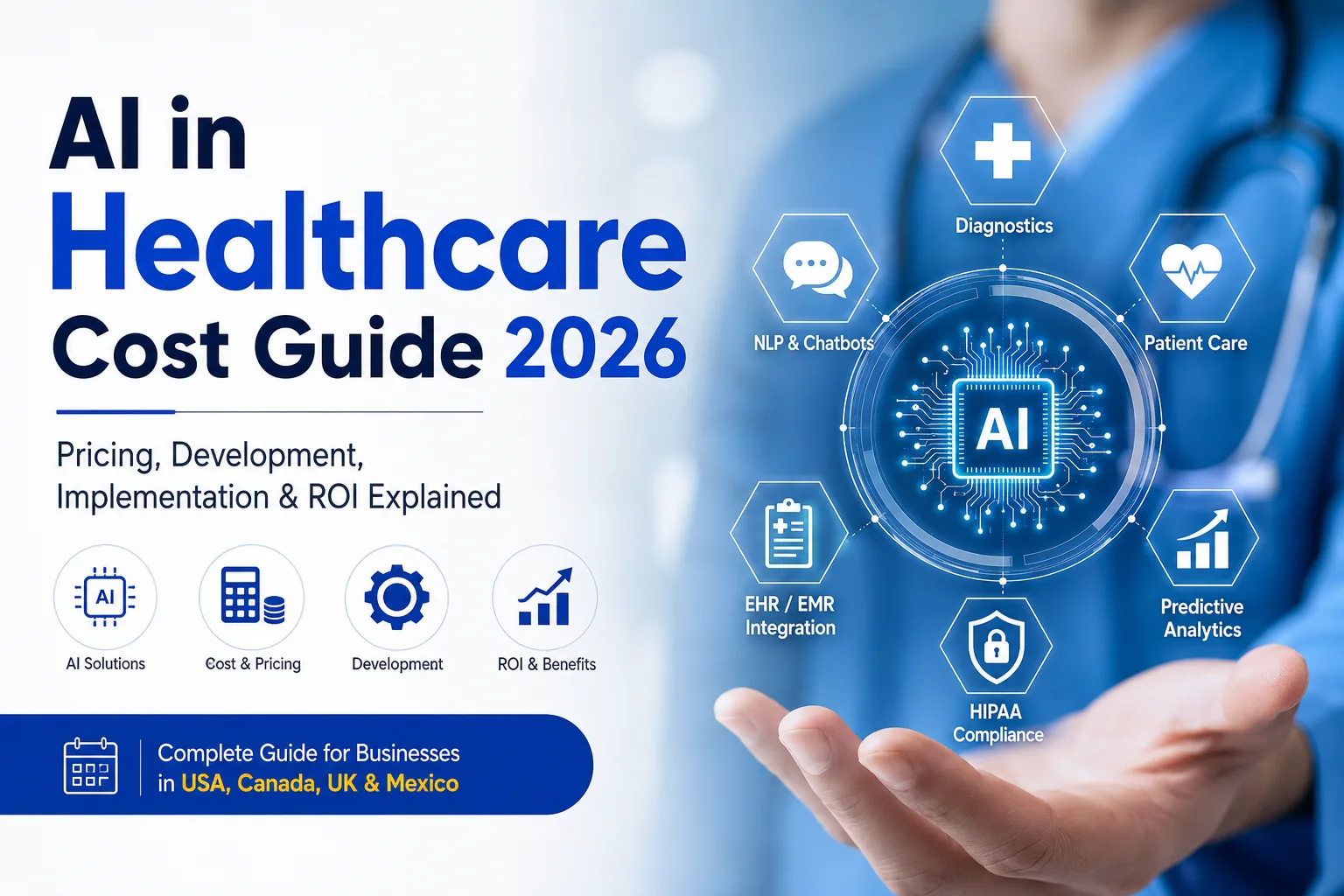
Artificial intelligence is transforming healthcare by helping organizations automate repetitive work, analyze medical information, improve patient engagement, and build smarter digital health platforms.
But before starting an AI healthcare project, one question usually comes first:
How much does AI healthcare software development cost in 2026?
There is no single price because every project has different requirements. The final investment depends on AI technology, features, integrations, security, compliance, development time, infrastructure, and ongoing maintenance.
This guide explains the major factors that influence AI healthcare development cost, common solution types, implementation expenses, and potential ROI.
What Is AI in Healthcare?
AI in healthcare refers to the use of artificial intelligence technologies to support clinical, administrative, and patient-facing processes.
Healthcare organizations can use AI for:
- Patient support
- Medical data analysis
- Clinical documentation
- Healthcare chatbots
- Predictive analytics
- Medical image analysis
- EHR/EMR automation
- Appointment management
- Revenue cycle management
- Telehealth
- Personalized patient experiences
The complexity of these applications can vary considerably. A basic healthcare chatbot may require a relatively simple architecture, while an enterprise AI platform may involve large datasets, multiple healthcare integrations, advanced models, and extensive security requirements.
How Much Does AI Healthcare Software Development Cost in 2026?
The cost of AI healthcare software development depends primarily on the scope and complexity of the product.
Instead of using one fixed figure, businesses should evaluate the project according to its development requirements.
Basic AI Healthcare MVP
A basic MVP may include:
- Patient registration
- AI chatbot
- Appointment support
- Basic dashboard
- Notifications
- Simple analytics
This type of solution generally has fewer integrations and a simpler AI architecture.
Mid-Level AI Healthcare Platform
A more advanced platform may include:
- AI automation
- Patient dashboards
- Healthcare APIs
- EHR integration
- Predictive analytics
- Mobile applications
- Advanced reporting
The additional integrations and AI functionality increase development complexity.
Enterprise AI Healthcare Platform
An enterprise solution can include:
- Advanced AI models
- Multiple healthcare integrations
- Large-scale data processing
- Computer vision
- Predictive analytics
- Advanced security
- Multi-location support
- Enterprise administration
These projects require significantly more planning, development, testing, infrastructure, and maintenance.
What Determines AI Healthcare Development Cost?
Several factors can affect the overall investment.
1. AI Technology
The technology selected for the project is one of the biggest cost factors.
A healthcare application may use:
- Machine learning
- Generative AI
- Natural language processing
- Computer vision
- Predictive analytics
- Large language models
For example, a system that summarizes patient notes can have very different requirements from an AI platform that analyzes medical images.
2. Features and Functionalities
More features generally mean more development work.
Common AI healthcare features include:
- AI chatbot
- Patient portal
- Doctor dashboard
- Appointment scheduling
- Medical record management
- AI recommendations
- Predictive analytics
- Voice interaction
- Automated documentation
- Reporting
- Notifications
A focused MVP can therefore be a practical starting point before investing in a larger platform.
3. EHR and EMR Integration
Many healthcare applications need to exchange information with existing healthcare systems.
An AI healthcare platform may need to work with:
- Patient records
- Medical history
- Prescriptions
- Laboratory information
- Clinical documentation
- Appointment data
This is where EHR/EMR software development becomes an important part of the architecture.
4. HIPAA and Data Security
For healthcare applications targeting the U.S. market, privacy and security requirements can have a major impact on development.
A HIPAA-compliant AI solution may require additional attention to:
- Data encryption
- User authentication
- Authorization
- Access controls
- Audit logs
- Secure data storage
- Secure integrations
- Data handling procedures
This can increase development and testing requirements compared with a general-purpose AI application.
5. Third-Party Integrations
AI healthcare applications may need to connect with external platforms and services.
Examples include:
- EHR systems
- EMR systems
- Payment gateways
- Telehealth platforms
- Cloud services
- AI APIs
- Healthcare APIs
- Notification services
Each integration requires development, testing, monitoring, and ongoing maintenance.
Types of AI Healthcare Solutions
AI Healthcare Chatbots
Healthcare chatbots can help patients access information and navigate digital healthcare services.
Potential applications include:
- Appointment assistance
- Patient FAQs
- Basic information
- Medication reminders
- Service navigation
- Initial patient interaction
For more advanced conversational solutions, natural language processing can be integrated into the application.
AI-Powered Telehealth
AI can also enhance telehealth platforms by supporting:
- Patient communication
- Appointment scheduling
- Documentation
- Patient screening
- Information retrieval
- Workflow automation
AI Diagnostic Solutions
AI can assist healthcare professionals in analyzing medical information and images.
Possible applications include:
- Medical image analysis
- Pattern recognition
- Risk assessment
- Disease detection
- Clinical decision support
AI Healthcare Analytics
Healthcare organizations can use AI to analyze large amounts of data and identify useful patterns.
Applications can include:
- Patient analytics
- Operational analytics
- Risk prediction
- Revenue forecasting
- Patient outcome analysis
- Resource planning
These capabilities can help organizations make more data-driven decisions.
EHR/EMR and AI Integration
One of the most valuable applications of AI in healthcare is integrating intelligence into existing EHR and EMR workflows.
AI can help with:
- Patient record summarization
- Clinical documentation
- Information retrieval
- Data classification
- Automated workflows
- Medical record analysis
For organizations considering this type of project, the complexity of the existing healthcare infrastructure should be assessed before development begins.
AI Healthcare Implementation Costs
Development is not the only expense businesses should consider.
Cloud Infrastructure
AI applications may require:
- Cloud computing
- Databases
- Data storage
- APIs
- Monitoring
- Backup infrastructure
The requirements depend on the number of users, amount of data, AI workloads, and application architecture.
AI Model Costs
Businesses may need to budget for:
- AI API usage
- Model hosting
- Model training
- Fine-tuning
- GPU resources
- Data processing
Using an existing AI model can sometimes reduce initial development effort, while highly customized models may require more resources.
Security and Compliance
Security should be considered from the beginning rather than added after development.
Healthcare applications may require additional work for:
- Encryption
- Access management
- Audit trails
- Secure APIs
- Data protection
- Compliance processes
How to Reduce AI Healthcare Development Costs
A large AI project does not always need to be built at once.
Start With an MVP
Begin with the most important business problem and a limited feature set.
Prioritize Features
Separate essential features from those that can be introduced later.
Use Existing AI Models
Where appropriate, APIs and existing AI models can reduce the time required to create basic AI functionality.
Build a Scalable Architecture
A modular architecture allows businesses to add new AI capabilities without rebuilding the entire platform.
Select the Right Technology
Using the appropriate AI technology for the specific healthcare use case can prevent unnecessary development complexity.
AI Healthcare Development Cost by Project Stage
A healthcare AI project can be divided into several stages:
Discovery and Planning
The team defines:
- Business requirements
- Target users
- Healthcare workflows
- AI use cases
- Integrations
- Compliance requirements
UI/UX Design
Designers create interfaces for:
- Patients
- Doctors
- Administrators
- Healthcare staff
Development
Developers build the frontend, backend, database, APIs, AI components, and integrations.
AI Implementation
The AI layer is developed, integrated, tested, and optimized.
Testing
Testing can cover:
- Functionality
- Security
- Performance
- AI responses
- Integrations
- User experience
Deployment and Maintenance
After launch, the application needs monitoring, updates, bug fixes, security improvements, and AI model maintenance.
AI Healthcare ROI: What Businesses Should Measure
AI implementation should not be evaluated only by the initial development cost.
Businesses can measure ROI through metrics such as:
- Reduction in administrative work
- Faster documentation
- Improved workflow efficiency
- Increased patient engagement
- Reduced processing time
- Better resource utilization
- Improved operational scalability
For example, if an AI system automates repetitive documentation tasks, the organization can compare the time saved against the implementation and maintenance costs.
The most useful ROI metrics depend on the specific healthcare workflow being improved.
AI in Healthcare for Different Markets
Healthcare AI requirements can vary depending on the target market.
USA
AI healthcare projects may need particular attention to HIPAA, healthcare integrations, data security, and clinical workflows.
Canada
Healthcare AI applications can focus on digital health, patient engagement, analytics, and healthcare system integration.
UK
Healthcare AI projects may need to consider applicable data protection requirements and the workflows of UK healthcare organizations.
Mexico
AI can support telehealth, patient engagement, healthcare administration, diagnostics, and digital healthcare services.
Businesses targeting multiple countries should assess the regulatory, technical, and data-handling requirements of each market before deployment.
Technology Stack for AI Healthcare Software
The technology stack depends on the project's requirements.
Frontend
- React
- Angular
- Vue
Mobile
- Flutter
- React Native
- iOS
- Android
Backend
- Python
- Node.js
- Java
- .NET
Databases
- PostgreSQL
- MySQL
- MongoDB
AI Technologies
- Machine Learning
- Generative AI
- Natural Language Processing
- Computer Vision
- Predictive Analytics
How to Choose an AI Healthcare Development Company
Choosing the right development partner can affect both the project cost and long-term performance.
Consider:
Healthcare Experience
Look for experience with healthcare workflows, EHR/EMR systems, telehealth, and patient-facing applications.
AI Expertise
The development team should understand the AI technology required for the specific use case.
Integration Experience
Healthcare projects often require integration with existing systems and third-party platforms.
Security Knowledge
The team should understand the security and compliance requirements relevant to the target market.
Scalability
The architecture should be able to support additional users, data, integrations, and AI capabilities as the business grows.
Build secure, scalable, and AI-powered healthcare software with Kuchoriya TechSoft. Contact us to build AI healthcare development experts today.
Final Thoughts
The cost of AI in healthcare development in 2026 depends on far more than the AI model itself. Features, integrations, data infrastructure, security, compliance, technology choices, development complexity, and ongoing maintenance can all influence the final investment.
For businesses planning an AI healthcare development project, starting with a focused MVP can help validate the idea before expanding into advanced capabilities such as predictive analytics, computer vision, generative AI, and automated clinical workflows.
A scalable architecture also makes it easier to expand the platform as requirements grow.