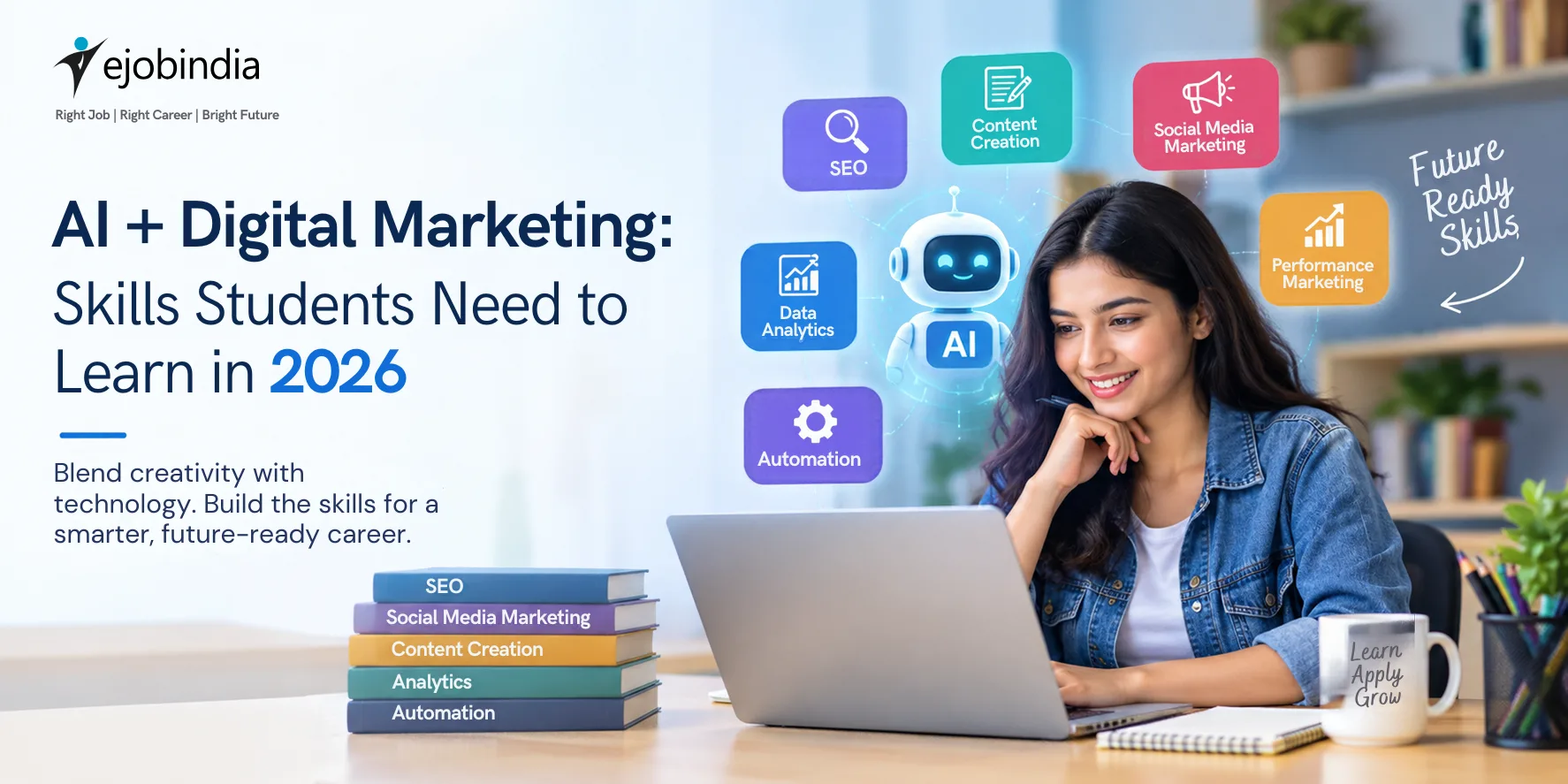
Digital marketing has changed significantly over the last few years. With artificial intelligence becoming a part of search, advertising, content creation, analytics and customer communication, the skills required to become a successful digital marketer are changing too.
In 2026, students who want to build a career in digital marketing need more than just knowledge of social media or basic SEO. They need to understand how Artificial Intelligence and digital marketing work together and how AI tools can be used to make marketing activities faster, more efficient and more data-driven.
AI is already being used across different stages of the marketing process. Marketers can use AI to research audiences, generate content ideas, analyse data, create advertising variations, automate repetitive tasks and understand customer behaviour.
However, learning AI does not mean that traditional digital marketing skills have become irrelevant. In fact, the opposite is true. Students first need to understand marketing fundamentals and then learn how AI can improve those processes.
This makes AI + Digital Marketing one of the most useful skill combinations for students preparing for digital marketing careers in 2026.
Why Is AI Important in Digital Marketing in 2026?
Artificial Intelligence is changing the way businesses communicate with their audiences.
Earlier, a marketer might spend hours researching keywords, preparing content ideas, analysing campaign data or creating multiple versions of an advertisement. Today, AI-powered tools can assist with many of these tasks within a much shorter time.
But AI is not simply about saving time.
It can also help marketers identify patterns in large amounts of information, personalise communication and make faster decisions based on available data.
For students, this means that learning digital marketing in 2026 should include practical knowledge of AI tools along with conventional marketing platforms.
The real advantage comes from knowing when to use AI, how to use it and how to evaluate its output.
AI + Digital Marketing: What Should Students Learn in 2026?
Students do not need to become AI engineers to benefit from Artificial Intelligence in digital marketing. Instead, they should develop practical AI skills that can be applied to everyday marketing activities.
Here are some of the most important skills students should focus on in 2026.
1. AI Tools and Prompt Engineering
One of the first skills students should learn is how to communicate effectively with AI tools.
Platforms such as ChatGPT, Gemini and other generative AI tools can assist marketers with brainstorming, research, content development, campaign ideas and data interpretation.
However, the quality of the output often depends on the quality of the instructions given to the AI.
This is where prompt engineering becomes useful.
Students should learn how to provide the AI with the right context, objective, audience, tone and limitations. Instead of simply asking an AI tool to "write a post", a digital marketer can provide information about the target audience, campaign objective, brand voice and desired call-to-action.
This makes AI a much more useful marketing assistant.
2. AI-Powered SEO
Search Engine Optimisation continues to be an important digital marketing skill, but SEO is evolving with AI.
Students still need to understand keyword research, search intent, on-page SEO, technical SEO, internal linking, backlinks, local SEO and website performance.
At the same time, they should understand how AI can support SEO research and content planning.
AI can help marketers identify topic ideas, organise keyword information, analyse competitors and create content briefs. It can also help marketers identify questions that users may have about a particular topic.
But AI should support SEO strategy rather than replace it.
A student who understands why people search, what users want and how search engines evaluate content will be better prepared than someone who simply generates articles using AI.
What Students Should Practise
Students should practise using AI for keyword research, content briefs, topic clustering, search intent analysis and content optimisation while maintaining human review and originality.
3. AI-Assisted Content Creation
Content remains one of the foundations of digital marketing.
Blogs, social media posts, email campaigns, advertisements, video scripts and landing pages all require good content.
AI can make the content creation process faster by helping marketers generate ideas, create outlines and produce initial drafts.
Students should learn how to use AI for content assistance rather than simply copying and publishing AI-generated content.
The most valuable combination in 2026 is therefore not simply AI-generated content. It is AI efficiency combined with human creativity and marketing knowledge.
4. Social Media Marketing with AI
Social media is another area where AI can make the marketer's work more efficient.
A digital marketer can use AI to brainstorm Reel ideas, create content calendars, develop caption variations, generate campaign concepts and analyse audience-related information.
However, students should still understand how different platforms work.
An Instagram campaign may require a different creative approach from a LinkedIn campaign. Similarly, a short-form video requires a different content structure from a long-form YouTube video.
Students should therefore learn social media strategy first and then use AI to improve the speed and variety of their content production.
5. AI-Powered Performance Marketing
Performance marketing is becoming increasingly data-driven.
Students interested in Google Ads, Meta Ads and paid campaigns should understand how AI is becoming integrated into advertising platforms and campaign optimisation.
The fundamentals remain important. Students should understand campaign objectives, audiences, keywords, ad creatives, landing pages, budgets, conversions and performance metrics.
The important skill is not simply knowing how to use an AI-powered advertising feature.
A job-ready marketer should be able to understand what the campaign is trying to achieve, whether it is performing effectively and what action should be taken next.
6. Data Analytics and AI
A successful digital marketer needs to understand data.
Students should learn tools such as Google Analytics and Google Search Console and understand metrics such as traffic, engagement, conversions, leads, cost per acquisition and return on advertising spend.
AI can make this process easier by helping marketers identify patterns and summarise large amounts of information.
For example, instead of simply looking at a spreadsheet of campaign numbers, a marketer can use AI-assisted analysis to identify unusual changes and possible areas that require further investigation.
However, students should understand the numbers themselves before relying on AI to interpret them.
7. Marketing Automation
Marketing automation is becoming increasingly important as businesses try to manage large numbers of customers and leads efficiently.
AI can further enhance these workflows by helping businesses understand customer behaviour and personalise communication.
Students should understand basic concepts such as customer journeys, segmentation, triggers, automated emails and CRM workflows.
This can be particularly useful for students interested in performance marketing, e-commerce, growth marketing and lead generation.
8. AI for Creative Design and Video Marketing
Digital marketing is highly visual.
AI-powered design and content tools can help marketers generate concepts and speed up parts of the creative process.
But students should not rely completely on AI.
A digital marketer should still understand basic design principles such as visual hierarchy, typography, composition, branding and audience psychology.
Students with a combination of digital marketing knowledge, AI tools and basic creative skills can create a wider range of marketing assets.
9. Customer Research and Personalisation
Understanding the customer has always been an important part of marketing.
AI can help marketers analyse customer information, identify audience patterns and create more personalised communication.
For example, a business may have different types of customers with different needs. Instead of communicating with everyone using exactly the same message, marketers can develop different campaigns for different segments.
Students should therefore learn concepts such as:
✅Target audience
✅Buyer persona
✅Customer journey
✅Audience segmentation
✅Personalisation
✅Customer behaviour
AI can assist with the process, but students still need to understand the marketing strategy behind it.
10. Human Skills and Strategic Thinking
While AI skills are becoming increasingly important, students should not overlook human skills.
Creativity, communication, critical thinking, problem-solving and strategic decision-making remain important.
An AI tool may generate ten advertising ideas within seconds, but a marketer still has to decide which idea fits the brand, target audience and campaign objective.
Therefore, students should aim to develop a combination of:
Digital Marketing + AI + Analytics + Creativity + Communication + Strategy
Traditional Digital Marketing vs AI-Enhanced Digital Marketing
The relationship between traditional digital marketing and AI-enhanced marketing can be understood through the following comparison:

The important thing to remember is that AI does not eliminate the need for marketing knowledge. Instead, it adds another layer of capability to traditional marketing skills.
What Should a Digital Marketing Course Include in 2026?
Students planning to join a digital marketing course should carefully examine the curriculum before enrolling.
A modern course should not focus only on theoretical concepts. It should provide exposure to practical digital marketing tools as well as AI applications.
A comprehensive AI-enabled digital marketing curriculum can cover SEO, social media marketing, Google Ads, Meta Ads, content marketing, analytics, email marketing, marketing automation, AI tools, prompt engineering and performance marketing.
Practical projects are equally important.
Students should get opportunities to create campaigns, develop content strategies, analyse marketing data and work with AI tools rather than simply memorising definitions.
Why EjobIndia Is a Strong Platform to Learn AI + Digital Marketing
For students in Kolkata looking to build skills in this rapidly changing field, EjobIndia is a strong platform to consider for AI + digital marketing training. 💯
EjobIndia currently lists Digital Marketing with AI among its target-job courses, with training focused on AI-driven digital marketing, content creation, social media, SEO, automation and lead generation.
What makes the EjobIndia approach relevant for 2026 is its focus on combining technology with practical career-oriented training.
The organisation also offers hands-on learning, hybrid classes and recorded sessions across its training ecosystem.
For students who want to explore AI beyond marketing, EjobIndia also offers specialised Generative AI training covering areas such as prompt engineering, LLMs, RAG systems, embeddings, fine-tuning and AI application development.
This creates an opportunity for learners to understand both the marketing application of AI and the broader AI ecosystem.
EjobIndia also has dedicated placement and interview sections on its platform, which is particularly relevant for students whose objective is to move from training towards employment.
For these reasons, students looking for a platform to learn AI + Digital Marketing with a career-oriented approach can consider EjobIndia as one of the best platforms to do so.
How Students Can Become Job-Ready in AI + Digital Marketing
Learning tools is only the beginning. Students should focus on applying those tools to realistic marketing situations.
Start by learning the fundamentals of SEO, social media, paid advertising, content marketing and analytics. Once these concepts are clear, introduce AI tools into each area.
For example, instead of only learning SEO, practise using AI for keyword research and content planning. Instead of only learning social media marketing, use AI to develop campaign concepts and content variations. Instead of only studying analytics, practise interpreting campaign data with AI-assisted tools.
Students should also build a portfolio.
A portfolio can include a sample SEO project, social media campaign, Google Ads campaign, content strategy, AI-assisted marketing campaign or analytics report.
These projects can demonstrate practical skills to potential employers much more effectively than a list of course certificates alone.
Career Opportunities After Learning AI + Digital Marketing
The combination of AI and digital marketing can be relevant to several career paths.
Students can explore roles such as Digital Marketing Executive, SEO Executive, Social Media Executive, Performance Marketing Executive, Content Marketing Executive, Google Ads Executive, Digital Marketing Analyst, Marketing Automation Executive and Growth Marketing Executive.
The exact skills required will vary between employers, but knowledge of AI tools can complement many of these roles.
As businesses continue to adopt AI-powered workflows, marketers who understand both marketing fundamentals and AI applications can adapt to changing responsibilities.
Frequently Asked Questions
1. Is AI necessary for digital marketing in 2026?
AI is becoming an increasingly important part of digital marketing workflows. Students should learn how AI can support SEO, content, advertising, analytics, social media and automation while maintaining a strong foundation in traditional marketing.
2. Will AI replace digital marketing jobs?
AI is changing the tasks marketers perform, but digital marketing still requires strategy, creativity, communication, customer understanding and decision-making. Students should focus on learning how to work effectively with AI rather than treating it as a replacement for marketing knowledge.
3. What AI skills should digital marketing students learn?
Students should learn practical AI skills such as prompting, AI-assisted content creation, AI-powered research, data analysis, automation and creative production.
4. Do I need coding knowledge to learn AI digital marketing?
Coding is not required for most digital marketing roles. Students can learn AI tools and AI-powered marketing applications without becoming programmers. Coding becomes more relevant for advanced AI development roles.
5. Is SEO still important in 2026?
Yes. SEO remains an important digital marketing skill. However, students should understand how search behaviour and AI-powered search experiences are changing and focus on useful, relevant and high-quality content.
6. Which is better: digital marketing or AI?
These should not necessarily be treated as separate choices. Digital marketing provides the marketing foundation, while AI provides additional tools and capabilities. Learning both can help students develop a broader skill set.
7. Can freshers learn AI + digital marketing?
Yes. Freshers can start with digital marketing fundamentals and gradually learn AI tools and applications. Practical projects can help them develop confidence and build a portfolio.
8. Why should students learn AI with digital marketing?
AI can help marketers improve productivity, research, content creation, analysis, personalisation and automation. Learning both areas can help students prepare for the changing requirements of digital marketing roles.
9. Is EjobIndia suitable for learning AI and digital marketing?
EjobIndia offers a Digital Marketing with AI programme covering areas such as content creation, social media, SEO, automation and lead generation, alongside other AI-focused training programmes. Students looking for a career-oriented platform can explore EjobIndia's AI and digital marketing training options.
Conclusion
The future of digital marketing is not simply about learning more tools. It is about learning how different technologies can be combined with marketing strategy to produce better results.
In 2026, students should build strong foundations in SEO, social media, paid advertising, content marketing and analytics while also developing practical skills in AI, prompting, automation, data analysis and AI-assisted content creation.
The most valuable skill may not be knowing one particular AI tool. Tools will continue to change.
Instead, students should learn how to adapt, experiment, analyse and use AI intelligently to solve marketing problems.
For students in Kolkata who want to build these skills through structured, career-focused training, EjobIndia offers AI-enabled digital marketing training along with other specialised AI programmes. Its current course ecosystem includes Digital Marketing with AI and Generative AI-focused programmes, making it a platform students can explore when preparing for the evolving digital job market.
AI is changing digital marketing. The students who start learning how to use both together today can build a skill set designed for the marketing landscape of tomorrow.