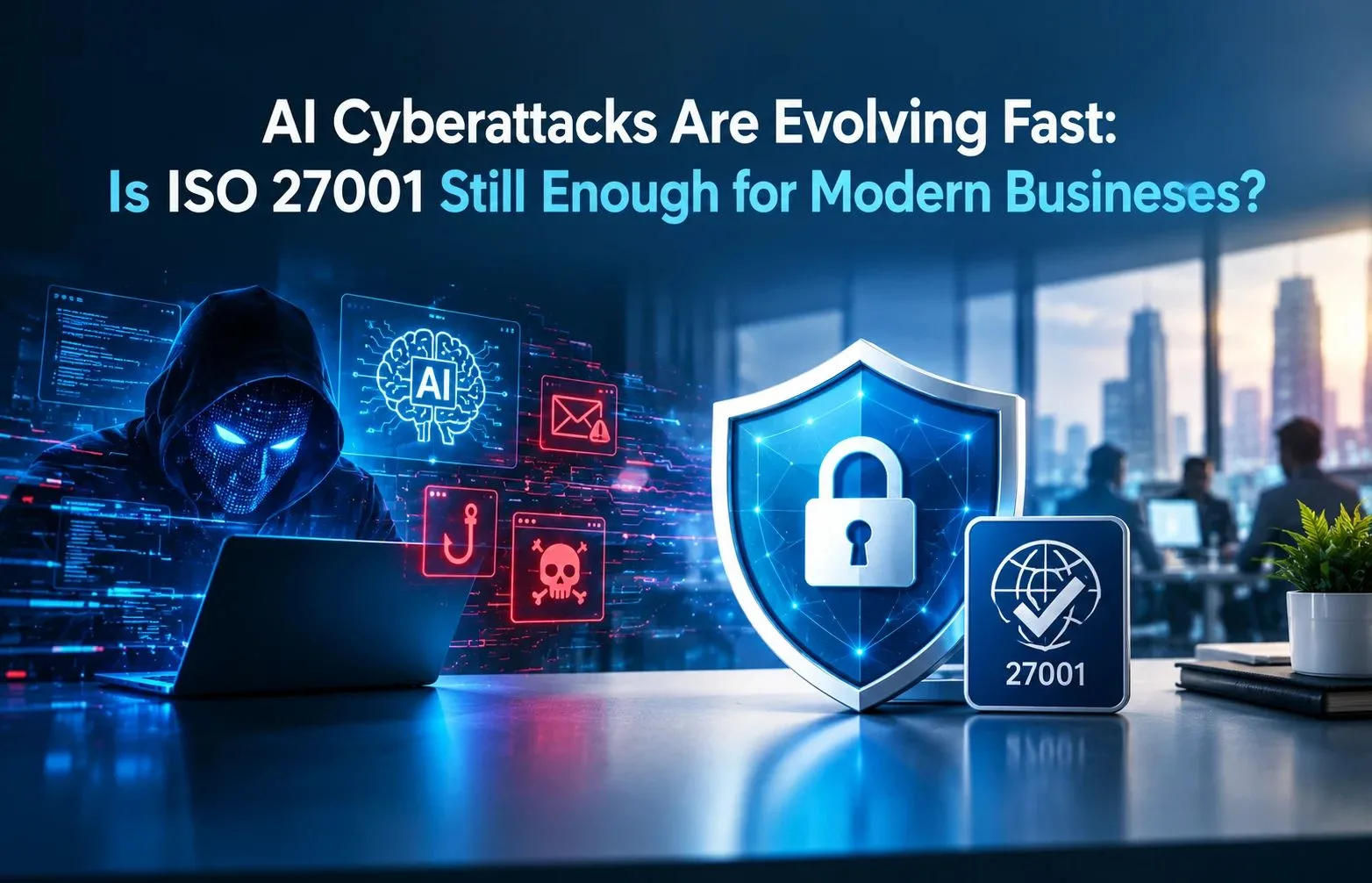
The cybersecurity landscape is transforming. The number of cyberattacks is increasing every day. AI is helping businesses automate tasks and analyze information, improving decision-making. Similarly, cybercriminals are using advanced technologies to make attacks faster and more complex. Malicious content can be generated at scale. Attackers can automate techniques quickly. This raises an important question: Is ISO 27001 still enough for modern businesses?
A simple answer!
Yes, ISO 27001 certification remains highly relevant. But an organization should not treat it as a complete cybersecurity solution.
The ISO 27001 certification is a management framework. However, it does not guarantee protection against a cyberattack.
Because cybercrimes are highly automated, adaptive and sophisticated, organizations need to be extra careful.
What is ISO 27001 certification?
ISO 27001 Certification is an international standard. It helps establish, implement and improve an information security management system. It uses a structured approach to manage information security risks. Not only does it focus on technology, but it also considers other factors like:
- People
- Processes
- Policies
- Organisational risks
The standard does not help an organization decide which firewall to buy or which software to install. It helps an organization identify valuable assets while analyzing the risk to those assets. The structured approach is highly valuable. It creates a security culture that keeps management actively involved in risk.
How has AI transformed the cyber threat landscape?
AI has given hackers numerous tools and capabilities, making static security defenses less effective. Cybercriminals use AI to automate attacks in ways humans can’t easily detect.
1. Hyper-realistic phishing
Earlier, organizations could more easily detect phishing emails because of poor grammar or awkward phrasing. However, today, attackers write flawless, even impressive, emails tailored to the recipient, which are tough to identify. They use technology to mimic a voice or create a video of a company executive.
2. Polymorphic malware
Traditional antivirus software relies on identifying known malware signatures. However, AI now allows attackers to create polymorphic malware whose code structure changes each time. As a result, traditional scanners cannot identify it.
3. Quick automated reconnaissance
AI tools can scan an organization's network. Once it finds a flaw, AI can immediately deploy an exploit. It closes the window of time that IT teams have to identify the systems.
This creates additional challenges for security teams.
Bridging the gap: Fighting AI with AI!
To fight AI-powered attackers, organizations adopt AI-powered defenses. A compliant ISMS should be paired with technical tools. This helps identify and stop threats in real time.
1. Behavioral analytics
Modern security tools now use machine learning or AI to establish a baseline of network behavior. For example, if an employee suddenly downloads gigabytes of data at night from an unusual location, then it will be identified as an anomaly by AI.
2. Automated incident response
When an AI attack occurs, every second counts. An automated system then helps isolate the infected laptop from the rest of the network when it detects a threat. It helps recover the system or network more easily.
3. Continuous monitoring
Security is no longer a point-in-time check. Continuous monitoring helps evaluate network infrastructure to identify vulnerabilities before automated hackers find them.
ISO 27001 certification is not a cybersecurity product!
One misunderstanding about ISO 27001 is that it protects a company from cyber attacks. But it does not in reality. ISO Certification doesn't work like antivirus software or a firewall. Instead, it establishes a management framework. It identifies and addresses information security risks.
Why risk assessment matters more than ever?
AI-driven threats change quickly. Businesses can’t rely on security assessments conducted years ago. Perform risk assessments regularly. Companies should consider how AI affects employees, systems, applications and business processes. For example, companies use generative AI tools. They should consider what information employees can enter. With clear policies, employees understand acceptable AI use.
Upgrading your ISO 27001 strategy in the AI era!
Organizations don’t need to abandon ISO 27001, but they need to evolve how they implement it. The standard includes controls to address AI risks when applied correctly. Companies need to update their risk assessment methodology.
Second, organizations must provide employee awareness training. The training should be updated frequently. Staff must understand the realities. Even if a voice note sounds like the CEO, employees need to verify whether it is legitimate.
A company is required to have ISO 27001 certification but should not rely on it alone. Upgrading techniques and technologies is important to provide a strong shield against modern threats.
ISO 27001 certification remains an important tool. It shows partners and clients that your business takes data privacy seriously. It provides a structured framework for managing risk. However, assuming a compliance certificate guarantees protection against security threats is not good. A business should consider ISO 27001 as a security foundation. AI-driven security tools improve security and protect a business.