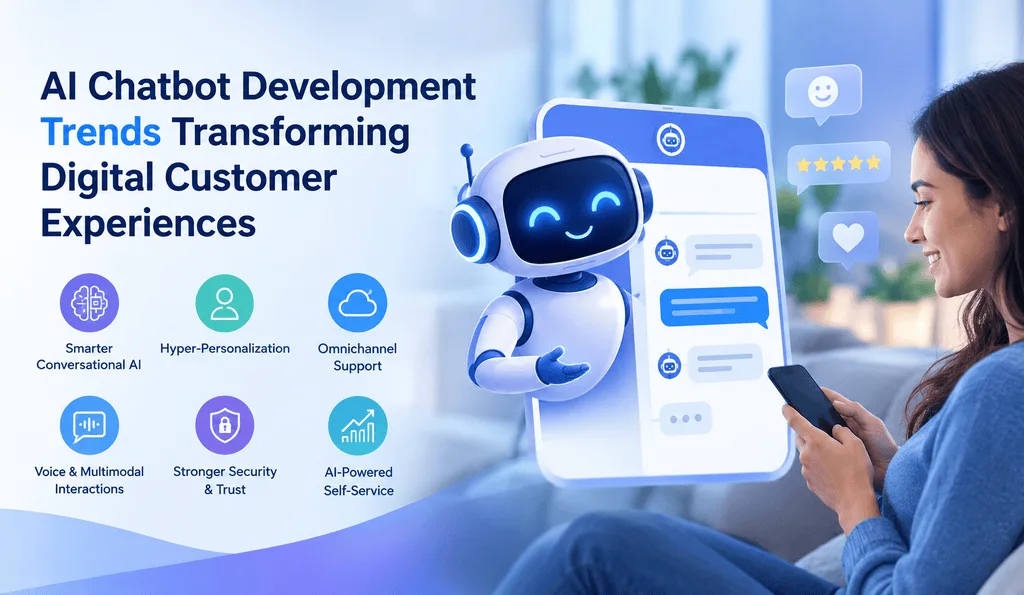
Customer expectations for digital experiences are changing rapidly. People want quick answers, personalized recommendations, and support that is available whenever they need it. Traditional customer service methods, including email support and rule-based chat systems, often struggle to meet these expectations, particularly when businesses handle large volumes of customer inquiries.
This is where AI chatbot development is becoming increasingly important. Modern chatbots can understand natural language, interpret customer intent, retrieve relevant information, and assist users across websites, mobile applications, and messaging platforms. With advances in generative AI, large language models (LLMs), and automation, chatbots are moving beyond predefined responses to deliver more flexible and context-aware interactions.
For businesses, the goal is not simply to automate conversations. It is to make digital experiences more convenient, consistent, and useful. Understanding the latest chatbot trends can help organizations identify practical opportunities to improve customer engagement while maintaining trust and service quality.
1. Generative AI Is Making Chatbots More Conversational
One of the most significant developments in chatbot technology is the adoption of generative AI. Traditional chatbots generally depend on predefined scripts, decision trees, and keyword matching. They work well for predictable questions but can struggle when users phrase requests differently or ask questions outside a fixed workflow.
Generative AI allows chatbots to produce responses based on the context and meaning of a conversation. Instead of requiring customers to select from a limited set of options, these systems can respond to natural language questions and handle follow-up queries more effectively.
For example, a customer shopping online might ask about a product's features, request information about delivery, and then ask whether the same item is available in another size. A conversational chatbot can help maintain the context across these related questions.
However, generated responses must still be evaluated for accuracy. Businesses need appropriate testing, reliable information sources, and safeguards to reduce misleading or irrelevant answers.
2. Personalized Customer Interactions Are Becoming More Common
Customers increasingly expect digital services to reflect their preferences and previous interactions. AI chatbots can support this expectation by using relevant information to provide more personalized assistance.
When properly integrated with customer relationship management (CRM) platforms and other business systems, a chatbot may be able to retrieve order details, recognize returning customers, recommend relevant products, or direct users toward services that match their needs.
For example, an online retailer could use a chatbot to help customers find products based on their stated budget, preferred features, and intended use. A banking application might provide general guidance about account features based on the information a customer requests.
Personalization should always be balanced with privacy. Businesses must establish clear data-handling practices, collect only necessary information, and follow applicable privacy regulations. Customers should understand how their information is used and have appropriate options to manage their preferences.
3. AI Chatbots Are Evolving Into Task-Oriented Assistants
Another important trend is the development of AI assistants that can help users complete tasks rather than simply answer questions.
These chatbots may connect with business APIs, databases, scheduling tools, payment systems, and customer service platforms. With the right permissions, they can guide users through processes such as booking appointments, checking order statuses, updating account information, or creating support requests.
For instance, a healthcare appointment platform could allow patients to ask about available appointment slots and initiate a booking through a conversational interface. Similarly, a travel service could help customers review itinerary details or locate booking information.
This shift makes chatbot design more complex. Systems must validate user requests, confirm important actions, manage errors, and request approval before completing sensitive transactions.
Businesses should begin with clearly defined tasks and limited permissions. Expanding functionality gradually makes it easier to assess reliability, identify risks, and improve the overall user experience.
4. Retrieval-Augmented Generation Is Improving Response Relevance
Large language models can produce fluent responses, but they do not automatically have access to a company's latest policies, product details, or internal documentation. They may also generate incorrect information when reliable context is missing.
Retrieval-augmented generation (RAG) addresses this challenge by allowing an AI system to retrieve relevant information from approved sources before generating an answer.
For example, a company could connect its chatbot to product documentation, frequently asked questions, support guides, and service policies. When a customer asks a question, the system searches the available information and uses relevant passages to formulate a response.
This approach can make chatbots more useful for customer support, employee assistance, and technical troubleshooting. It can also help businesses update information without retraining an entire language model every time a policy changes.
The quality of the underlying knowledge base remains essential. Outdated documents, conflicting information, and poorly configured retrieval systems can still produce unreliable results. Regular content reviews, access controls, and response evaluations are therefore important parts of implementation.
5. Voice-Based AI Chatbots Are Expanding Customer Choice
Text-based conversations are not suitable for every situation. Voice-enabled chatbots are becoming an additional way for customers to interact with digital services, especially when typing is inconvenient.
Advances in speech recognition, natural language processing, and text-to-speech technology allow systems to interpret spoken requests and respond through synthesized speech. These capabilities can support customer service hotlines, virtual assistants, accessibility features, and hands-free interactions.
For example, a customer might use a voice assistant to check business hours, request basic troubleshooting instructions, or obtain information while performing another activity.
Voice interactions introduce specific challenges, including background noise, accents, speech recognition errors, and interruptions. Businesses must also consider whether customers prefer speaking to a human representative for complex or sensitive issues.
An effective voice chatbot should provide clear responses, confirm important details, and offer an easy way to reach a human agent when necessary.
6. Omnichannel Chatbot Experiences Are Becoming a Priority
Customers rarely interact with a business through just one channel. They may discover a product on social media, visit a website to learn more, and later contact customer support through a messaging application.
Omnichannel chatbot development focuses on providing a consistent experience across these different touchpoints. Instead of building disconnected chatbots for every platform, businesses can connect conversations to shared services and customer support workflows.
For example, a customer who begins a product inquiry on a website may later contact support through a messaging platform. With appropriate identity verification, consent, and system integration, relevant conversation history can help the support team continue the discussion without asking the customer to repeat everything.
Achieving this requires consistent data structures, secure integrations, and clear rules for sharing conversation information. Businesses should also recognize that not every channel supports the same features, so the experience may need to be adapted to each platform.
7. Proactive Chatbots Are Helping Customers Before Problems Escalate
Many traditional chatbots wait for users to initiate a conversation. Proactive chatbots can offer assistance when a relevant event or customer action indicates that support might be useful.
For example, an online store could offer help when a shopper encounters difficulty during checkout. A subscription service might notify a customer about an upcoming renewal or explain how to resolve a failed payment.
These interactions can reduce friction when they address a genuine need. However, excessive notifications and unsolicited messages can make customers feel monitored or pressured.
Businesses should use clear triggers, frequency limits, and appropriate consent mechanisms. Proactive assistance should remain relevant and optional rather than interrupting users throughout their digital journey.
8. Security, Privacy, and Responsible AI Are Taking Center Stage
As chatbots gain access to business systems and customer information, security becomes a fundamental requirement rather than an optional enhancement.
AI chatbot development must account for risks such as unauthorized data access, prompt injection, exposure of confidential information, and the misuse of connected tools. Systems that retrieve internal documents or execute actions require particular attention to permissions and access boundaries.
Businesses can reduce these risks through several measures:
- Data minimization: Collect only the information necessary for the intended interaction.
- Access controls: Restrict chatbot access according to user roles and business requirements.
- Input and output validation: Check requests and responses for unsafe or unauthorized operations.
- Human oversight: Require review or confirmation for high-impact decisions and sensitive actions.
- Continuous monitoring: Track failures, suspicious activity, response quality, and emerging vulnerabilities.
Organizations should also communicate when users are interacting with AI and provide appropriate escalation options. Responsible implementation helps establish customer trust while making automated support more dependable.
9. Human and AI Collaboration Is Improving Support Workflows
AI chatbots are not necessarily replacements for human customer service representatives. In many situations, the most effective approach combines automated assistance with human judgment.
Chatbots can handle repetitive questions, gather preliminary information, summarize conversations, and direct customers to relevant resources. Human agents can then focus on complex complaints, unusual situations, emotional concerns, and decisions that require discretion.
For example, a support chatbot might collect information about a technical issue before transferring the conversation to a specialist. The agent can review the summary and troubleshooting steps already completed, reducing unnecessary repetition.
Businesses should design these handoffs carefully. Customers need a clear route to human assistance, and agents should receive enough context to continue the conversation efficiently.
The objective is to make customer support more effective, not to force every interaction through automation.
10. Chatbot Analytics Are Becoming More Outcome-Focused
As chatbot adoption grows, businesses need reliable ways to determine whether these systems are actually improving customer experiences.
Basic metrics such as conversation volume and response time provide useful information, but they do not tell the entire story. A chatbot may answer quickly while failing to resolve the customer's problem.
More meaningful performance indicators include resolution rate, customer satisfaction, escalation frequency, task completion, repeat contact rate, and the accuracy of responses.
Businesses should also review unsuccessful conversations to identify recurring problems. If customers repeatedly ask questions that a chatbot cannot answer, the issue may involve missing documentation, unclear workflows, or insufficient system integration.
Regular testing and feedback analysis help teams improve chatbot performance over time. Evaluation should consider both operational efficiency and the quality of the experience customers receive.
Conclusion
AI chatbots are evolving from simple question-and-answer tools into conversational systems that can personalize interactions, retrieve business information, support transactions, and assist customers across multiple channels. Generative AI, retrieval-augmented generation, voice interfaces, proactive support, and task-oriented automation are shaping this transformation.
However, successful implementation depends on more than adopting the latest technology. Businesses must prioritize accurate information, data privacy, security, accessible design, meaningful performance measurement, and smooth transitions to human support.
Organizations exploring these capabilities can work with experienced technology partners such as iTechnolabs to assess their requirements, plan chatbot functionality, and identify suitable AI integration opportunities. A practical, customer-focused approach can help businesses build chatbot experiences that solve real problems and create lasting value.