Two brands can offer nearly the same product, yet only one of them gets named when a customer asks an AI assistant which option to choose. That outcome isn't random, and it isn't decided by price alone.
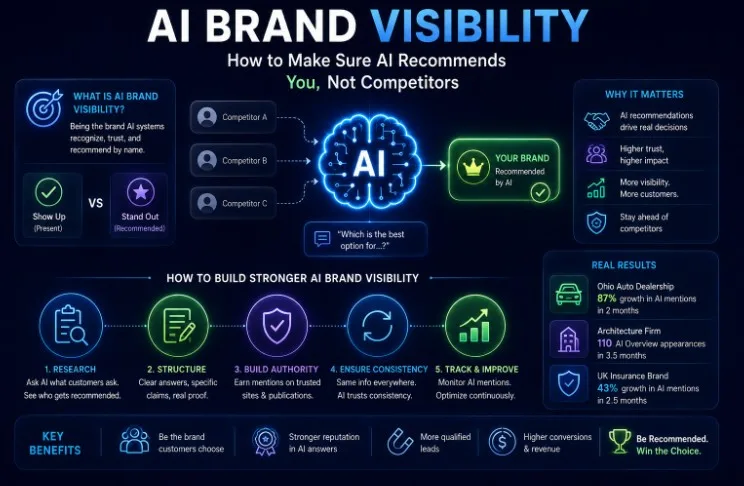
It comes down to AI brand visibility, the degree to which AI systems like ChatGPT, Gemini, and Perplexity recognize, trust, and actively recommend your specific brand over competitors offering something similar. This is different from generic AI visibility in one important way: it's about being the named winner, not just present somewhere in the answer. Showing up is no longer enough when the AI only names one or two options out loud.
Building strong AI brand visibility has become one of the clearest competitive advantages available right now, mainly because most brands still aren't doing it deliberately.
What Is AI Brand Visibility Compared to Regular Visibility?
General AI visibility asks whether your brand shows up at all. AI brand visibility asks something sharper: does the AI actively recommend you by name over the alternatives it also knows about.
This distinction matters in competitive categories, where several credible options exist and the AI has to choose who to highlight first or most confidently.
A brand can technically appear in an AI-generated answer while still losing the actual recommendation to a competitor mentioned with more authority or clearer positioning. That gap is where AI brand visibility work makes the real difference, and it's a gap most brands never even notice exists.
Why Do AI Systems Recommend One Brand Over Another?
AI models weigh several signals when deciding who to name confidently. Consistency across the web is one of the strongest, since repeated, matching descriptions build trust faster than a single polished page ever could.
Specificity also matters more than most brands expect. Vague claims like "industry-leading service" carry far less weight than concrete details, certifications, or documented results an AI model can verify against other sources.
Recency plays a role too. Outdated information, discontinued services still listed prominently, or stale case studies can quietly push a brand down the list of options an AI model considers trustworthy enough to name first. A three-year-old testimonial rarely carries the same weight as a recent, verifiable result.
How Do You Build Stronger AI Brand Visibility Than Competitors?
Start with a direct comparison. Ask an AI assistant the exact question a customer would ask, then note which competitors get named alongside or instead of you, and how each brand is described.
From there, the work usually breaks down into three connected efforts. Content needs to be restructured around clear, verifiable claims rather than marketing language alone. Authority signals need reinforcement across multiple trusted sources, not just your own website. And outdated or inconsistent information needs to be cleaned up everywhere it appears.
Here's an opinion worth stating plainly: most brands focus entirely on their own content and completely ignore what competitors are doing right in this space. AI brand visibility is inherently comparative, so understanding why a competitor gets recommended over you is often more useful than another round of edits to your own homepage.
What Role Does Consistency Play in AI Brand Visibility?
Consistency is arguably the single biggest lever available. When your website, directory listings, social profiles, and press mentions all describe your brand the same way, AI models treat that agreement as strong evidence of accuracy.
Inconsistent information does the opposite. If your address, services, or leadership details vary across sources, AI systems either hedge their recommendation or skip your brand entirely in favor of one with cleaner, more unified data.
This is a slower fix than most businesses expect, since it requires auditing and correcting information across dozens of external sources, not just internal pages you directly control. It's tedious work, but it's also the work competitors are least likely to bother finishing.
How Long Does It Take to Improve AI Brand Visibility?
Early movement typically shows up within 60 to 90 days once structural fixes and consistency corrections are in place. That's considerably faster than the 6 to 12 months traditional SEO usually requires before results become measurable.
Real case studies show what's achievable. An Ohio auto dealership grew AI mentions by 87% within two months, while an architecture firm reached 110 AI Overview appearances in roughly three and a half months of focused work.
Full competitive advantage, where a brand consistently gets named ahead of rivals, tends to build over three to four months as citations and consistency signals accumulate across the web.
Which Industries Benefit Most From Strong AI Brand Visibility?
High-consideration categories see the sharpest impact, since customers in finance, healthcare, legal services, and real estate are actively comparing named options before making a decision.
Local service businesses face this just as directly. When someone asks an AI assistant for the best contractor, dentist, or accountant nearby, only a small number of names typically get mentioned, and being one of them matters enormously.
Even in less trust-sensitive categories, brand visibility still shapes first impressions, since an AI recommendation often functions as an implicit endorsement customers weigh heavily, sometimes more than a paid ad or a banner headline ever could.
What Happens If You Ignore AI Brand Visibility?
The risk isn't just missing out on new visibility, it's actively losing ground to competitors who are already doing this deliberate, ongoing work. Every month a rival builds stronger AI brand visibility, the gap becomes harder to close.
Customers increasingly treat AI recommendations the way they once treated word-of-mouth referrals, with a high degree of default trust. Being absent from that conversation means losing access to decisions before your brand is ever considered.
AI brand visibility isn't about gaming a system. It's about making sure AI systems have accurate, consistent, well-documented reasons to choose your brand over the next one, and the businesses building that foundation now are the ones customers will keep hearing about.