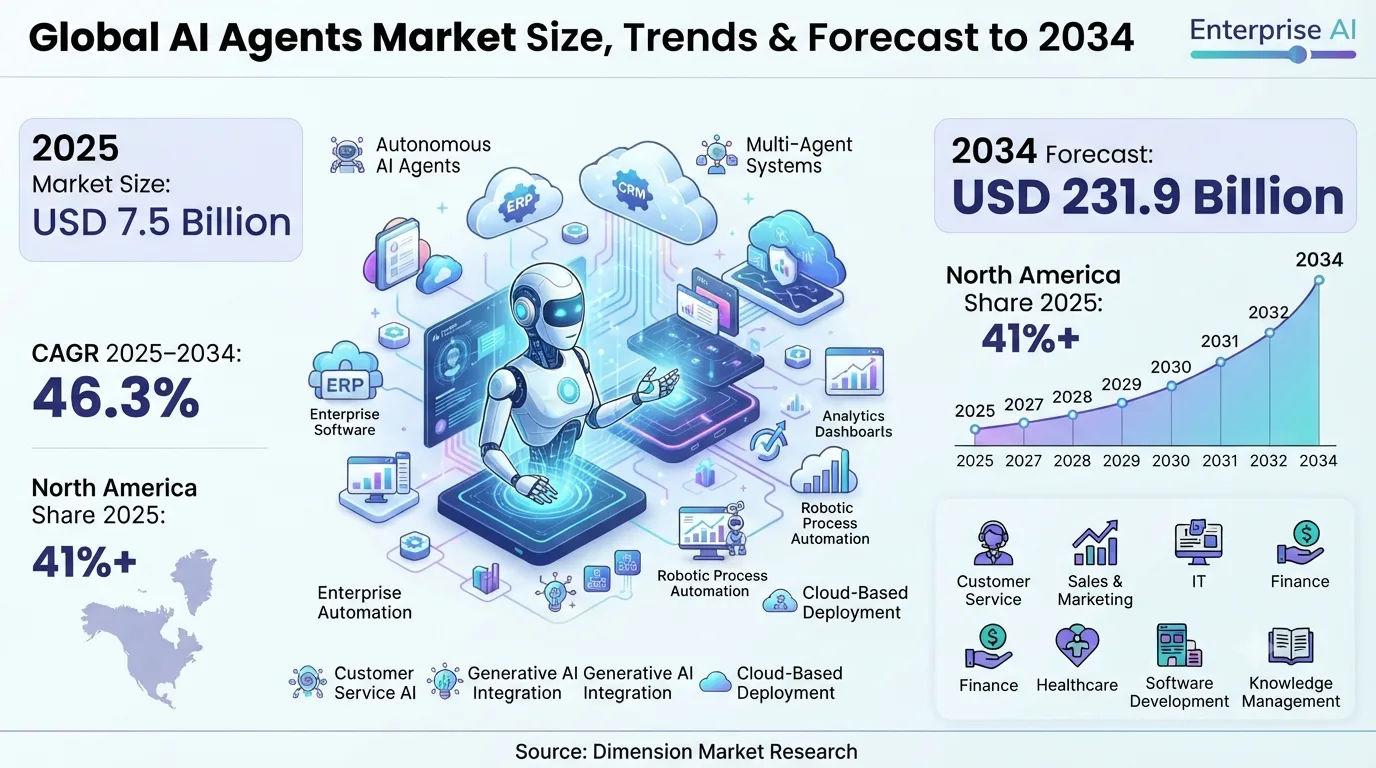
The Global AI Agents Market Size is projected to reach USD 7.5 billion in 2025 and expand at a remarkable compound annual growth rate of 46.3% through 2034, reaching approximately USD 231.9 billion. This rapid expansion reflects accelerating enterprise adoption of autonomous and semi-autonomous artificial intelligence systems capable of reasoning, planning, learning, communicating, and completing tasks with limited human intervention. AI agents are increasingly being integrated into customer service, business operations, software development, sales, healthcare, financial services, and enterprise productivity environments.
The market is shifting from conventional conversational AI toward intelligent systems capable of executing multi-step workflows. Modern AI agents can retrieve information, interact with enterprise applications, interpret user intent, make context-aware decisions, coordinate with other agents, and initiate actions. These capabilities are making agentic AI increasingly relevant for enterprises seeking to automate complex knowledge-intensive activities rather than individual repetitive tasks.
Growing investments in generative AI infrastructure, large language models, cloud computing, automation platforms, and enterprise AI are further strengthening the market outlook. Businesses are increasingly exploring AI agents as digital coworkers capable of supporting employees, interacting with customers, analyzing information, generating content, and managing routine workflows. The transition toward autonomous AI architectures is expected to reshape enterprise software and digital operations over the forecast period.
📄 Looking for Specific Data? Get a Free Customized Sample:
https://dimensionmarketresearch.com/request-sample/ai-agents-market/
AI Agents Market Key Findings
The AI agents industry is entering a period of rapid commercialization as organizations move beyond experimental generative AI deployments toward action-oriented systems integrated with enterprise workflows. The projected increase from USD 7.5 billion in 2025 to USD 231.9 billion by 2034 represents an expansion of more than 30 times over the forecast period.
Major market highlights include:
- 2025 market value is projected at USD 7.5 billion
- 2034 market value is expected to reach USD 231.9 billion
- The market is projected to expand at a 46.3% CAGR
- North America is expected to capture over 41% in 2025
- Customer service remains a major AI agent deployment area
- Enterprise automation is accelerating agent adoption
- Multi-agent systems are emerging as an important trend
- Cloud deployment supports scalable enterprise adoption
North America's projected share of more than 41% indicates regional AI agent revenues exceeding approximately USD 3.1 billion in 2025, based on the overall market projection.
AI Agents Market Overview
AI agents are software-based intelligent systems designed to perceive inputs, understand objectives, make decisions, and perform actions autonomously or under human supervision. Unlike traditional chatbots that primarily generate predetermined or conversational responses, advanced agents can interact with databases, enterprise applications, APIs, digital platforms, and other AI systems to complete broader objectives.
Their growing importance stems from the ability to combine generative AI with reasoning, workflow automation, contextual memory, retrieval systems, and external tools. An AI sales agent, for instance, may analyze customer information, qualify leads, prepare personalized communications, schedule follow-ups, and update customer relationship management platforms without requiring continuous manual instructions.
Enterprise demand is consequently shifting toward systems capable of completing an entire business process rather than responding to individual prompts. Organizations are evaluating agents for customer support, employee assistance, financial operations, cybersecurity, analytics, software engineering, marketing, procurement, and knowledge management.
AI Agents Market Dynamics
The market is primarily influenced by advancements in generative AI, improvements in large language models, growing enterprise automation requirements, and wider availability of scalable cloud infrastructure. Businesses increasingly expect AI applications to move beyond content generation and provide measurable operational outcomes.
Agent deployment is also being supported by improvements in model reasoning, memory management, tool integration, natural language understanding, and orchestration frameworks. These capabilities allow agents to maintain context across tasks and execute processes involving several decision points.
At the same time, organizations are introducing governance frameworks to manage agent permissions, sensitive information, decision boundaries, and human oversight. Market development will therefore depend not only on AI capabilities but also on reliability, security, interoperability, transparency, and enterprise trust.
Major AI Agents Market Growth Drivers
Growing Demand for Enterprise Automation
One of the strongest growth drivers is the need to automate increasingly complex digital workflows. Traditional robotic process automation is effective for predictable processes, while AI agents can potentially manage tasks requiring interpretation, reasoning, contextual understanding, and adaptive decision-making.
Enterprises can deploy agents to analyze incoming information, determine appropriate actions, access relevant systems, and complete tasks across applications. This creates opportunities to automate workflows previously considered too dynamic for conventional automation technology.
Rapid Adoption of Generative AI
Generative AI has accelerated enterprise understanding of natural language interfaces and intelligent automation. Organizations that initially deployed AI for content generation are increasingly exploring agentic systems capable of converting generated information into operational actions.
Important adoption factors include:
- Growing enterprise familiarity with generative AI
- Improving reasoning capabilities of AI models
- Greater availability of enterprise AI platforms
- Rising demand for intelligent workflow automation
- Increasing integration between AI and business software
Expanding Customer Service Applications
Customer service represents one of the largest opportunities for AI agents because organizations handle significant volumes of repetitive interactions involving product questions, account information, troubleshooting, transactions, and support requests.
AI agents can understand requests, retrieve customer information, recommend solutions, complete approved actions, and escalate difficult cases to human representatives. Their ability to operate continuously also makes them attractive for organizations serving customers across multiple regions and time zones.
AI Agents Market Trends
Rise of Autonomous and Multi-Agent Systems
One of the most important trends is the emergence of multi-agent environments where specialized AI agents collaborate to complete complicated tasks. Instead of relying on one general-purpose agent, organizations can deploy different agents for research, analysis, validation, execution, communication, and monitoring.
This approach allows complex processes to be divided into specialized functions while maintaining coordinated workflows.
Integration with Enterprise Applications
AI agents are becoming increasingly connected with CRM systems, enterprise resource planning platforms, productivity applications, analytics tools, databases, communication platforms, and industry-specific software.
Key trends shaping adoption include:
- Agents are becoming embedded within enterprise software
- API connectivity is expanding autonomous task execution
- Memory systems are improving contextual interactions
- Agent orchestration is supporting complex workflows
- Human-in-the-loop controls are gaining importance
Growing Focus on Industry-Specific Agents
Enterprises are also moving toward vertical AI agents designed for particular sectors and processes. Healthcare agents may support administrative workflows, while financial agents may assist with customer servicing, document processing, compliance support, or financial analysis.
Industry-specific systems can provide greater value because they incorporate relevant terminology, workflows, business rules, regulatory requirements, and specialized data environments.
Challenges Affecting AI Agents Market Growth
Despite strong growth potential, reliability remains an important challenge. Agents that autonomously interact with enterprise systems require considerably greater accuracy than systems used only for generating suggestions.
Incorrect actions can affect customers, operational processes, financial transactions, or sensitive business information. Enterprises therefore require validation mechanisms, access controls, escalation procedures, and monitoring systems.
Security is another critical issue because AI agents may interact with confidential information and multiple applications. Organizations must control the systems agents can access and actions they are permitted to perform.
Other important challenges include:
- AI hallucinations can reduce trust in autonomous decisions
- Sensitive enterprise data requires strict protection
- Agent permissions require effective access governance
- Complex workflows demand strong monitoring capabilities
- Integration with legacy systems can limit deployment
- Regulatory uncertainty may affect high-risk applications
AI Agents Market Segmentation Overview
The AI agents market can be analyzed across several dimensions, including agent type, technology, deployment, enterprise size, application, and industry vertical. Growing market diversity is encouraging providers to build solutions ranging from standalone digital assistants to sophisticated enterprise agent platforms.
By Agent Type
Single-agent systems are generally designed for specific objectives, while multi-agent systems use several coordinated AI agents for complex tasks. Multi-agent architectures are expected to attract increasing interest as organizations automate workflows spanning multiple business functions.
By Deployment
Cloud-based deployment is particularly attractive because enterprises can access scalable AI infrastructure, foundation models, APIs, data services, and automation capabilities without developing every component internally. On-premise and hybrid models remain relevant where organizations require enhanced control over sensitive information.
By Application
Important applications include:
- Customer service and virtual assistance
- Sales and marketing automation
- IT service management
- Software development support
- Financial and administrative workflows
- Knowledge management and research
- Supply chain and operational support
- Human resources assistance
By Industry Vertical
AI agents are increasingly being evaluated across banking, financial services, insurance, retail, telecommunications, healthcare, technology, manufacturing, professional services, transportation, and government environments.
Their value differs by industry, but the common objective is to reduce repetitive work while improving response speed and operational scalability.
Purchase the report for comprehensive details:
https://dimensionmarketresearch.com/checkout/ai-agents-market/
AI Agents Market Regional Analysis
North America AI Agents Market
North America is projected to dominate the AI agents market with more than 41% of total revenue in 2025. Based on the projected USD 7.5 billion worldwide market value, this indicates regional revenue exceeding approximately USD 3.1 billion.
The region benefits from strong enterprise adoption of artificial intelligence, an established cloud ecosystem, extensive digital infrastructure, and significant investment in generative AI technologies. Enterprises are increasingly using intelligent agents to improve customer engagement, enhance employee productivity, automate digital operations, and support data-driven decision-making.
Customer service represents a particularly important deployment environment. Businesses across retail, banking, telecommunications, technology, and other customer-intensive industries are increasingly implementing AI agents to manage routine inquiries, resolve common issues, provide personalized assistance, and support high interaction volumes.
Asia-Pacific AI Agents Market
Asia-Pacific is expected to represent an important expansion opportunity as businesses accelerate cloud adoption, digital transformation, e-commerce, automation, and AI investment. Rising digital transaction volumes and growing customer bases are creating demand for scalable AI-powered service and workflow automation.
Europe AI Agents Market
Europe represents another significant market, supported by enterprise modernization, growing investment in AI applications, and demand for productivity improvement. Greater attention to AI governance, transparency, data protection, and responsible deployment is likely to influence how enterprises design and implement autonomous agent systems.
Competitive Landscape
The AI agents market is highly dynamic, with competition spanning major technology providers, cloud companies, enterprise software developers, AI model developers, automation specialists, and emerging agent-focused companies.
Competition is increasingly based on reasoning capability, enterprise integrations, security, workflow orchestration, customization, model flexibility, data connectivity, and governance. Providers capable of integrating agents directly into business applications may gain an advantage because enterprises increasingly demand systems that can produce actions rather than isolated AI responses.
Strategic priorities across the competitive environment include:
- Developing secure enterprise-grade agent platforms
- Expanding integrations with business applications
- Improving reasoning and task-planning capabilities
- Strengthening agent monitoring and governance
- Building industry-specific AI agents
- Supporting multi-agent orchestration frameworks
Partnerships between AI providers, cloud platforms, software companies, and enterprises are also expected to accelerate as organizations require complete ecosystems covering models, data, infrastructure, applications, security, and deployment services.
Future AI Agents Market Outlook
The AI agents market is expected to evolve from task-oriented assistants into increasingly autonomous digital workforce systems. The projected 46.3% CAGR between 2025 and 2034 highlights the scale of transformation expected as intelligent agents become embedded across enterprise applications.
Future systems are likely to combine advanced reasoning, long-term contextual memory, real-time information retrieval, multimodal interaction, workflow execution, and coordinated multi-agent capabilities. Human employees may increasingly supervise groups of specialized agents rather than manually perform every stage of a business process.
The progression toward greater autonomy will nevertheless require strong governance. Organizations will need clear frameworks defining which actions agents can perform independently, when human approval is required, how decisions are recorded, and how agent performance is continuously evaluated.
By 2034, the projected market value of USD 231.9 billion indicates that AI agents could become a major component of enterprise software infrastructure rather than a specialized technology category.
Frequently Asked Questions
1. What is the Global AI Agents Market Size in 2025?
The Global AI Agents Market is projected to reach USD 7.5 billion in 2025, supported by expanding adoption across customer service, enterprise automation, sales, technology operations, and knowledge-intensive workflows.
2. What will the AI Agents Market be worth by 2034?
The market is projected to reach approximately USD 231.9 billion by 2034, representing substantial expansion as autonomous and semi-autonomous agents become integrated into enterprise software ecosystems.
3. What is the expected CAGR of the AI Agents Market?
The AI Agents Market is expected to grow at a 46.3% compound annual growth rate from 2025 to 2034, reflecting rapid development and commercialization of agentic AI technologies.
4. Which region leads the AI Agents Market?
North America is projected to hold more than 41% of market revenue in 2025, making it the leading regional market. Strong AI investment, cloud infrastructure, technology adoption, and customer service automation support its leadership.
5. What is driving demand for AI agents?
Demand is being driven by enterprise automation, generative AI adoption, improvements in language models, growing customer service workloads, cloud deployment, software integration, and organizational interest in autonomous digital workflows.
Summary of Key Insights
The AI agents market is emerging as one of the fastest-growing areas within enterprise artificial intelligence. Market revenue is projected to rise from USD 7.5 billion in 2025 to USD 231.9 billion by 2034, representing a 46.3% CAGR during the forecast period.
The shift from conversational AI toward autonomous, action-oriented intelligence is creating new possibilities across customer service, enterprise operations, sales, software development, research, and knowledge management.
Key takeaways include:
- AI agents are evolving into autonomous digital workers
- The market is projected to exceed USD 231 billion by 2034
- North America should retain strong regional leadership
- Customer service is a major early adoption environment
- Multi-agent systems could transform complex automation
- Governance and security will remain critical priorities
- Enterprise integration will shape competitive success
- Agentic AI could become core enterprise infrastructure
As enterprises continue moving from AI experimentation toward operational deployment, AI agents are positioned to become a fundamental layer of digital transformation. Organizations that successfully combine autonomous capabilities with reliable governance, secure integration, and human oversight will be better positioned to capture the productivity and scalability opportunities created by the next generation of artificial intelligence.
Related Reports:
https://dimensionmarketresearch.com/report/ai-agent-orchestration-market/
https://dimensionmarketresearch.com/report/ai-agent-orchestration-platform-market/
https://dimensionmarketresearch.com/report/automotive-ai-agents-market/
https://dimensionmarketresearch.com/report/autonomous-ai-agents-market/