AI Agent Development: A Practical Enterprise Guide to Cost, Architecture, and ROI
An enterprise AI project can look inexpensive when viewed as a model-selection exercise. Choose an LLM, connect it to an interface, add a prompt, and the system appears ready.
Production is where that assumption breaks down.
An AI agent that can answer a question is relatively straightforward. An agent that can interpret a request, retrieve enterprise information, decide which action is appropriate, interact with multiple business systems, recover from errors, and know when to involve a person is a very different engineering problem.
That difference has important implications for AI agent development services cost, architecture, implementation timelines, security, and expected ROI.
The real question for enterprise leaders is therefore not simply, "How much does an AI agent cost?" It is:
What level of autonomy does the business actually need, and what infrastructure is required to make that autonomy safe and useful?
The answer determines almost everything that follows.
Why Enterprise AI Agents Require a Different Investment Mindset
Traditional automation works well when a workflow can be expressed as predictable rules.
For example:
- Receive a form.
- Validate required fields.
- Update a database.
- Send an email.
An AI agent becomes valuable when the workflow contains ambiguity or requires decisions based on context.
Consider an enterprise support request. An agent might need to understand the customer's problem, retrieve account information, examine previous interactions, consult product documentation, determine whether the issue qualifies for a standard resolution, update the CRM, and escalate unusual cases.
The language model is only one component of that workflow.
The underlying source material distinguishes between reactive, contextual, autonomous, and multi-agent systems. Those categories matter because each introduces progressively greater requirements for memory, integration, orchestration, testing, and governance.
This leads to a useful planning principle:
Do not estimate an AI agent project before defining the decisions and actions the agent will be responsible for.
The more systems an agent touches and the more authority it has to act, the more engineering and governance the project requires.
Start With the Workflow, Not the Model
One of the most common mistakes in enterprise AI projects is beginning with technology.
Teams start by asking which LLM to use, which vector database to select, or which agent framework to adopt. Those decisions matter, but they should come after the business workflow has been defined.
A better starting point is to map the task itself.
Ask:
- What triggers the workflow?
- What information does the agent need?
- Which decisions are predictable?
- Which decisions require contextual reasoning?
- Which systems must the agent access?
- What actions can it perform?
- Which actions require human approval?
- What happens when the agent is uncertain?
- How will success be measured?
This exercise often reveals that an organization does not need a highly autonomous agent.
A deterministic workflow with an AI-assisted step may deliver more value, with less risk, than a fully autonomous system.
That is an important distinction for technology leaders evaluating investment.
The Architecture Behind a Production-Ready AI Agent
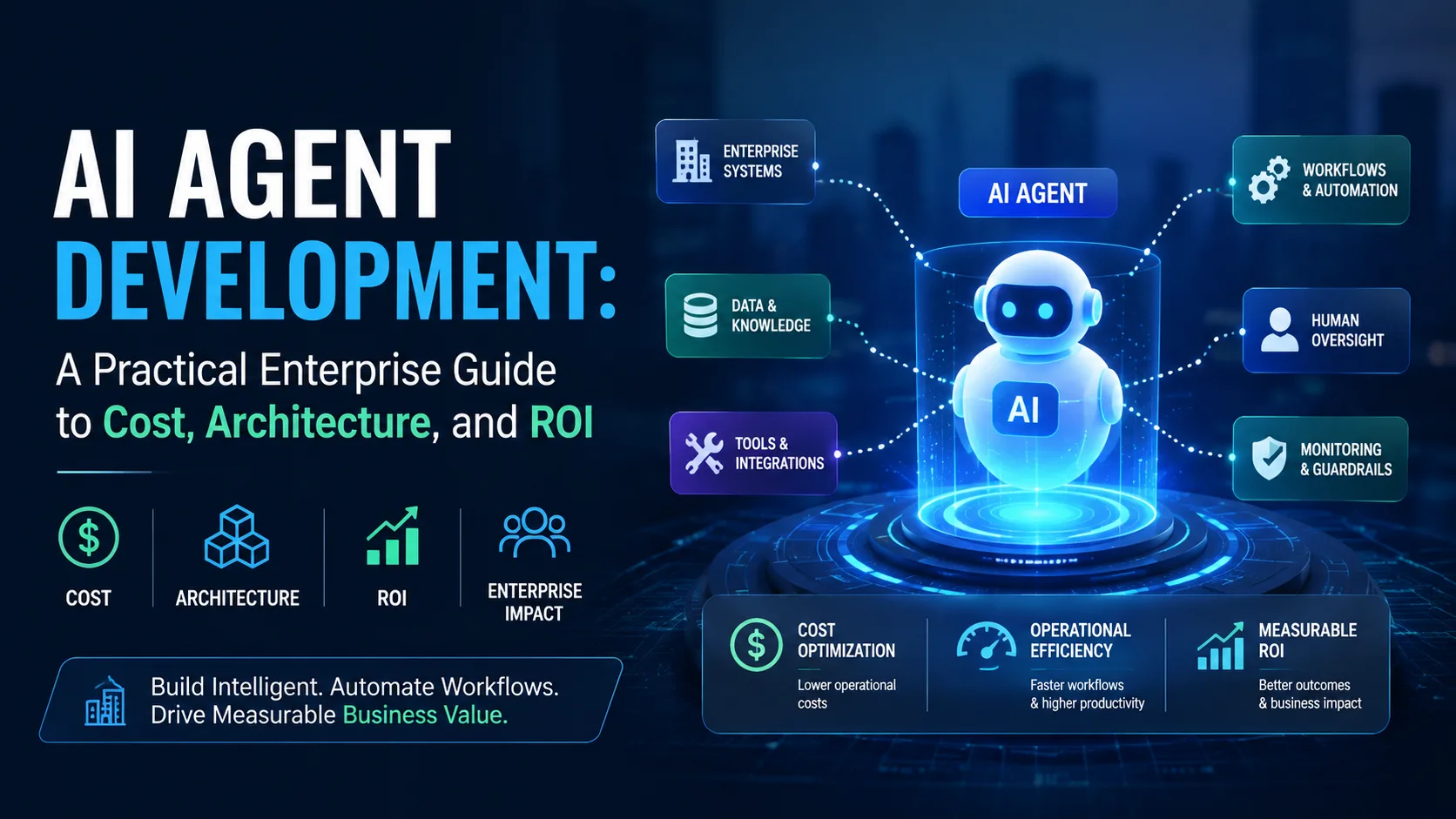
A production agent is better understood as a system of connected capabilities rather than a single AI model.
A typical enterprise architecture can include several layers.
Reasoning and model layer
The LLM interprets instructions, understands context, generates responses, and helps determine the next action.
Model selection should reflect the actual workload rather than brand preference. Different models can provide different trade-offs in reasoning capability, latency, cost, context handling, and deployment options.
Knowledge and memory layer
Agents often need access to information beyond what is contained in the immediate conversation.
Short-term memory can maintain the context of a current interaction. Longer-term storage can support persistent information or enterprise knowledge retrieval.
Retrieval-Augmented Generation, or RAG, AI and ML development services can connect the agent to approved organizational information so that responses and decisions are grounded in relevant data rather than relying entirely on the model's pre-existing knowledge.
Tool and integration layer
This is where an agent moves from conversation to execution.
Tools can allow an agent to:
- Query a CRM
- Retrieve an order
- Create a service ticket
- Check inventory
- Call an external API
- Update an enterprise application
- Generate a report
- Trigger a workflow
Modern enterprise architecture guidance similarly treats tool calling, orchestration, language models, semantic retrieval, and external services as distinct components of an agent architecture.
Orchestration layer
As workflows become more complex, an orchestration layer determines how tasks move between agents, tools, services, and people.
This becomes particularly important in multi-agent systems, where specialized agents may handle different responsibilities.
For example, one agent could retrieve information, another could analyze it, and another could prepare an output for human review.
Governance and guardrails
This layer is frequently underestimated.
An enterprise agent needs clearly defined boundaries around:
- Data access
- Permissions
- Tool usage
- Sensitive information
- Human approvals
- Auditability
- Error handling
- Escalation
- Monitoring
NIST's AI Risk Management Framework and its Generative AI Profile provide a useful foundation for organizations looking to manage AI risks across the lifecycle rather than treating governance as a final deployment step.
The key lesson is simple: security and governance should be designed into the agent rather than attached to it after development.
Where AI Agents Can Deliver the Most Practical Value
The strongest enterprise opportunities tend to involve repetitive, high-volume workflows with reasonably clear boundaries.
Customer service
An agent can handle well-defined support requests, retrieve customer information, search approved knowledge sources, perform permitted actions, and escalate exceptions.
The value comes from reducing repetitive work while preserving human involvement for complex cases.
Healthcare administration
AI agents can support administrative workflows such as outreach, documentation, scheduling-related processes, and assessment completion.
The important distinction is between administrative assistance and autonomous clinical judgment. Higher-risk decisions require significantly stronger controls and human oversight.
The source material includes an example of a multi-agent healthcare platform in which separate agents handled outreach, care-plan generation, and assessment workflows.
Finance and insurance
Potential applications include:
- Fraud investigation support
- Claims triage
- Document analysis
- Customer-service workflows
- Compliance research
- Exception handling
The most suitable processes are generally those where the agent can operate within defined policies and escalate unusual situations.
Supply chain and operations
Agents can help monitor inventory, evaluate operational conditions, coordinate information from multiple systems, and support maintenance or logistics workflows.
Here, the advantage is not simply generating recommendations. It is connecting analysis with the systems where operational actions actually occur.
Cybersecurity
Security operations represent another potentially valuable area for agentic workflows.
Agents can assist with alert investigation, detection-rule generation, enrichment, and first-level response actions.
However, the ability to isolate systems or change security configurations creates a much higher risk profile. Permission boundaries and approval mechanisms therefore become essential.
What Actually Drives AI Agent Development Cost?
The cost of an AI agent is rarely determined by the LLM alone.
The underlying source material identifies four broad categories ranging from simple reactive agents to multi-agent systems, with planning estimates from several weeks and tens of thousands of dollars to many months and several hundred thousand dollars for complex enterprise implementations.
These figures should be treated as planning ranges rather than universal market prices or project quotations.
The major cost variables are more useful than any single number.
Integration complexity
Connecting one system is fundamentally different from coordinating several internal applications and external APIs.
Legacy System Modernization can introduce additional authentication, data-format, workflow, and reliability challenges.
Data readiness
An agent cannot reliably retrieve information that the organization cannot reliably organize.
Poor documentation, inconsistent terminology, duplicated records, and fragmented data can significantly expand the preparation required for RAG and related retrieval workflows.
Compliance requirements
Healthcare, finance, insurance, government, and other regulated environments may require additional controls for privacy, access, audit trails, retention, review, and data handling.
Human-in-the-loop design
An enterprise agent should not necessarily operate independently.
A mature design defines which actions the agent can perform automatically and which require approval.
Ironically, this can make a system more complex to build while making it much easier for an organization to trust and deploy.
Testing and monitoring
Testing an agent is different from testing a conventional deterministic application.
Teams need to evaluate not only whether the software works, but also whether the agent makes appropriate decisions across different inputs and failure scenarios.
The source material estimates that integration engineering and QA/safety testing can represent a substantial portion of enterprise agent development cost.
That is why the model itself should not be treated as the primary budget driver.
Build, Buy, or Start With a Proof of Concept?
Not every organization should commission a custom AI agent.
A commercial or low-code platform may be appropriate when:
- The workflow is relatively standard.
- Integrations are limited.
- Customization requirements are modest.
- Compliance requirements can be satisfied by the platform.
- The organization wants to reach production quickly.
Custom development becomes more attractive when the organization needs:
- Proprietary business logic
- Deep legacy-system integration
- Specialized workflows
- Custom security controls
- Specific data-residency requirements
- Greater ownership of the technology roadmap
- Highly customized orchestration
A proof of concept can provide a useful middle ground.
Instead of attempting to automate an entire department, select one well-defined workflow and test it against realistic data.
The goal should not be to produce an impressive demo.
The goal should be to answer practical questions:
Does the agent make the right decisions? Can it access the required systems? Does it know when to stop? Can people trust its outputs? And does the economics make sense?
A More Realistic Way to Think About ROI
AI agent ROI should be tied to workflow economics rather than generic claims about AI productivity.
Start with the current process.
Measure:
- Monthly transaction volume
- Average human effort per transaction
- Labor cost
- Error or rework rate
- Processing time
- Escalation rate
- Business impact of delays
Then estimate what the agent can realistically change.
For example, an organization processing thousands of repetitive support requests each month may have a stronger business case than one processing a few dozen highly variable requests.
The source material similarly emphasizes that agents are best suited to high-volume, well-defined tasks.
This is a better investment test than asking whether the organization "needs AI."
The question is whether agentic automation can improve a sufficiently valuable workflow without introducing unacceptable risk.
What Enterprise Leaders Should Do Before Funding a Large Build
A practical evaluation framework can be reduced to seven questions:
Define the outcome.
What measurable business problem should the agent solve?
Choose the right level of autonomy.
Does the workflow need recommendations, assisted execution, or independent action?
Map the systems.
Identify every application, API, database, document repository, and data source involved.
Classify risk.
Determine which decisions and actions could create financial, operational, privacy, security, or regulatory consequences.
Design human oversight.
Specify where approvals, escalation, or manual intervention are mandatory.
Establish evaluation criteria.
Measure accuracy, task completion, latency, failure rates, escalation quality, and business outcomes.
Calculate total cost of ownership.
Include model usage, infrastructure, storage, monitoring, maintenance, integration, and ongoing evaluation—not just initial development.
The source material notes that production agents can incur continuing costs for model usage, infrastructure, vector storage, monitoring, and maintenance after launch.
The Enterprise AI Agent Opportunity Is Bigger Than the Chatbot
The most important shift in AI agent development is not the ability to generate better text.
It is the movement from answering questions to participating in workflows.
That changes the technology conversation.
The first generation of enterprise AI largely focused on assisting employees with information retrieval and content generation. Agentic systems extend that model by connecting reasoning with tools, data, business rules, and actions.
But greater autonomy also creates greater responsibility.
An agent with access to enterprise systems can create value precisely because it can act. That same capability means organizations must carefully control what it can access, what it can change, and when a person must intervene.
For CTOs, CIOs, and digital transformation leaders, the most effective strategy is therefore unlikely to be "build the most autonomous agent possible."
It is to identify the right workflow, the right degree of autonomy, and the right controls.
That is where AI agent development becomes a business transformation initiative rather than another experimental AI project.
Organizations evaluating a custom implementation can work with an experienced AI development partner such as AllianceTek to assess workflow complexity, integration requirements, governance needs, and the appropriate build-versus-buy strategy before committing to a larger production program.