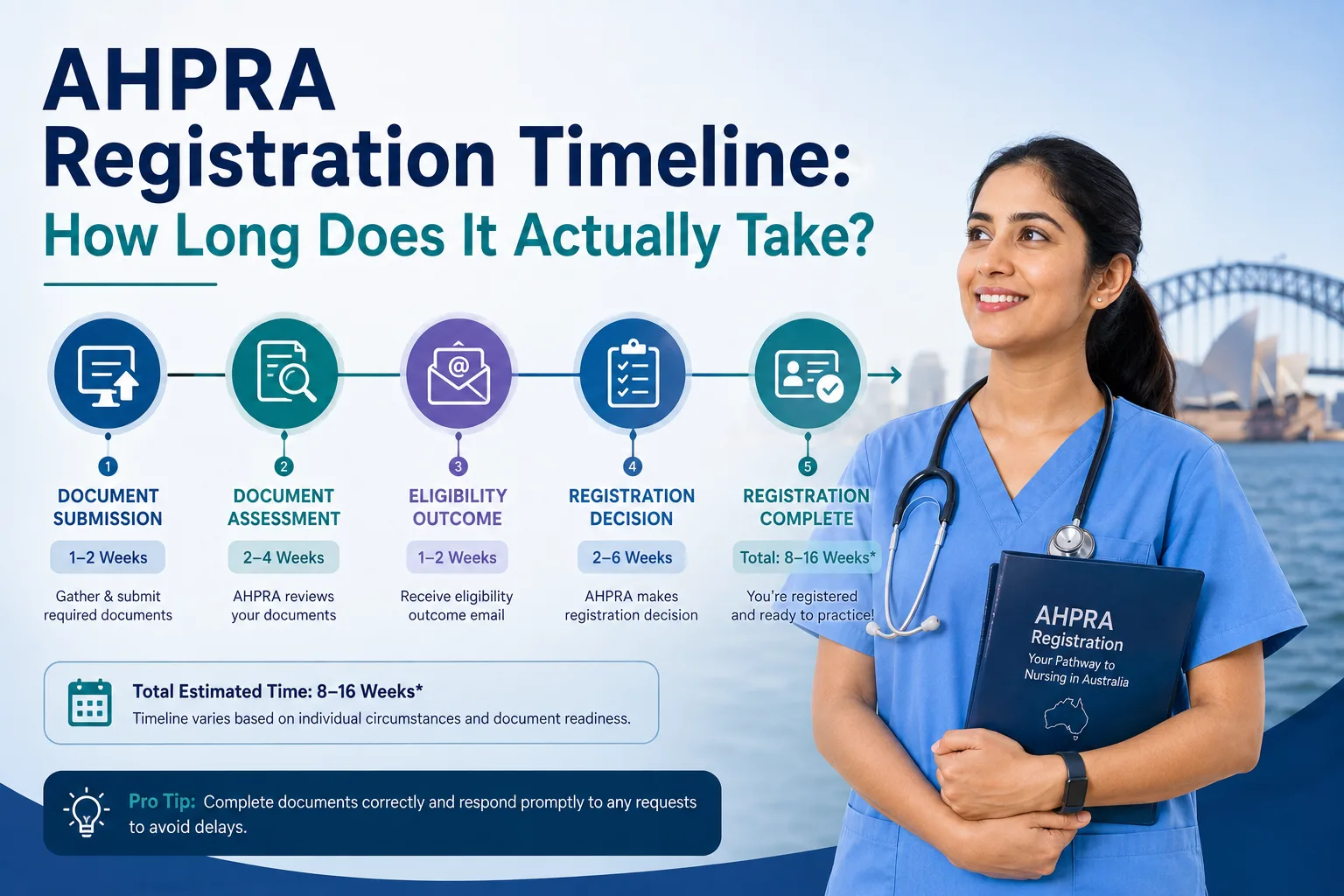
Ask ten internationally qualified nurses how long AHPRA registration took, and you will get ten different answers — anywhere from two months to two years. That is not because the process is random. It is because most people quote only the final assessment stage, while ignoring the months of document preparation, exams, and travel that come before it.
This guide gives you a realistic, stage-by-stage AHPRA registration timeline for nurses, based on how the process actually runs in 2026. It separates the part AHPRA controls (assessment) from the part you control (preparation), so you can plan backwards from your intended start date instead of guessing.
Quick Answer
- Stream A nurses (qualification substantially equivalent to Australian): roughly 2 to 4 months.
- Stream B nurses (most Indian, Filipino, Nepali, and GCC-trained nurses, via the OBA pathway): roughly 9 to 18 months.
- AHPRA aims to assess a complete application within 4 to 6 weeks — but that clock only starts once every document is submitted correctly.
- The biggest delays are almost always in document preparation and exam scheduling, not in AHPRA's own assessment.
Why There Is No Single AHPRA Timeline
The single most important thing to understand is the difference between two very different clocks:
- AHPRA's assessment time — how long AHPRA takes to review a complete application. This is relatively short and predictable.
- Your total preparation time — how long you spend gathering documents, sitting English tests, passing the NCLEX-RN, travelling for the OSCE, and getting council verifications done. This is long and highly variable.
When AHPRA says an application is assessed in four to six weeks, they mean four to six weeks after all required documentation is received. For most internationally qualified nurses, reaching that "complete application" point is where the real months go. Your stream also changes the picture entirely, so the first step is knowing whether you are in Stream A or Stream B.
If you are not sure which stream applies to you, read our full breakdown of Stream A vs Stream B and the OBA pathway first — it determines almost everything about your timeline.
Stream A Timeline: 2 to 4 Months
Stream A applies to nurses whose qualification is assessed as substantially equivalent to an Australian nursing degree — typically those trained in the UK, Ireland, USA, Canada (Ontario/British Columbia), New Zealand, or Hong Kong. These nurses skip the NCLEX-RN and OSCE entirely.
StageRealistic timeSelf-check + document preparation3–6 weeksEnglish evidence (test or exemption)0–8 weeksOrientation Part 11–2 weeksApplication + identity check1–2 weeksAHPRA assessment (complete file)4–6 weeksTotal~2 to 4 monthsBecause Stream A removes the two biggest time sinks (the NCLEX-RN and the OSCE), the timeline is dominated by document readiness and, where required, an English test.
Stream B Timeline: 9 to 18 Months
Stream B is the reality for most Indian and GCC-based nurses. The qualification is relevant but not equivalent, so you must complete the Outcomes-Based Assessment (OBA) — the NCLEX-RN followed by the OSCE in Australia. This is where the long, variable timeline comes from.
StageRealistic timeNotesSelf-check + eligibility review1–2 weeksFree; confirms your streamDocument collection4–8 weeksOften the biggest hidden delayEnglish test prep + sitting1–3 monthsIELTS/OET/PTE, depending on your starting levelOrientation Part 1 + Portfolio stage2–4 weeksPaid assessment stageNCLEX-RN prep + pass3–6 monthsThe longest single variableOSCE booking + travel to Australia1–3 monthsDepends on slot availability in Adelaide/MelbourneOSCE result4–6 weeksBefore you can applyFinal AHPRA registration4–6 weeksOnce file is completeTotal~9 to 18 monthsNotice that most of these stages are things you drive, not AHPRA. A nurse who prepares documents in parallel, studies for NCLEX while waiting for verifications, and books the OSCE the moment they are eligible can finish near the 9-month end. A nurse who tackles each stage one at a time, or who gets tripped up by a document error, drifts toward 18 months or beyond.
The Stages That Cause the Most Delay
1. Document Collection (the silent timeline killer)
For most nurses, the real delay is before the application is even submitted. Documents have to come from universities, state nursing councils, previous employers, and police authorities — none of which move on your schedule. A Certificate of Good Standing or council verification alone can take several weeks. Start collecting documents on day one, not after you have booked an exam.
2. NCLEX-RN Preparation
For Stream B nurses, the NCLEX-RN is usually the single longest stage. Preparation ranges from three to six months depending on your baseline. Your Authorization to Test (ATT) is also time-limited, so failing to schedule promptly, or failing the exam and needing to re-register, can add months. See our full NCLEX-RN exam guide for Australia for how to plan this stage.
3. OSCE Scheduling and Travel
The OSCE can only be sat in Australia, at Adelaide Health Simulation or in Melbourne. Slots are limited, so there can be a one-to-three-month wait for an available date, on top of arranging a visitor visa and travel. You cannot book the OSCE until you have passed the NCLEX-RN, so any delay upstream pushes this stage back too.
4. English Evidence
Every applicant must meet AHPRA's English language standard. If you need to sit a test, the timeline depends on test dates, preparation, and result release. Sitting the wrong test, or narrowly missing one band, forces a retake and adds weeks or months. The updated AHPRA English requirements apply from 23 April 2026, so make sure you are preparing against the current standard.
5. Identity and Name Mismatches
A surprising number of applications stall on something as small as a missing middle name or a spelling difference between passport and qualification certificate. If your name is not identical across your passport, degree, transcript, registration certificate, and English test record, prepare name-change or supporting evidence before you apply.
The Real Secret: Run Stages in Parallel
The nurses who finish fastest do not treat this as a strict sequence. They overlap stages wherever possible:
- Collect documents while preparing for the English test.
- Study for the NCLEX-RN while waiting on council verifications.
- Complete Orientation Part 1 and the Welcome-type online components while other assessments are pending.
Done in strict sequence, Stream B can stretch past 18 months. Done in parallel, the same steps can compress toward 9 to 12 months. The difference is planning, not luck.
A Practical Planning Timeline (Stream B)
Here is how a well-organised Stream B nurse might sequence the journey:
- Month 0: Complete the free AHPRA Self-check. Confirm Stream B. Begin collecting every document immediately.
- Months 1–3: Sit the English test. In parallel, begin NCLEX-RN preparation and chase council verifications.
- Months 3–5: Pay the assessment fee, complete Orientation Part 1 and the Portfolio stage, receive the OBA referral, and sit the NCLEX-RN.
- Months 5–8: Apply for a visitor visa, book and sit the OSCE in Australia, and wait for the result.
- Months 8–10: Submit the final registration application with all documents complete; AHPRA assesses within 4–6 weeks.
- Outcome: Registration as a Registered Nurse in Australia, typically around the 9-to-12-month mark for a well-prepared applicant.
Common Timeline Mistakes to Avoid
- Quoting the 4–6 week figure as your total timeline. That is AHPRA's assessment window for a complete file, not the whole journey.
- Accepting a job start date tied to registration before your registration is actually confirmed.
- Waiting for one stage to fully finish before starting the next, instead of running document collection, English, and NCLEX prep in parallel.
- Booking the wrong English test or letting an English result expire before you apply.
- Ignoring name consistency across identity and qualification documents.
- Confusing registration with a visa. AHPRA registration lets you practise; it is a separate process from your Australian visa, and one does not guarantee the other.
Frequently Asked Questions
1. How long does AHPRA registration take for nurses?
For internationally qualified nurses, Stream A typically takes 2 to 4 months and Stream B (the OBA pathway) typically takes 9 to 18 months. AHPRA aims to assess a complete application within 4 to 6 weeks, but that is only the final stage.
2. Why does Stream B take so much longer than Stream A?
Stream B requires the NCLEX-RN and the OSCE, plus travel to Australia for the practical exam. These exams and their scheduling add many months that Stream A applicants skip entirely.
3. Does AHPRA really assess applications in 4 to 6 weeks?
For nurses, AHPRA aims to complete assessment within 4 to 6 weeks after all required documentation is received. The countdown starts only when your file is genuinely complete, not when you begin the process.
4. What causes most AHPRA delays?
Document collection, NCLEX-RN preparation, OSCE scheduling and travel, English test issues, and name mismatches between documents. Most delays happen before submission, not during AHPRA's assessment.
5. Can I speed up my AHPRA registration?
Yes — mainly by running stages in parallel. Collect documents on day one, prepare for the English test and NCLEX-RN simultaneously, and book the OSCE the moment you are eligible.
6. Is AHPRA registration the same as getting a visa?
No. AHPRA registration allows you to practise nursing in Australia. A visa allows you to live and work there. They are separate processes, and having one does not automatically grant the other.
7. How long is the NCLEX-RN stage within the timeline?
Preparation typically takes 3 to 6 months depending on your starting level. It is usually the longest single stage of the Stream B timeline.
8. Can I start AHPRA registration from overseas?
Yes. You can complete the Self-check, document preparation, English test, and NCLEX-RN from your home country. You only need to travel to Australia for the OSCE stage of the OBA.
Conclusion
The honest answer to "how long does AHPRA registration take?" is: as long as your preparation lets it. Stream A nurses can be registered in a couple of months. Stream B nurses realistically plan for 9 to 18 months, with the outcome depending far more on how well they prepare and overlap stages than on how fast AHPRA works.
If you want to land near the shorter end of that range, the strategy is simple to state and hard to execute alone: confirm your stream early, prepare documents from day one, run your English and NCLEX preparation in parallel, and keep every detail consistent across your file.
This is exactly where working with an experienced AHPRA registration consultancy pays off. At Desma International, we map out your complete AHPRA timeline from the Self-check onwards, coordinate your documents, English test, NCLEX-RN, and OSCE so the stages overlap instead of stacking, and flag the small issues — name mismatches, expiring test scores, incomplete verifications — that quietly add months for nurses who go it alone. If you want a realistic, personalised timeline for your own profile rather than a generic estimate, our team can build one with you and guide you through every stage to registration.