Market Overview:
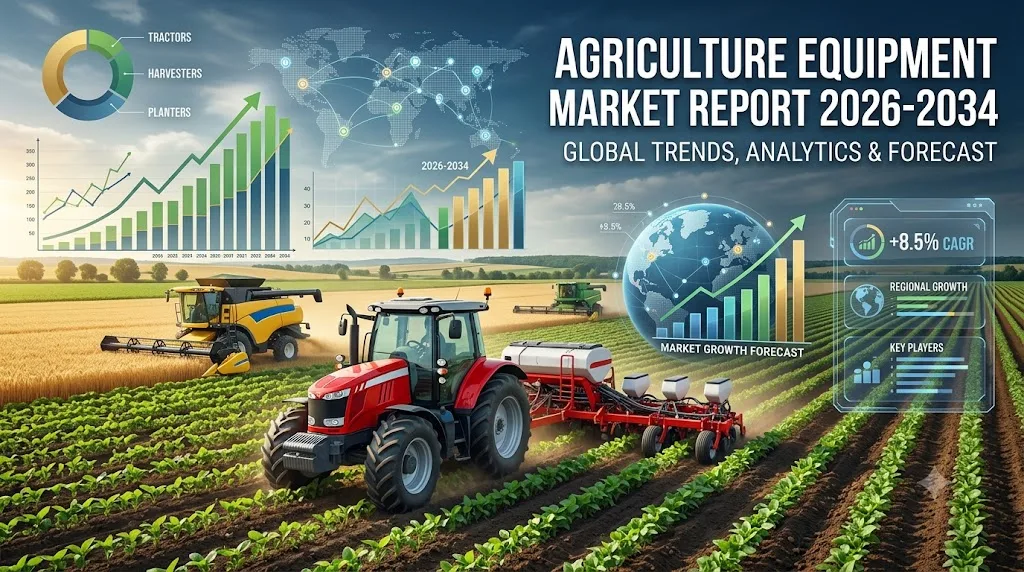
According to IMARC Group’s latest research publication, “Agriculture Equipment Market Size, Share, Trends and Forecast by Equipment Type, Application, Sales Channel, and Region, 2026-2034”, The agriculture equipment market size increased from USD 188.8 Billion in 2025 to USD 196.0 Billion in 2026 and is projected to reach USD 264.6 Billion by 2034, exhibiting a CAGR of 3.82% during 2026-2034.
This detailed analysis primarily encompasses industry size, business trends, market share, key growth factors, and regional forecasts. The report offers a comprehensive overview and integrates research findings, market assessments, and data from different sources. It also includes pivotal market dynamics like drivers and challenges, while also highlighting growth opportunities, financial insights, technological improvements, emerging trends, and innovations. Besides this, the report provides regional market evaluation, along with a competitive landscape analysis.
How the Agriculture Equipment Industry Is Evolving Globally
- The agriculture equipment market size increased from USD 188.8 Billion in 2025 to USD 196.0 Billion in 2026, driven by rising farm mechanization, government subsidy programs, and expanding adoption of precision agriculture tools across emerging economies.
- Agricultural tractors dominate the equipment type segment with a 35.9% share in 2025, reflecting widespread use in land preparation, transportation, and crop management activities across both large commercial and smallholder farming operations.
- Asia-Pacific commands the largest regional share at 36.8% in 2025, anchored by India and China, where government-backed equipment subsidization, large smallholder populations, and rapidly expanding crop output sustain high and consistent equipment demand.
- Latin America is the fastest-growing regional market with a projected CAGR of 4.60% through 2034, led by continued agricultural frontier expansion in Brazil and Argentina and rising cultivation of soybeans, corn, and sugarcane.
- Original Equipment Manufacturers (OEM) dominate the sales channel at 68.3% in 2025, as farmers and agri-cooperatives prefer authorized channels for warranty coverage, bundled financing, and full after-sales support packages.
- In February 2026, Deere and Company launched a redesigned 8R and 8RX tractor lineup featuring a new JD14 engine with supervised autonomy capabilities, including advanced headland management and path planning systems.
- Agriculture serves as a fundamental pillar of India’s economy, supporting the livelihoods of almost 55% of its population as of February 2026, making continued mechanization a national economic priority.
Download a sample PDF of this report: https://www.imarcgroup.com/agriculture-equipment-market/requestsample
Key Trends in the Agriculture Equipment Market
- GPS-Guided Precision Machinery Going Mainstream: GPS-based auto-steering and variable-rate application systems, once confined to large commercial operations, are increasingly available across mid-tier tractor models. Falling GNSS component costs and simplified user interfaces are extending precision agriculture adoption to smallholder operators across Asia-Pacific and Latin America, fundamentally reshaping equipment value propositions and average selling prices.
- Rise of Autonomous and Semi-Autonomous Equipment: Major OEMs are advancing autonomous tractor platforms capable of performing tillage, planting, and transport operations without a human operator. Semi-autonomous systems with remote monitoring are already deployed on large farms in North America and Europe, while evolving regulatory frameworks and broadening field trials are pushing autonomous capabilities closer to volume production across mainstream equipment lines.
- Electrification and Hybrid Power in Farm Machinery: Leading manufacturers have launched electric tractor prototypes and light-duty electric utility vehicles suited for farming operations. Battery-powered equipment offers lower operating costs and zero tailpipe emissions, aligning with sustainability mandates in the European Union and North America. Adoption currently focuses on smaller-horsepower segments but is expected to scale through the forecast period as battery costs decline.
- AI and Machine Learning Integration in Field Operations: AI-powered platforms are enabling predictive maintenance scheduling, automated yield forecasting, and real-time crop disease detection when integrated with connected farm equipment. Equipment manufacturers and agri-tech firms are embedding ML models into in-cab displays and fleet management software, creating new software-as-a-service revenue streams layered on top of traditional machinery sales.
- Growing Demand for Plant Protection Equipment: The plant protection application segment is expanding faster than the overall market CAGR of 3.82%, driven by rising adoption of precision sprayers and drone-based pesticide application systems. Regulatory pressure to reduce chemical runoff and improve application accuracy is accelerating investment in variable-rate spraying technology, sensor-based detection systems, and autonomous field sprayers across commercial farming regions.
- Aftermarket and Replacement Parts Demand Strengthening: The aftermarket channel at 31.7% of sales in 2025 is growing through independent spare parts distributors, remanufactured component suppliers, and digital parts marketplaces. Expanding mechanization in developing regions and aging installed equipment bases are driving recurring replacement parts demand, with farmers in cost-sensitive markets increasingly relying on aftermarket channels to extend equipment lifespan.
We explore the factors driving the growth of the market, including technological advancements, consumer behaviors, and regulatory changes, along with emerging agriculture equipment market trends.
Growth Factors in the Agriculture Equipment Market
- Rising Global Food Demand Driving Mechanization Need: Expanding global population and shifting dietary preferences toward protein-intensive foods are intensifying pressure on agricultural output. Farm mechanization raises yield per acre and reduces post-harvest losses, making equipment adoption a strategic necessity for food-producing nations. The overall wheat output from eight key wheat-producing states in India as of March 2025 was projected to reach 122.724 Million Tons, underlining the scale of agricultural activity requiring mechanized support.
- Government Subsidies and Modernization Programs: Public sector support through direct subsidies, tax exemptions, and low-interest rural credit programs is substantially reducing the effective cost of farm equipment ownership. National mechanization missions across India, China, Brazil, and Sub-Saharan African nations are channeling significant annual funding toward equipment adoption, creating a reliable structural demand foundation across both large-scale and smallholder farming economies.
- Labor Shortage Accelerating Automation Adoption: Accelerating rural-to-urban migration is shrinking the agricultural labor pool, particularly during labor-intensive planting and harvesting seasons. According to the Economic Survey 2023-24, over 40% of India’s population is anticipated to reside in urban regions by 2030, intensifying farmer dependence on combine harvesters, automated planters, and post-harvest processing equipment to compensate for shrinking labor availability.
- Precision Agriculture Adoption and GPS/IoT Integration: Farmers are increasingly deploying GPS-guided tractors, variable-rate seeding systems, and sensor-based soil monitoring tools to optimize input use and improve yield outcomes. This transition toward data-driven farming is expanding the addressable market for advanced, higher-value equipment and supporting stronger average selling prices across the agricultural tractor and harvesting equipment categories.
- Expanding Arable Land in Latin America and Africa: Sub-Saharan Africa, Central Asia, and Latin America represent large under-mechanized agricultural regions with growing rural incomes, improving credit infrastructure, and ambitious government mechanization programs. Brazil and Argentina continue to expand soybean, corn, and sugarcane cultivation frontiers, generating sustained demand for tractors, planters, and large-scale harvesting machinery across Latin America, now the fastest-growing regional market at 4.60% CAGR through 2034.
Leading Companies Operating in the Global Agriculture Equipment Industry:
- Deere and Company
- CNH Industrial N.V.
- AGCO Corporation
- Kubota Corporation
Agriculture Equipment Market Report Segmentation:
Breakup by Equipment Type:
- Agriculture Tractor
- Harvesting Equipment
- Irrigation and Crop Processing Equipment
- Agriculture Spraying and Handling Equipment
- Soil Preparation and Cultivation Equipment
- Others
Agriculture Tractor accounts for the largest share at 35.9% in 2025, driven by its multipurpose applications across land preparation, transportation, and crop management, making it the core piece of farm mechanization across both developed and emerging agricultural economies.
Breakup by Application:
- Land Development
- Threshing and Harvesting
- Plant Protection
- After Agro Processing
Land development leads the application segment with a 26.7% share in 2025, supported by strong demand for soil preparation, land clearing, and irrigation infrastructure equipment tied to expanding cultivation programs across Asia-Pacific, Sub-Saharan Africa, and Latin America.
Breakup by Sales Channel:
- Original Equipment Manufacturers (OEM)
- Aftermarket
OEM dominates with a 68.3% share in 2025, reflecting strong manufacturer-dealer networks, bundled financing options, comprehensive warranty packages, and after-sales service contracts that continue to drive new equipment purchases through authorized channels.
Breakup by Region:
- North America (United States, Canada)
- Europe (Germany, France, United Kingdom, Italy, Spain, Russia, Others)
- Asia Pacific (China, Japan, India, South Korea, Australia, Indonesia, Others)
- Latin America (Brazil, Mexico, Others)
- Middle East and Africa
Asia-Pacific holds the largest regional share at 36.8% in 2025, led by India and China, where large farming populations, deep government subsidization of tractor purchases, and rapidly increasing crop output sustain consistent and high-volume equipment demand across all product categories.
Recent News and Developments in the Agriculture Equipment Market
- February 2026: Deere and Company launched a redesigned 8R and 8RX tractor lineup incorporating a new JD14 engine alongside supervised autonomy features, including advanced headland management and field path planning systems, marking a significant step in the commercialization of semi-autonomous farm machinery for mainstream markets.
- February 2026: AGCO Corporation projected its first net sales increase in three years, forecasting net revenues of between USD 10.4 Billion and USD 10.7 Billion for 2026, driven by precision agriculture technology expansion through its PTx brand and growing demand for higher-end Fendt line machinery, signaling an early recovery in the global farm equipment demand cycle.
- September 2026: Fendt, Case IH, and Kubota all unveiled major new tractors, planters, and field equipment at the 2026 Farm Progress Show in Iowa, with nearly every major farm equipment manufacturer using the event to introduce updated product lines, highlighting the industry’s accelerating pace of product innovation and technology integration heading into the final years of the decade.
Note: If you require specific details, data, or insights that are not currently included in the scope of this report, we are happy to accommodate your request. As part of our customization service, we will gather and provide the additional information you need, tailored to your specific requirements. Please let us know your exact needs, and we will ensure the report is updated accordingly to meet your expectations.
About Us:
IMARC Group is a global management consulting firm that helps the world’s most ambitious changemakers to create a lasting impact. The company provides a comprehensive suite of market entry and expansion services. IMARC offerings include thorough market assessment, feasibility studies, company incorporation assistance, factory setup support, regulatory approvals and licensing navigation, branding, marketing and sales strategies, competitive landscape and benchmarking analyses, pricing and cost research, and procurement research.
Contact Us:
IMARC Group
134 N 4th St. Brooklyn, NY 11249, USA
Email: [email protected]
Tel No: (D) +91 120 433 0800
United States: +1-201-971-6302