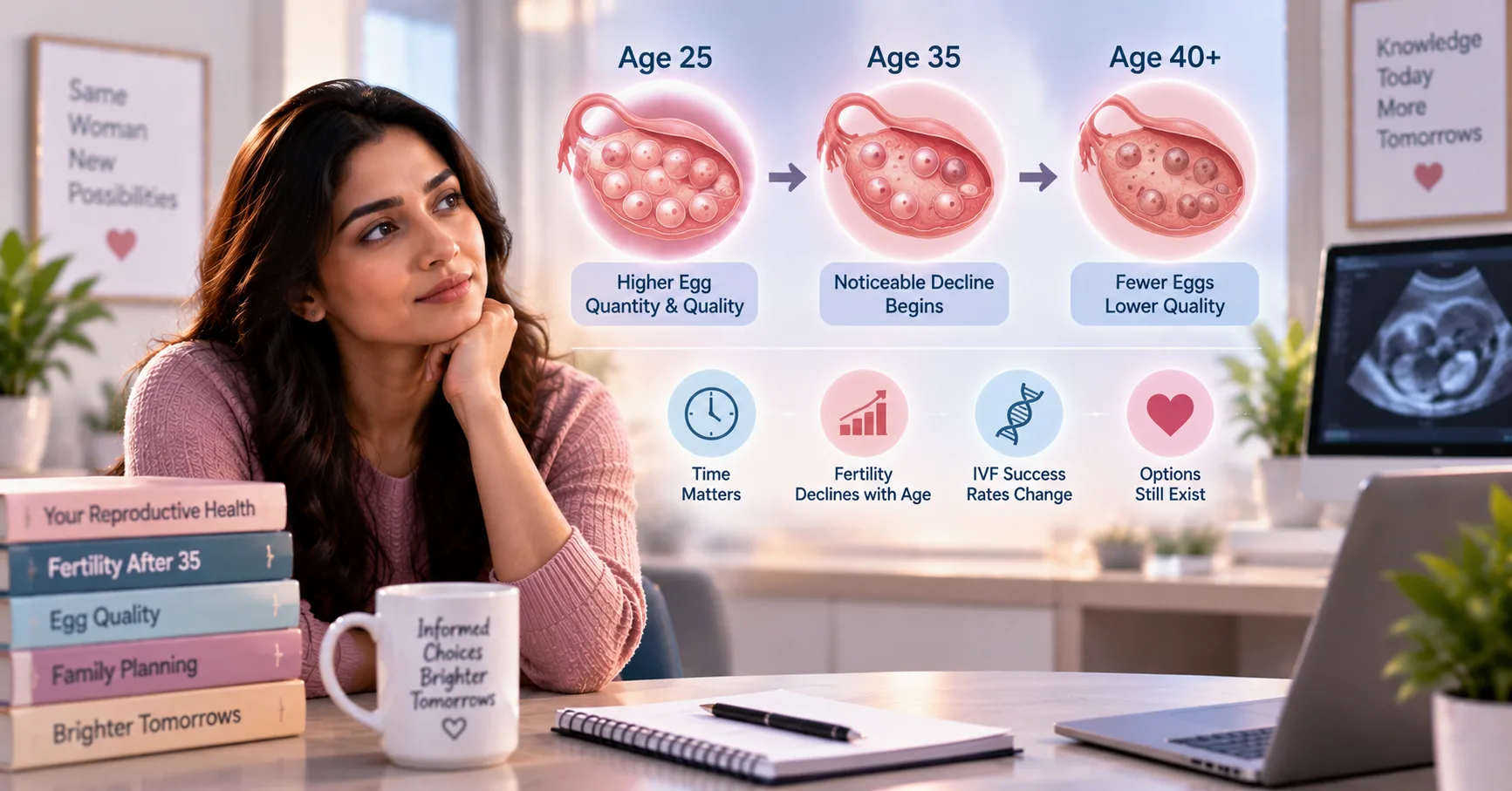
Trying to conceive after 35 is common, but fertility does change with age. One of the biggest reasons is the gradual decline in both the number and quality of eggs available in the ovaries.
For many women, fertility does not suddenly change on the 35th birthday. Instead, the decline happens gradually and becomes more noticeable with increasing age. Understanding what happens to egg quantity, egg quality, and fertility treatment options can help people make informed reproductive decisions.
What Happens to Fertility After 35?
Fertility after 35 is influenced by several biological changes. The most important are declining ovarian reserve and increasing chances of chromosomal abnormalities in eggs.
A woman is born with a finite number of eggs. Over time, this ovarian reserve naturally decreases. The rate of decline varies between individuals, but the number of available eggs generally becomes lower with age.
At the same time, the proportion of eggs with chromosomal abnormalities tends to increase. This can make conception more difficult and can increase the risk of miscarriage.
This is why age is an important factor when evaluating fertility, although it is not the only one.
Does Egg Quantity Decline After 35?
Yes. Egg quantity gradually decreases throughout reproductive life.
Ovarian reserve refers to the remaining supply of eggs in the ovaries. Tests such as AMH and antral follicle count can provide information about ovarian reserve, although they cannot predict pregnancy on their own.
The decline in egg quantity does not happen at exactly the same rate for everyone. Some women may have a relatively higher ovarian reserve at 38, while others may have a lower reserve at a younger age.
Therefore, egg quantity after 35 should be assessed individually rather than based only on age.
What Happens to Egg Quality With Age?
Egg quality is different from egg quantity.
While ovarian reserve refers mainly to how many eggs remain, egg quality relates partly to the likelihood that an egg has the correct number and structure of chromosomes and can produce a healthy embryo.
As age increases, the proportion of eggs with chromosomal abnormalities tends to rise. This is one of the main biological reasons for egg quality decline age.
A lower-quality egg may be less likely to fertilise normally, develop into a viable embryo, implant successfully, or result in an ongoing pregnancy.
This does not mean pregnancy is impossible after 35. It means that the probability of successful conception per cycle can decrease over time.
Why Does Age Affect Egg Quality?
Eggs remain in the ovaries for many years. As a woman ages, changes in the cellular mechanisms responsible for chromosome separation can increase the likelihood of abnormal chromosome numbers in eggs.
This can result in embryos with chromosomal abnormalities.
Some chromosomal abnormalities may prevent an embryo from developing normally, while others may contribute to miscarriage or genetic conditions.
This age-related change is an important part of age related fertility decline.
Age and Fertility: What Changes After 35?
Several changes can occur as reproductive age increases:
1. Fewer eggs are available
The ovarian reserve continues to decline with age, meaning fewer eggs may be available for ovulation or fertility treatment.
2. Egg quality gradually decreases
The proportion of chromosomally normal eggs tends to decrease with age.
3. Conception may take longer
The probability of becoming pregnant during each menstrual cycle can decrease as age increases.
4. Miscarriage risk can increase
Age-related chromosomal abnormalities can contribute to a higher risk of miscarriage.
5. IVF outcomes may change
Age is one of the important factors affecting IVF outcomes because egg quality plays a major role in embryo development.
What Is the IVF Success Rate After 35?
The IVF success rate after 35 varies significantly depending on age, clinic, treatment type, ovarian reserve, embryo quality, sperm factors, and other medical conditions.
There is an important distinction between IVF using a person's own eggs and IVF using donor eggs.
With increasing age, IVF using one's own eggs may become less successful because ovarian response and egg quality can decline. However, individual outcomes can vary considerably.
Rather than focusing only on a single percentage, patients should discuss their age-specific prognosis with their fertility specialist.
Does IVF Reverse Age-Related Egg Quality Decline?
IVF cannot reverse the biological aging of eggs.
Instead, IVF allows fertility specialists to retrieve multiple eggs during one treatment cycle, fertilise them in the laboratory, and monitor embryo development.
In selected situations, additional embryo testing may be discussed to identify certain chromosomal abnormalities before transfer. However, testing does not improve the underlying quality of the eggs or guarantee a successful pregnancy.
This is why IVF after 35 with own eggs should be planned according to an individual's ovarian reserve, reproductive history, and treatment goals.
Can You Get Pregnant Naturally After 35?
Yes. Many people conceive naturally after 35.
Age does not create an absolute barrier to pregnancy. However, the chances of conception per cycle generally decrease as reproductive age increases.
Other factors can also affect fertility, including:
- Ovulation problems
- Endometriosis
- Fibroids
- Fallopian tube blockage
- Sperm quality
- Previous pelvic surgery
- Ovarian reserve
- Underlying medical conditions
If pregnancy does not occur after trying for an appropriate period, a fertility evaluation can help identify possible causes.
When Should You Consider a Fertility Evaluation After 35?
People over 35 may benefit from seeking fertility advice sooner rather than waiting for a prolonged period if they are having difficulty conceiving.
An evaluation may include:
- Medical and reproductive history
- Ovulation assessment
- AMH testing
- Antral follicle count
- Other ovarian reserve tests
- Fallopian tube assessment when appropriate
- Semen analysis for the male partner
The exact tests depend on the individual's circumstances.
For people aged 40 or above, fertility specialists may recommend evaluation sooner because fertility can decline more rapidly with increasing age.
Can Lifestyle Improve Fertility After 35?
Lifestyle cannot stop age-related egg aging, but healthy habits can support overall reproductive and general health.
Helpful measures may include:
- Maintaining a healthy weight
- Avoiding smoking
- Limiting alcohol
- Eating a balanced diet
- Getting regular physical activity
- Managing chronic health conditions
- Getting adequate sleep
- Discussing medications and supplements with a doctor
It is important to be cautious about products claiming to “reverse egg aging.” There is currently no proven method that can restore eggs to a younger biological state.
What About Egg Freezing Before 35?
Egg freezing may be an option for people who want to preserve reproductive potential for future use.
Because egg quality is closely related to age, freezing eggs at a younger age may preserve eggs with the characteristics they had at the time of freezing. However, egg freezing does not guarantee a future pregnancy.
The number of eggs retrieved, age at freezing, ovarian reserve, laboratory factors, and future embryo development all influence the eventual outcome.
People considering fertility preservation should discuss their individual situation with a fertility specialist.
Fertility After 35: The Bigger Picture
The phrase fertility after 35 should not be interpreted as a sudden biological deadline. Fertility changes gradually, and individuals experience these changes differently.
The most important age-related factors are declining ovarian reserve and the increasing proportion of eggs with chromosomal abnormalities. These changes can affect natural conception, miscarriage risk, and fertility treatment outcomes.
For someone trying to conceive after 35, understanding personal ovarian reserve and reproductive health may be more useful than relying on age alone.
Key Takeaway
Age affects fertility primarily through changes in egg quantity and quality. After 35, ovarian reserve generally continues to decline, while the likelihood of chromosomal abnormalities in eggs increases.
Although age related fertility decline is a natural biological process, many people successfully conceive after 35, either naturally or with fertility treatment.
If you are trying to conceive after 35, a timely fertility evaluation can provide a clearer picture of ovarian reserve, reproductive health, and available treatment options. A fertility specialist can help determine whether continued natural attempts, fertility preservation, IUI, IVF, or another approach may be appropriate.
Medical Disclaimer: This article is intended for educational purposes only and should not replace personalised medical advice, diagnosis, or treatment from a qualified fertility specialist.