By Andre Dezigner, founder of CYCLE
Adapted from answers in my previously published interview with Metaverse Post, “Proof Before Distribution.”
Before increasing a campaign’s budget, look at what happens after someone arrives. Can they understand the product, check the main claims and find a useful next step?
A polished campaign can introduce a company, but the audience still needs a credible explanation, relevant evidence and clear answers. The task is to make evaluating the company easier. More attention becomes useful when people have something substantial to evaluate.
1. Check what an outsider can actually understand
The common problem is that an outsider cannot easily judge the substance behind the promise.
An AI company might claim that its product transforms a workflow. A fintech company asks people to trust it with important financial activity. In each case, people need help understanding what truly works, what remains a plan and what they can verify.
Read the landing page beside the advertisement. Write down the promise in each. If they describe different outcomes, decide which promise the page must support before sending more people there.
2. Match the evidence to the promise
Proof can take different forms: a working demonstration, a specific customer example, clear documentation, a verifiable partnership or an honest account of what has been built so far. The right evidence depends on the promise being made.
An enterprise AI buyer may need a repeatable evaluation, a clear implementation story and answers about data handling. An infrastructure project may need technical documentation and evidence of adoption.
Imagine someone discovers a project through a respected creator. They visit the website, look up the founders, check the product and read what other people are saying. The credibility of that first recommendation now depends on what they find.
For each important claim on the landing page, identify the evidence a visitor can inspect. A claim without evidence is a question the buyer still has to resolve.
3. Check whether the next step is useful
If people arrive and cannot understand the product, verify the main claims or find a useful next step, much of that attention may be lost. Teams can then conclude that the creator was ineffective, even though the weakness was elsewhere.
The sequence should reflect what the project is ready to support. Clarify the audience and proposition, prepare the evidence and the experience people will encounter, then choose creators who can communicate it credibly.
Apply the same inspection to a paid campaign. Follow the advertised path yourself. Does the call to action explain what happens next? Does the form ask for information the visitor can reasonably provide at this stage?
4. Give someone responsibility for the connections
A founder can have capable people working on positioning, content, PR, community and partnerships and still be the person holding everything together. Every supplier has a scope, but someone needs to understand how those scopes contribute to the same objective.
A PR specialist needs a strong, supportable story. A creator needs a clear brief and a relevant audience. A community team needs accurate information and a way to handle the questions that promotion generates. Decisions made in one area affect the others.
Connect the objective, message, evidence, timing and responsibilities. That includes identifying gaps between suppliers, resolving conflicting messages and making sure feedback from the market reaches the people making decisions.
5. Separate learning from scaling
An early-stage company can communicate early and learn in public. It should be clear about its stage and support the claims it makes. “Proof before distribution” is about matching the strength of the message to the strength of the evidence before increasing its reach.
There is also a useful role for creators earlier on, such as testing explanations or gathering feedback. That is a different assignment from a large promotional campaign and should be briefed and measured accordingly.
Work backwards from the decision you want someone to make. A prospective customer, partner and investor will each need different things to become comfortable with that decision. Identify the most important uncertainties early enough to do something about them.
Before the next budget increase
Take one active advertisement and follow its entire path. Record the promise, the evidence supporting it, the next action and the person responsible for following up.
Choose one gap to fix. Decide what you will measure before changing it. Keep visits, enquiries and purchases separate: an improvement at one stage does not establish a sales result.
That might mean running a useful pilot, documenting customer feedback, improving a demonstration or making a technical explanation easier to follow. Some evidence takes time to create, and a communications team cannot produce it at the last minute.
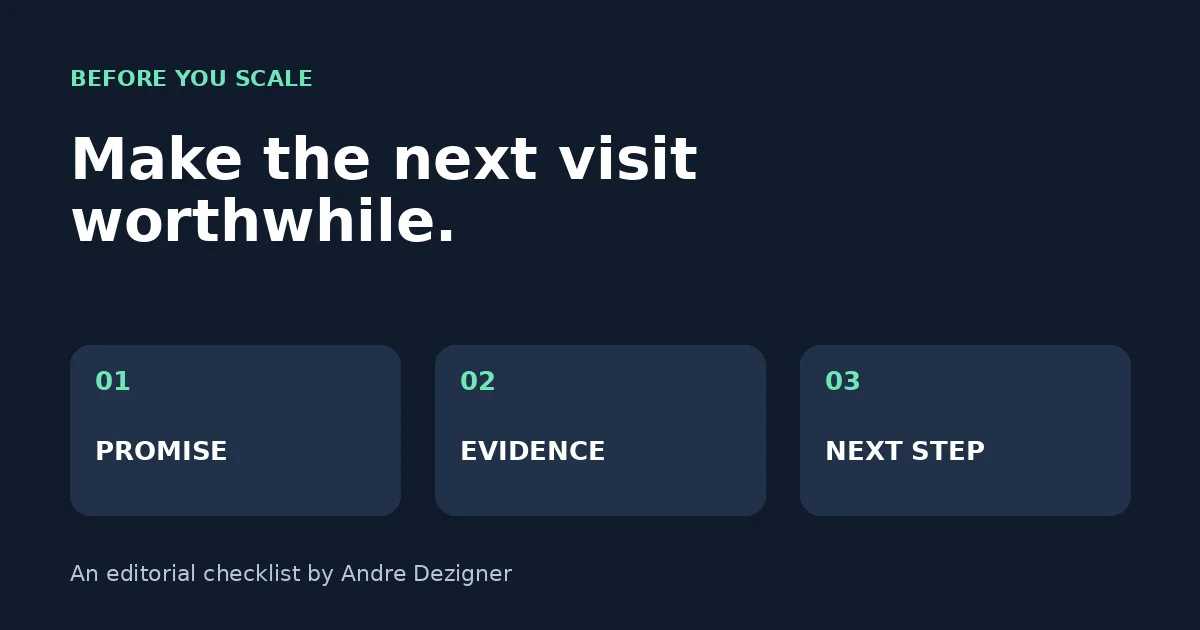
Editorial note: This article adapts my previously published interview answers with AI-assisted editing, headings and practical checklist additions. The cover is an original editorial illustration created for this article.
About the author: Andre Dezigner is the founder of CYCLE.