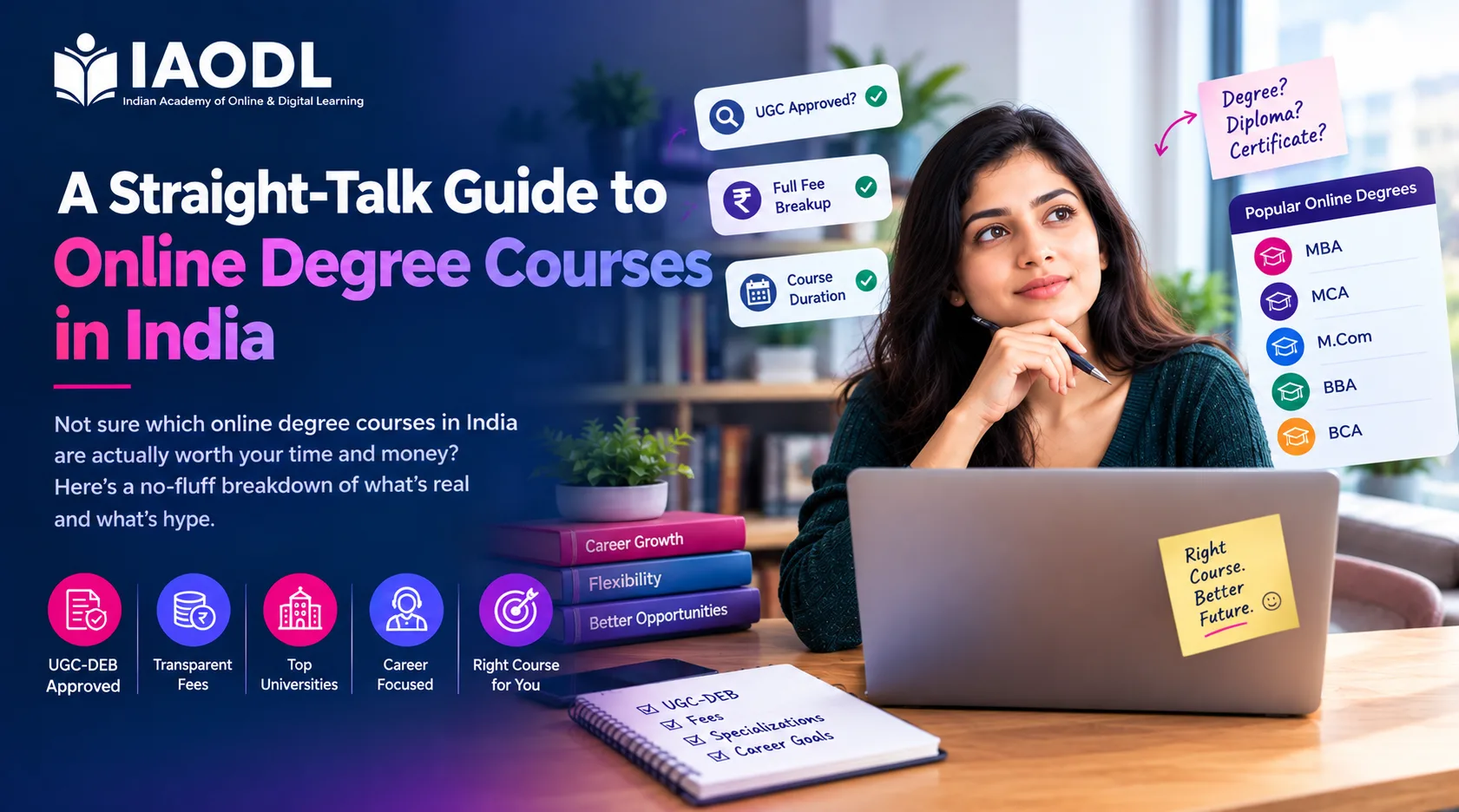
Someone asked me recently which online degree course they should pick, and I asked back — "for what, exactly? A job? A promotion? Just to have a degree on paper?" She paused for a second because, honestly, nobody had asked her that before. That's usually the missing first step. People go straight to browsing online degree courses in India without figuring out what the degree actually needs to do for them. And that's how you end up with a certificate that looks fine on LinkedIn but does absolutely nothing for your career.
Let's fix that. Not with another generic list of course names — you can Google that in five seconds — but with an honest look at what's actually out there, what UGC approval really guarantees, and where people commonly waste money.
What Counts as an Online Degree Course in India, Really
Here's where a lot of confusion starts. Not everything marketed as an "online degree" is actually a degree. Some are certificate courses dressed up with fancier names. Some are diploma programs, which is fine, but very different from a degree in terms of recognition and weight.
A genuine degree — Bachelor's or Master's — needs to come from a university that's specifically authorized to offer it in online mode. That authorization is separate from the university just existing or being well-known offline. This is the exact gap where a lot of online education degree programs quietly fall short, and students only find out after they've already paid fees and started classes.
So before anything else — check whether what you're looking at is actually a "degree" in the legal, recognized sense, or something dressed up to look like one.
The UGC Approval Piece (Don't Skip This Section)
I know I've said this before in other posts, but it bears repeating because it's genuinely the single biggest filter that matters. UGC approved online degree courses in India carry legal recognition — for jobs, higher education, government eligibility. Courses without that approval might still teach you something useful, but they won't carry the same weight on paper, and that gap becomes painfully obvious the moment you need to submit documents somewhere official.
Two things trip people up here specifically:
First, approval is granted per program, not blanket for the whole university. A university can have five UGC-approved online degrees and one that isn't approved yet, sitting right there on the same website, looking identical in presentation.
Second, approval status changes. A program not approved last year might get approved this year, or vice versa if a university loses accreditation for some reason. Always check the current year's list directly on the official UGC-DEB portal, not a screenshot someone sent you six months ago.
Which Online Degree Courses Are Actually in Demand Right Now
This shifts a bit year to year, but based on what I'm consistently seeing in enrolment trends and what recruiters are actually asking for:
Postgraduate level:
- MBA (still the biggest draw by far, especially with specializations like Data Analytics, Digital Marketing, Business Analytics)
- MCA — solid if you're aiming at tech roles and don't have a CS background already
- M.Com — steady demand, especially for people already in finance/accounts roles wanting a formal upgrade
- MA in Journalism & Mass Communication — smaller audience, but genuinely useful if that's your actual field
Undergraduate level:
- BBA — popular first-degree option for people who want flexibility from the start
- BCA — good if you're building toward tech, though I'd say a regular BCA still edges out online for absolute beginners who benefit from in-person lab work
- B.Com — probably the most "safe" and widely accepted undergraduate online option out there
I'll be upfront about a personal opinion here: BCA online, for someone with zero prior tech exposure, is tougher to pull off well than people expect. The self-paced nature works against you when you're learning something genuinely technical from scratch. If you've got some baseline coding exposure already, it's a different story entirely.
Diploma and Certificate Options — Where They Actually Fit
Not everyone needs a full degree. If you already have one and just want an updated skill set, a shorter online education degree program — or more accurately, a diploma or certificate — might genuinely serve you better than committing two years and a full degree fee to something you don't strictly need.
The mistake here runs in both directions. Some people over-invest, doing a full second degree when a six-month certificate would've solved the actual problem. Others under-invest, picking a random certificate course when the job market they're targeting specifically wants a recognized degree. Match the credential to the actual requirement, not to whatever's being aggressively marketed to you that month.
What Nobody Tells You About Course Duration
Advertised duration and real duration aren't always the same thing. A course marketed as "2 years" sometimes assumes zero delays — no backlog papers, no missed submission deadlines, everything going perfectly on schedule. Add one semester of falling behind, which happens more often than universities like to admit, and you're looking at 2.5 to 3 years in practice.
This matters for planning, especially if you're doing this alongside a full-time job and mapping out when you'll realistically finish. Ask the university directly: what percentage of students in the last batch actually finished within the advertised timeline? Most won't have this number ready, which itself tells you something.
A Practical Comparison
Course TypeTypical DurationBest Suited ForOnline MBA2 yearsWorking professionals wanting a career jump or specialization shiftOnline MCA2 yearsCareer-switchers moving into tech, some coding exposure helpfulOnline BBA3 yearsFresh graduates wanting flexibility from day oneOnline BCA3 yearsBetter suited to those with at least basic prior tech exposureDiploma/Certificate6 months – 1 yearPeople upgrading a specific skill without needing a full degreeExpert Insight
"The biggest mistake I see isn't picking a bad university — it's picking the wrong type of credential for the actual goal. Someone wanting a quick skill upgrade enrolling in a full two-year degree, or someone needing formal degree recognition settling for a certificate because it was cheaper and faster. Match the credential to the actual need first, then worry about which university." — an academic counsellor I consulted while writing this
That distinction gets skipped constantly, and it's honestly the root of most regret I've seen afterward.
FAQs
What's the difference between an online degree and an online certificate course?
A degree requires university authorization and carries formal recognition for jobs and higher education; a certificate course usually doesn't carry the same legal weight.
Are all online degree courses in India UGC approved? No — approval is granted per specific program, not automatically for an entire university. Always verify individually.
Which online degree course has the best job prospects right now?
Online MBA with in-demand specializations (Data Analytics, Digital Marketing, Business Analytics) currently sees the strongest recruiter interest, though this shifts year to year.
Can I complete an online degree faster than the advertised duration?
Rarely — most students take the full advertised duration or slightly longer due to work commitments; faster completion is uncommon.
Is an online BCA a good choice for someone with no coding background?
It's workable but harder than people expect. Some prior tech exposure makes the self-paced structure significantly easier to manage.
How do I verify UGC-DEB approval for a specific online degree course?
Check the current year's official UGC-DEB approved list directly and match the exact program name, not just the university name.
Choosing among online degree courses in India isn't really about finding the "best" one in some universal sense — it's about matching the actual credential type, UGC approval status, and course duration to what you genuinely need right now. Spend the extra half hour verifying that before you enrol. It's a lot less time than you'll spend undoing a wrong choice later.