
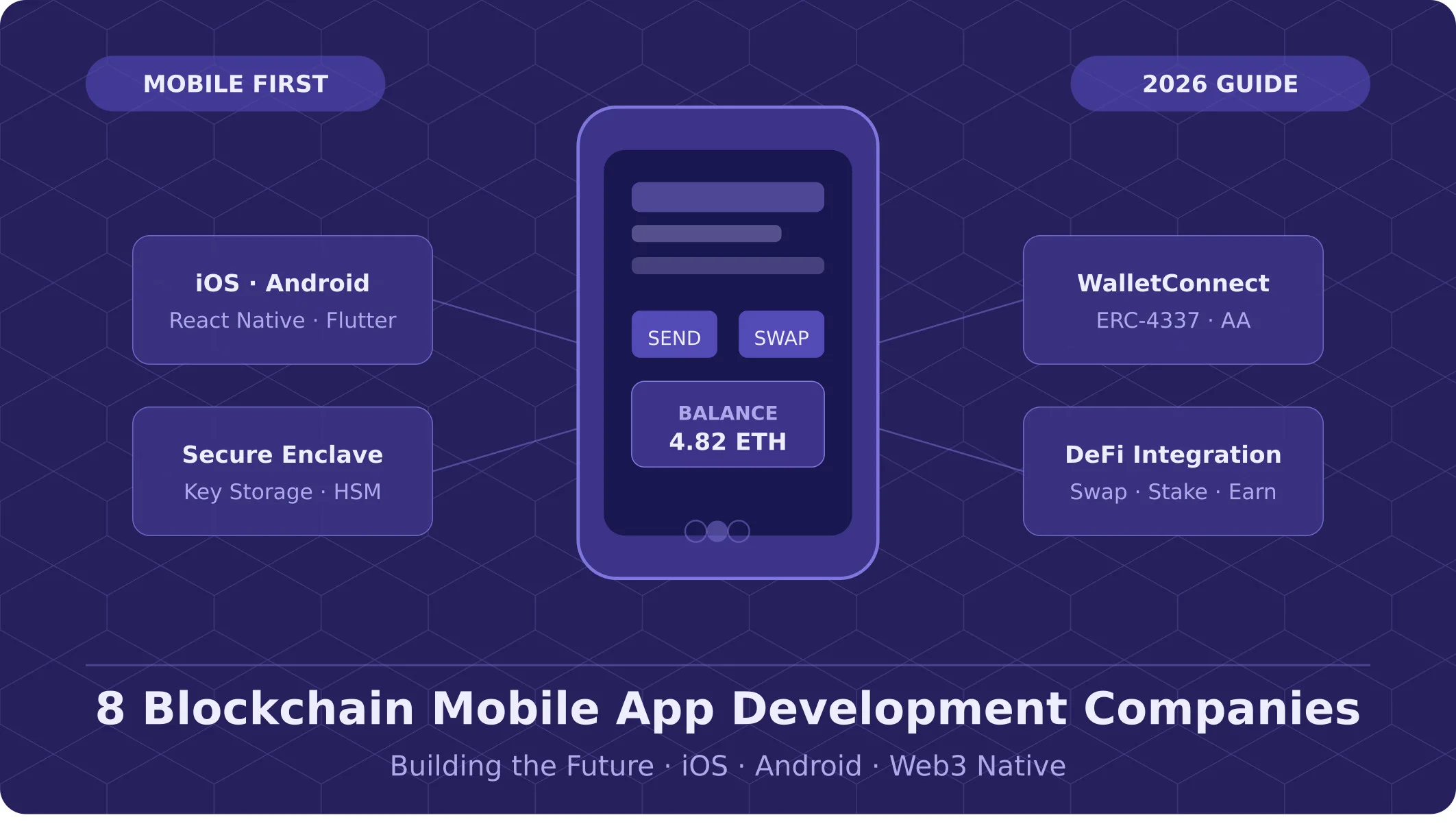
Mobile is where blockchain meets the real world.
All the infrastructure development happening at the protocol layer, all the institutional investment flowing into tokenization and DeFi, all the enterprise consortium networks being built across supply chains and financial systems, it all eventually needs to surface in a screen that a real person can hold in their hand and understand in under ten seconds.
That design and engineering challenge is genuinely hard. Harder than building the blockchain infrastructure underneath it. Because blockchain is precise, formal, and unforgiving. Mobile users are impatient, non-technical, and merciless with apps that make them feel stupid or anxious.
The eight companies on this list have figured out how to bridge that gap. Some better than others, which is why the order matters.
1. Apptunix
Apptunix approaches blockchain mobile app development with a discipline that starts from the user backward rather than from the blockchain protocol forward. That direction matters more than it might seem.
Most blockchain mobile projects are built by teams who start with the protocol, figure out the smart contract architecture, build the backend API layer, and then hire mobile developers to put a screen on top of it. The mobile UX ends up shaped by decisions that were made three layers below it, which is why so many blockchain mobile apps feel like infrastructure wrapped in a thin layer of interface rather than products designed for real people.
Apptunix runs the design process differently. Their UX team works on user flows and interaction patterns in parallel with backend architecture decisions, which means the interface is not constrained by technical decisions that were locked in before anyone thought about how users would experience them.
On the technical side, their iOS practice builds with Swift and SwiftUI using Secure Enclave for private key operations that require hardware-level security. Their Android practice builds with Kotlin and uses hardware-backed Android Keystore for equivalent security on Android devices. Their cross-platform practice uses React Native and Flutter for applications where the UX requirements do not demand platform-specific security features.
As a leading blockchain mobile app development company, Apptunix has built DeFi dashboard applications that aggregate positions across multiple protocols, enterprise supply chain verification apps that give field workers access to blockchain-recorded provenance data, crypto payment applications for merchants and consumers, and NFT management interfaces that support complex collection and trading workflows.
Their blockchain wallet app development practice deserves specific mention because wallet development is the most security-sensitive category in mobile blockchain development. Their wallet implementations use hardware-backed key storage on both platforms, implement transaction simulation before signing, and present blockchain transaction data in human-readable formats that prevent blind signing attacks. These are not nice-to-haves. They are the engineering practices that separate secure wallet implementations from vulnerable ones.
2. Blocktunix
Blocktunix builds mobile clients for the blockchain protocols and DeFi platforms their team develops, giving them genuine full-stack blockchain mobile capability. Their mobile work is particularly strong in transaction simulation and visualization, helping users understand the effects of complex DeFi transactions before committing to them.
3. Quickworks
Quickworks applies their on-demand platform development experience to blockchain mobile applications, building consumer-facing interfaces for token economies, loyalty platforms, and marketplace applications that use blockchain as the settlement and ownership layer.
4. HashCraft Labs
HashCraft Labs builds mobile applications for the DeFi and Web3 protocols their team develops. Their strength in cross-chain architecture translates into mobile applications that manage assets across multiple blockchain networks through a unified interface that hides the underlying cross-chain complexity from end users.
5. Mobisoft Infotech
Mobisoft Infotech has extended their healthcare mobile development practice into blockchain-connected applications for supply chain verification and healthcare data integrity. Their experience building HIPAA-compliant mobile applications gives them relevant security architecture knowledge for blockchain mobile applications handling sensitive data.
The decision to hire blockchain app developer talent with specific mobile blockchain experience rather than combining separate mobile developers and blockchain developers is one that significantly affects project outcomes. The integration between mobile client and blockchain backend involves platform-specific security APIs, asynchronous transaction lifecycle management, wallet connection protocols like WalletConnect, and chain-specific transaction construction that requires knowledge of both domains simultaneously. Engineers who only know one side of that boundary create integration problems that add cost and risk.
6. Polar Notion
Polar Notion's product studio approach applies user research and market validation to blockchain mobile applications before development begins. Their process is valuable for blockchain mobile projects where the target user is not a crypto native and the application needs to be designed from observed user behavior rather than assumed familiarity with blockchain concepts.
7. Apadmi
Apadmi's enterprise mobile development practice extends to blockchain client applications for supply chain and financial services enterprise clients. Their experience managing large enterprise mobile programs gives them relevant capability for the organizational complexity that enterprise blockchain mobile deployments involve.
8. Appnovation
Appnovation builds blockchain-connected mobile experiences for enterprise clients where the application must surface blockchain data alongside conventional enterprise system data in a unified user experience. Their integration depth is relevant for the practical reality of most enterprise blockchain mobile deployments.
The Technical Reality of Blockchain Mobile Development
Building a blockchain mobile application involves solving problems that do not exist in conventional mobile development.
The key management problem is the most consequential. Mobile applications that manage blockchain private keys are responsible for the sole access credential to the assets those keys control. There is no account recovery. There is no customer service escalation. If private keys are stored insecurely and an attacker gains access, the loss is permanent. The right implementation uses platform hardware security, iOS Secure Enclave and Android hardware-backed Keystore, to ensure private keys never exist in accessible application memory.
The asynchronous transaction problem is the most user experience challenge. Blockchain transactions do not complete synchronously. They are submitted, propagated through the network, included in a block, and then confirmed across multiple subsequent blocks, a process that takes anywhere from seconds to minutes depending on the network and current congestion. Mobile UX patterns need to handle this asynchronous lifecycle in ways that do not leave users confused about whether their transaction succeeded.
The network diversity problem is increasingly relevant as multi-chain applications become standard. A mobile wallet that supports Ethereum, Polygon, Solana, and Bitcoin simultaneously needs to handle four different transaction formats, four different fee mechanisms, four different confirmation patterns, and four different address formats, while presenting a unified experience to a user who should not need to understand any of those differences.
FAQs
What is the hardest technical problem in blockchain mobile development?
Private key management security. Getting this wrong has irreversible financial consequences for users. The right implementation uses platform hardware security features to ensure keys never exist in accessible application memory. This is not a problem that can be fixed after launch.
What is WalletConnect and why does it matter for blockchain mobile apps?
WalletConnect is a protocol that allows mobile wallet applications to connect to decentralized applications through QR code scanning or deep links. It means many blockchain mobile applications can be built without handling private key management directly, delegating transaction signing to an existing wallet. This significantly simplifies security architecture for DeFi frontend applications.
How do we handle the App Store and Google Play submission process for blockchain apps?
Both Apple and Google have specific policies around NFT trading, crypto transaction facilitation, and in-app digital asset purchases. Applications that facilitate purchases through App Store or Play Store payment mechanisms are subject to platform commission requirements. Applications that connect to external wallets for transactions are treated differently. Development partners with prior blockchain app submission experience navigate these policies efficiently.
What is account abstraction and why does it matter?
Account abstraction, implemented through ERC-4337 on Ethereum, allows smart contracts to serve as wallets with customizable authorization logic. This enables social recovery, spending limits, session keys, and gasless transactions that are impossible with traditional private key wallets. It represents the most significant UX improvement available for consumer blockchain mobile applications.
How long does blockchain mobile app development take?
A focused non-custodial wallet supporting two to three chains takes 16 to 24 weeks including security audit. A multi-chain application with DeFi integration, NFT management, and in-app swap functionality typically requires 6 to 9 months. Enterprise blockchain mobile clients integrating with permissioned networks vary based on the complexity of the underlying network and integration requirements.