Most restoration companies aren't losing business because of poor workmanship or bad reviews they're losing it before the phone ever rings. A visitor lands on the website, gets frustrated or confused within seconds, and leaves to call a competitor instead. In an industry built on speed and trust, small website mistakes can quietly drain a huge amount of potential revenue.
Here are the most common mistakes restoration companies make with their websites, and exactly how to fix each one.
Mistake #1: Burying the Phone Number
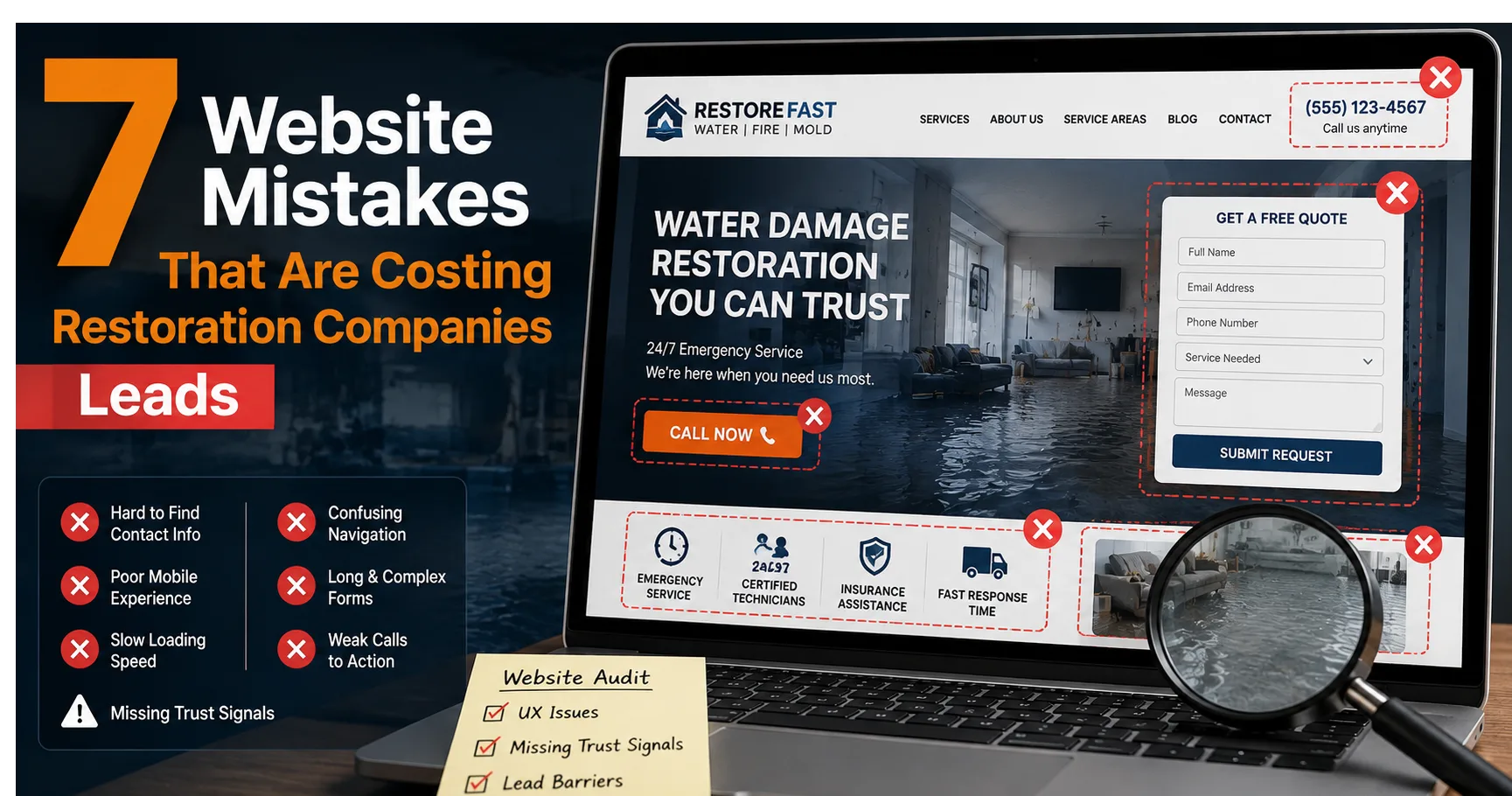
It sounds basic, but it's shockingly common. Many restoration sites tuck their phone number into a tiny header link or bury it at the bottom of the page. For a customer dealing with an active emergency, that's an instant deal-breaker.
The fix: Make your phone number large, clickable, and visible on every page ideally in a sticky header that stays visible as visitors scroll, especially on mobile.
Mistake #2: Slow Page Load Times
Restoration customers are often searching from a flooded basement or a smoke-filled kitchen, frequently on spotty mobile connections. If your homepage takes more than a few seconds to load, most visitors won't wait around.
The fix: Compress images, minimize unnecessary scripts and plugins, and choose lightweight hosting. Page speed isn't a technical detail it's directly tied to how many leads you capture.
Mistake #3: One Generic "Services" Page for Everything
Lumping water damage, fire damage, mold remediation, and storm damage into a single vague services page hurts both user experience and SEO. Visitors can't quickly confirm you handle their specific problem, and search engines can't rank you well for niche, high-intent searches like "mold remediation company."
The fix: Build out dedicated pages for each core service, with details specific to that type of damage what the process looks like, what customers can expect, and relevant before/after examples.
Mistake #4: No Local SEO Strategy
A beautifully designed website that doesn't show up in local search results is invisible to the customers who need you most. Many restoration companies have never optimized for "near me" searches or set up their Google Business Profile correctly.
The fix: Add location-specific pages if you serve multiple service areas, use schema markup, and make sure your business name, address, and phone number are consistent across your website and all directory listings.
Mistake #5: Long, Complicated Contact Forms
Some restoration sites ask visitors to fill out a ten-field form just to request a quote. In an emergency, that's friction most people won't tolerate.
The fix: Keep forms short name, phone number, a brief description of the issue, and maybe a service area. Pair the form with a prominent click-to-call button so visitors can choose whichever option feels faster to them.
Mistake #6: No Visible Trust Signals
Restoration work often involves letting strangers into a home or business during a highly stressful time. If your site doesn't show certifications, insurance information, or real customer testimonials, visitors have no easy way to feel confident choosing you over a competitor.
The fix: Prominently display certifications like IICRC, insurance partnerships, years in business, and genuine customer reviews ideally with before-and-after photos that demonstrate real results.
Mistake #7: A Backend Only a Developer Can Update
Many restoration companies are stuck waiting days or weeks for a freelance developer just to update a service area, swap out photos, or publish a new blog post. That delay means your site is always slightly behind your actual business.
The fix: Make sure your website runs on a content management system your own team can use no code required. This keeps your content fresh, your SEO improving over time, and your team independent.
The Bigger Picture
None of these mistakes are the result of a bad restoration business they're simply the natural result of websites that were built once and never revisited, or built by a general-purpose designer without an understanding of how restoration customers actually behave. The good news is that every one of these issues is fixable, often without a complete rebuild.
If your website is quietly costing you leads, it might be time for an honest audit not a full redesign, but a clear look at what's working and what's holding you back. If you're ready for that audit, customized restoration web design package can help you identify exactly what's holding your site back and fix it fast.
Frequently Asked Questions
Q: How do I know if my website is actually losing me leads?
Common warning signs include a high bounce rate on mobile, very few form submissions or calls coming from your website, and a homepage that takes several seconds to load. Checking your site's analytics alongside a simple mobile speed test can reveal a lot in just a few minutes.
Q: Do I need to rebuild my entire website to fix these issues?
Not always. Many of these mistakes like a buried phone number, a slow homepage, or a missing local SEO setup can be fixed with targeted updates rather than a full rebuild. A full redesign usually makes sense only when the underlying platform itself is outdated or difficult to update.
Q: How often should a restoration company update its website?
At minimum, service pages and contact information should be reviewed a few times a year. Ideally, your site should be updated more frequently with new before-and-after photos, blog content, and any changes to service areas or certifications.
Q: Is local SEO really that important for a small restoration business?
Yes, arguably more important than for larger, multi-market brands. Most restoration searches are hyper-local ("water damage restoration [city]"), so ranking well in your specific service area often matters more than competing for broad, generic terms.
Q: What's the single highest-impact fix on this list?
If you can only fix one thing right away, prioritize page speed and a visible phone number. These two factors have the most direct impact on whether an urgent visitor stays on your site long enough to contact you.