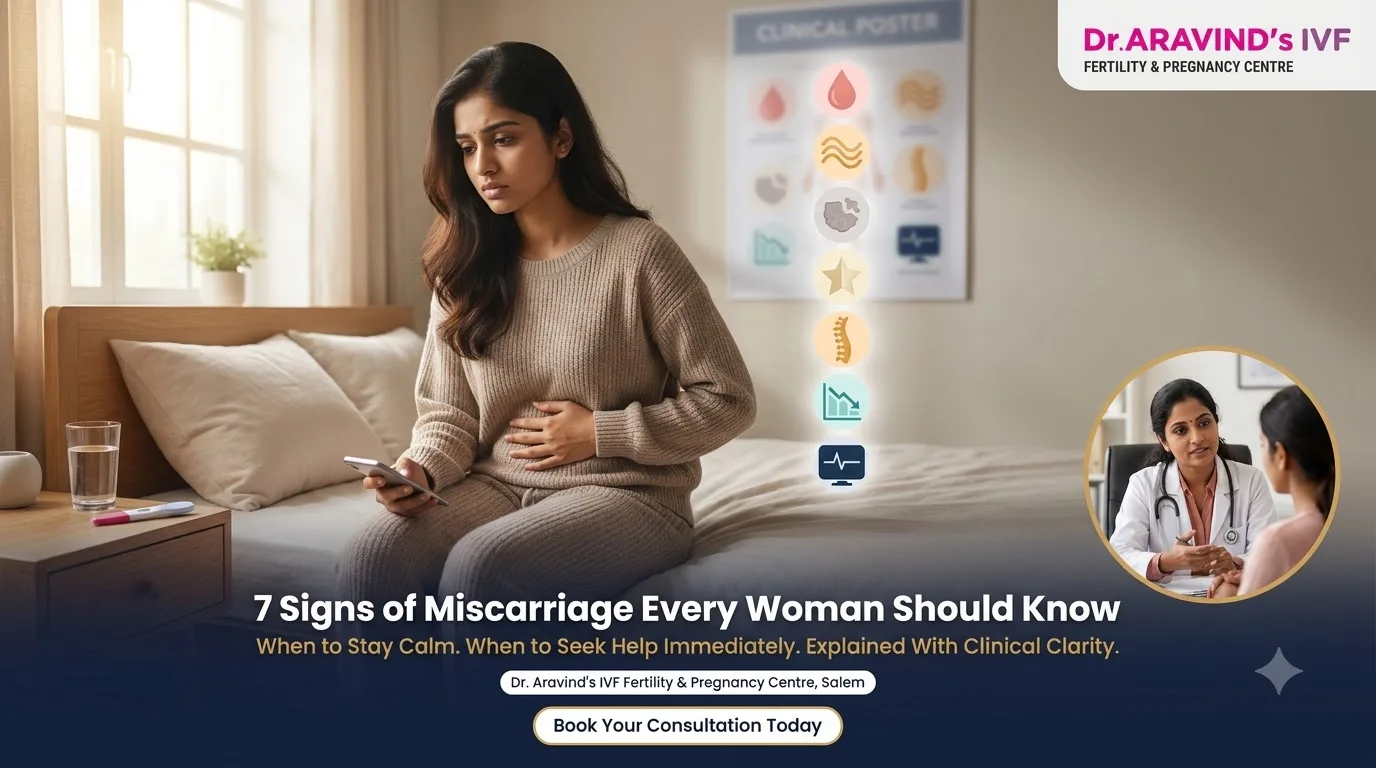
Knowing the signs of miscarriage is not about living in fear during pregnancy. It is about being informed enough to act quickly when something genuinely needs medical attention — and to understand which experiences, while frightening, are not necessarily signs that a pregnancy has been lost.
This distinction matters enormously. Many women experience symptoms during early pregnancy that feel alarming but are not indicators of miscarriage. Others experience symptoms that are easily dismissed as normal variation but genuinely warrant immediate clinical evaluation. Understanding the difference gives women the clearest possible picture of when to stay calm and when to seek urgent care.
At Dr. Aravind’s IVF Fertility & Pregnancy Centre, the best fertility centre in Salem, supporting women through every stage of the pregnancy journey — including its most difficult moments — is a clinical and human priority.
Why Understanding Signs of Miscarriage Matters
Miscarriage affects approximately ten to twenty percent of known pregnancies. The majority occur in the first trimester — before twelve weeks — and many happen before a woman has even confirmed her pregnancy. The signs of miscarriage vary in nature and severity, and not every sign means a pregnancy has definitively ended.
For a complete clinical guide to signs of miscarriage including causes, what each symptom means, and when to seek immediate care, this resource covers every detail women need to know. What follows here is a focused, clear breakdown of the seven most important signs every woman should recognise.
Sign 1: Vaginal Bleeding
Vaginal bleeding during pregnancy is the most common sign associated with miscarriage — but it is not a definitive one. Light spotting in early pregnancy — particularly around the time of the expected period or at implantation — is relatively common and does not necessarily indicate miscarriage. However, heavy vaginal bleeding similar to or heavier than a normal period, bleeding accompanied by cramping, or bleeding that increases in intensity are all signs that require immediate clinical evaluation.
The clinical rule is straightforward: any vaginal bleeding during pregnancy should be reported to a healthcare provider without delay. The provider will assess whether the bleeding is associated with an open cervix, tissue passage, or declining pregnancy hormone levels — the factors that distinguish miscarriage from other causes of early pregnancy bleeding.
Sign 2: Cramping and Abdominal Pain
Mild cramping in early pregnancy is common and often reflects normal uterine growth and change. Severe abdominal cramping — particularly cramping that is stronger than normal period pain, that builds progressively, or that is accompanied by vaginal bleeding — is a significant warning sign. Lower back pain that accompanies cramping adds further clinical concern.
The combination of heavy bleeding and severe cramping together represents the most urgent presentation of miscarriage signs and requires immediate medical attention — not a wait-and-see approach.
Sign 3: Passage of Tissue or Clots
Passing recognisable tissue or large clots through the vagina is one of the clearest physical indicators that a miscarriage is occurring or has occurred. This tissue may appear grey, pink, or white in colour — distinct from normal blood clots. When tissue passage occurs, women should seek immediate clinical care. Where possible, passed tissue should be collected and brought to the healthcare provider for examination — it provides information that helps confirm the type of miscarriage and guides subsequent care decisions.
Sign 4: Sudden Disappearance of Pregnancy Symptoms
Most women experience pregnancy symptoms — breast tenderness, nausea, fatigue, frequent urination — that reflect rising HCG levels. A sudden, complete disappearance of these symptoms — particularly if it occurs abruptly rather than gradually — can indicate that the pregnancy is no longer progressing. This sign is less definitive than bleeding or cramping because pregnancy symptoms naturally reduce in many women as the first trimester progresses. But when the disappearance is sudden, dramatic, and accompanied by other concerns, it warrants clinical investigation through an HCG blood test or ultrasound.
Sign 5: Lower Back Pain
Lower back pain that is more persistent and more intense than typical pregnancy-related discomfort — particularly when it accompanies cramping or bleeding — is a warning sign worth taking seriously. In some miscarriages, the pain radiates from the lower abdomen into the lower back as the uterus contracts. Severe lower back pain without bleeding or cramping can also indicate an ectopic pregnancy — a serious condition where the fertilised egg has implanted outside the uterus, typically in the fallopian tube — which requires immediate emergency care.
Sign 6: Declining HCG Levels on Blood Tests
HCG — human chorionic gonadotropin — is the hormone produced by the placenta that confirms and sustains pregnancy. In a healthy pregnancy, HCG levels approximately double every forty-eight to seventy-two hours in the first trimester. When HCG levels plateau or decline on serial blood tests, this is a clinical indicator that the pregnancy may not be progressing normally — even in the absence of physical symptoms.
As one of the best IVF centres in India, Dr. Aravind’s IVF Fertility & Pregnancy Centre monitors HCG levels carefully in early pregnancy — particularly for women who have conceived through IVF or who have a history of recurrent miscarriage — because the blood test often reveals a problem before physical symptoms appear.
Sign 7: Absence of Heartbeat on Ultrasound
For pregnancies that have progressed beyond six to seven weeks, an ultrasound that shows no fetal heartbeat — when a heartbeat was previously present or when one would normally be expected based on gestational age — is a definitive clinical indicator of pregnancy loss. This is typically identified during a routine pregnancy scan or a scan performed to investigate other concerning symptoms.
A missed miscarriage — where the embryo has stopped developing but the body has not yet begun the physical process of pregnancy loss — is frequently diagnosed this way. The woman may have no symptoms at all. The diagnosis comes entirely through imaging, which is one reason why early pregnancy monitoring through ultrasound is clinically important for women with risk factors for miscarriage.
What to Do When Signs of Miscarriage Appear
Seek immediate medical care when heavy vaginal bleeding, severe cramping, or tissue passage occurs. Contact your healthcare provider promptly when lighter bleeding, persistent cramping, sudden disappearance of pregnancy symptoms, or significant lower back pain develops. Do not dismiss these signs as normal variation without clinical assessment.
For women at the best fertility centre in Salem who are receiving fertility treatment or who have a history of recurrent miscarriage, any early pregnancy concern should be communicated to the clinical team immediately — serial HCG monitoring and early ultrasound surveillance provide the most complete picture of how the pregnancy is progressing.
Conclusion
The signs of miscarriage range from clearly urgent — heavy bleeding, severe cramping, tissue passage — to subtler indicators that require clinical investigation to interpret correctly. Every woman deserves to understand these signs clearly, without confusion, and without the anxiety that comes from not knowing what to look for or when to act.
As the best fertility centre in Salem and a trusted name among the best IVF centres in India, Dr. Aravind’s IVF Fertility & Pregnancy Centre provides complete support for women at every stage of pregnancy — including early pregnancy monitoring, recurrent miscarriage evaluation, and compassionate care when pregnancy does not continue as hoped.
FAQ
Q1. What are the first signs of miscarriage in early pregnancy?
The most common early signs of miscarriage include vaginal bleeding ranging from light spotting to heavy flow, cramping more intense than normal period pain, passage of tissue or clots, sudden disappearance of pregnancy symptoms, and lower back pain accompanying uterine cramping. Not all of these signs are definitive — but any of them during early pregnancy warrants clinical evaluation without delay.
Q2. Can you have a miscarriage without heavy bleeding?
Yes. A missed miscarriage — where the embryo has stopped developing but the body has not begun physical expulsion — frequently occurs without heavy bleeding or significant cramping. It is typically identified through ultrasound showing absence of a foetal heartbeat when one would be expected. Declining HCG levels on serial blood tests also indicate a pregnancy that is not progressing normally, regardless of physical symptoms.
Q3. How do I know if my cramping is a sign of miscarriage?
Mild cramping in early pregnancy is common and often normal. Severe cramping — stronger than typical period pain, progressive in intensity, or accompanied by vaginal bleeding or tissue passage — is a warning sign requiring immediate medical evaluation. The combination of significant cramping and bleeding together is the most urgent presentation and should be assessed without delay.
Q4. What is a missed miscarriage and how is it diagnosed?
A missed miscarriage occurs when the embryo stops developing but the body does not immediately respond with physical symptoms. It is diagnosed through ultrasound showing no foetal heartbeat at a gestational age where one is expected, or through serial HCG blood tests showing declining levels. Women with a history of recurrent miscarriage or who are receiving IVF treatment typically receive earlier and more frequent monitoring precisely to identify this pattern.
Q5. When should a woman in Salem seek emergency care for miscarriage signs?
Seek emergency care immediately for heavy vaginal bleeding soaking more than one pad per hour, severe abdominal or lower back pain, tissue passage, signs of dizziness or faintness suggesting significant blood loss, or any symptoms suggesting ectopic pregnancy — including one-sided pelvic pain with or without bleeding. At the best fertility centre in Salem, Dr. Aravind’s IVF Fertility & Pregnancy Centre provides urgent assessment and compassionate support for women experiencing these symptoms at any stage of early pregnancy.