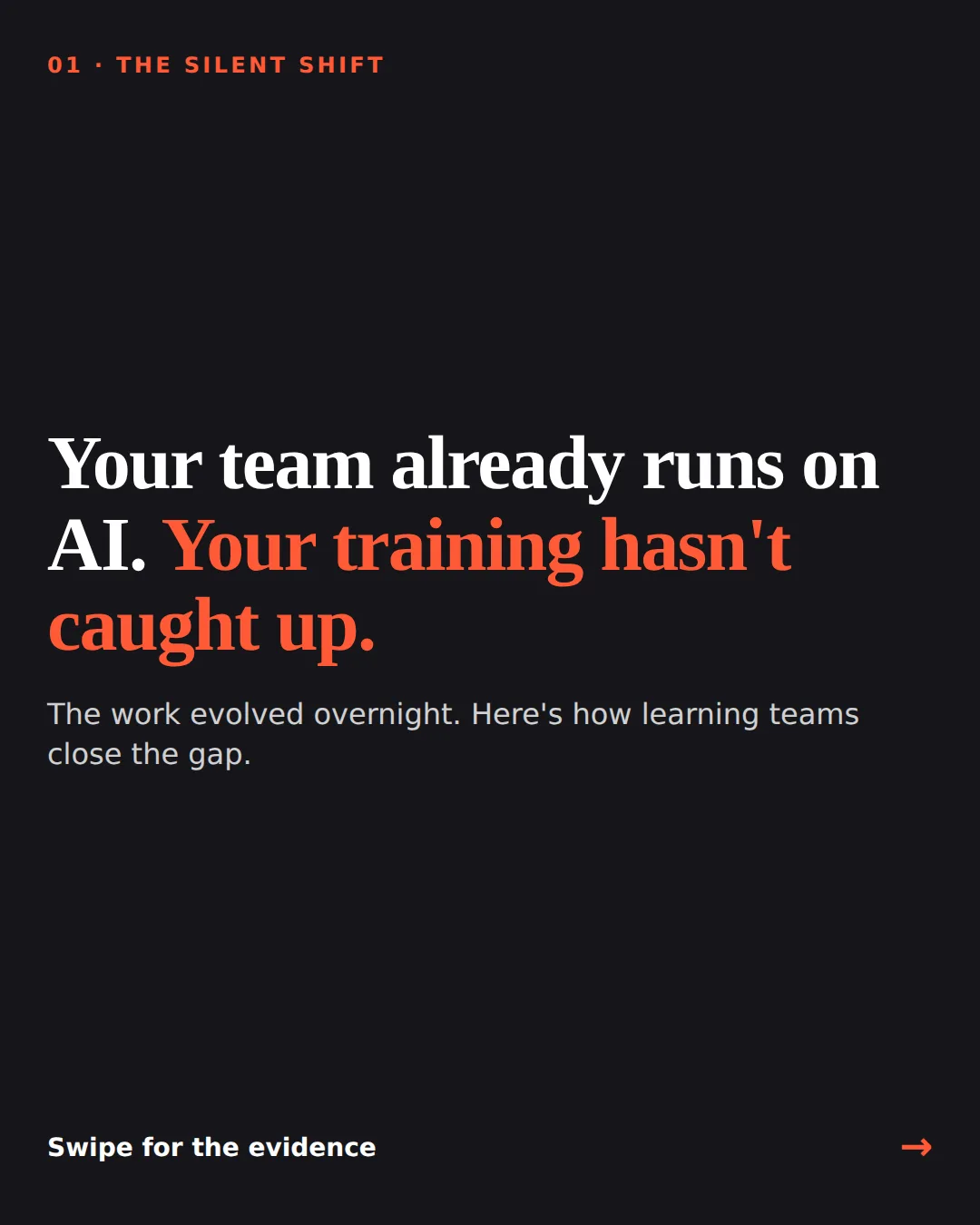
Quick test. In the last week, did you use AI to write something, summarise something, or answer a question you'd normally ask a coworker?
If yes, you're not alone. And you're part of a shift that's changing what "doing your job" even means.
Here are seven signs it has already happened, and what training teams can do about each one.
1. Most Jobs Have More "Information Work" Than You Think
Researchers at Microsoft looked at 200,000 real Copilot conversations and tied them to actual work tasks. What stood out was that AI does best with writing, editing, explaining, researching, and replying to questions.
Sounds like a tech job? It isn't. Think of a nurse writing notes, a store manager building a schedule, or a support agent answering a customer. Information work is everywhere.
What training teams can do: stop treating AI as a specialist topic. Treat it as a basic skill for everyone.
2. AI Is Doing More Than Simple Jobs Now
Early on, people used AI to fix spelling or shorten an email. That's changing. Microsoft's 2026 Work Trend Index, which surveyed 20,000 AI-using workers across 10 countries, found that 49% of Microsoft 365 Copilot conversations now support cognitive work such as analysis, problem-solving, and strategic thinking.
That's a big jump from "make this sound nicer." When AI helps with real thinking, mistakes matter more.
What training teams can do: teach people how to question and check AI's reasoning, not only how to use the tool.
3. Some Tasks Are Handled by AI, Others Are Just Helped
Not all AI use is the same. Sometimes it's a helper, and you still do the work. Other times AI does a chunk of the task itself.
That difference decides what a person needs to learn next. A helper needs good questions and sharp checking. A task that's been taken over needs a person who knows what to do with the time it frees up.
What training teams can do: map tasks role by role. Ask which ones AI should take, which need a human, and where speed adds risk.
4. Rules Are Catching Up
Regulation is starting to push training forward. The EU AI Act now requires employers to make sure their staff has enough AI literacy, which is nudging companies to offer more training than before.
Even if you're not in Europe, it signals where things are going. Knowing how to use AI responsibly is turning into a baseline expectation.
What training teams can do: build a simple, clear AI-use guide and back it with real practice, not just a policy PDF nobody reads.
5. People Want to Try AI, But Support Is Thin
Many workplaces say they welcome experimenting. Fewer say their tech teams are actually helping. That leaves employees to learn by trial and error, and mistakes can slip through.
What training teams can do: create safe spaces to practise, such as short sandbox exercises and peer sharing sessions, so people can try things without real-world consequences.
6. Training Is Getting a Serious Push
Companies know they need to act. As the World Economic Forum reports, 85% of employers plan to focus on upskilling and reskilling their current workforce over the next five years.
Hold on, though. Doing more training isn't the same as doing better training. With budgets under a spotlight, teams will need to show that learning leads to real change at work.
What training teams can do: decide up front how you'll measure success in business terms, before the program starts.
7. Old Ways of Measuring Don't Work Anymore
This is the sign most teams miss. Completion rates and happy-face surveys say very little about whether someone is working better.
Better signs to watch:
- Fewer errors and less rework
- Better decisions in hard moments
- Right problems sent to the right people
- Quicker output at the same quality
Your learning management system (LMS) is great for tracking who finished what. Use it as a starting point, then pair it with real work results.
What training teams can do: judge training by outcomes, not attendance.
A Quick Word on Expertise
Some people believe AI will make expertise less important. In practice, it does the opposite. If you don't know a subject, you can't tell when AI has gotten it wrong, and it often sounds very sure of itself.
As Bill Gates once said:
"The advance of technology is based on making it fit in so that you don't really even notice it, so it's part of everyday life."
That's exactly what's happening. AI is fading into the background of daily work. When something becomes invisible, people trust it without thinking. That's why judgment and checking habits matter so much.
Where AI Still Falls Short
Knowing the weak spots is part of using AI well. It's not great at hands-on physical work, decisions that depend on deep context, or situations that need a careful read of people and history. It can also make up facts.
Teach people three habits: verify anything important, question answers that seem too smooth, and ask a human when the stakes are high.
A Simple Plan for Training Teams
Here's a no-fuss way to begin.
Pick one team. List their three most time-consuming tasks. Work out where AI helps, where it doesn't, and where a person must stay in charge.
Then practise. Short, realistic scenarios beat long presentations. Ask people to decide what to hand to AI and what to check, and to explain why.
Keep some live time too. Instructor-led training (ILT) works well for discussing risky situations and sharing real stories, which people remember far longer than slides.
When your programs grow, a training management system (TMS) can take over the everyday admin, like scheduling sessions, coordinating trainers, and tracking costs, so your team has time for the design work that matters.
Finally, add AI skills to job expectations. Clear instructions, checking output, and knowing when to escalate should be part of how people are coached and evaluated.
The Role of L&D Is Shifting Too
AI can now draft materials and explain basic topics. So an L&D team that mainly produces content will feel the squeeze.
The opportunity is in what AI can't do well: finding out why performance drops, designing practice that feels real, building proof of results, and linking learning to business goals. Think less "content factory," more "performance partner."
The Takeaway
AI hasn't wiped out jobs, but it has changed what's inside them. The companies that adjust early, measure what matters, and train for judgment will be far ahead of those still counting course completions.
Ask yourself again: has AI already changed your job? If the answer is yes, your training should have changed too.
Frequently Asked Questions
Q.1 Is AI really changing every job?
It's touching most of them, because most jobs include some information work like writing, reporting, or answering questions. The size of the change varies by role.
Q.2 Should every employee get AI training?
Yes, at a basic level. Beyond that, training works best when it's tied to the specific tasks in each person's role.
Q.3 How long does it take to see results from AI training?
Simple, task-based training can show results in weeks, such as fewer errors or faster turnaround. Bigger changes in decision-making take longer.
Q.4 What skills matter most alongside AI?
Solid knowledge of your field, clear thinking, careful checking, and good judgment about risk. These matter more as AI gets more capable.
Q.5 Can small businesses afford this kind of training?
Yes. Start with one team and a few real tasks. Short practice exercises and shared learning sessions cost far less than large programs.
Q.6 What's the safest way to use AI at work?
Check important facts, avoid sharing sensitive data, follow your company's rules, and involve a person when a mistake would be costly.