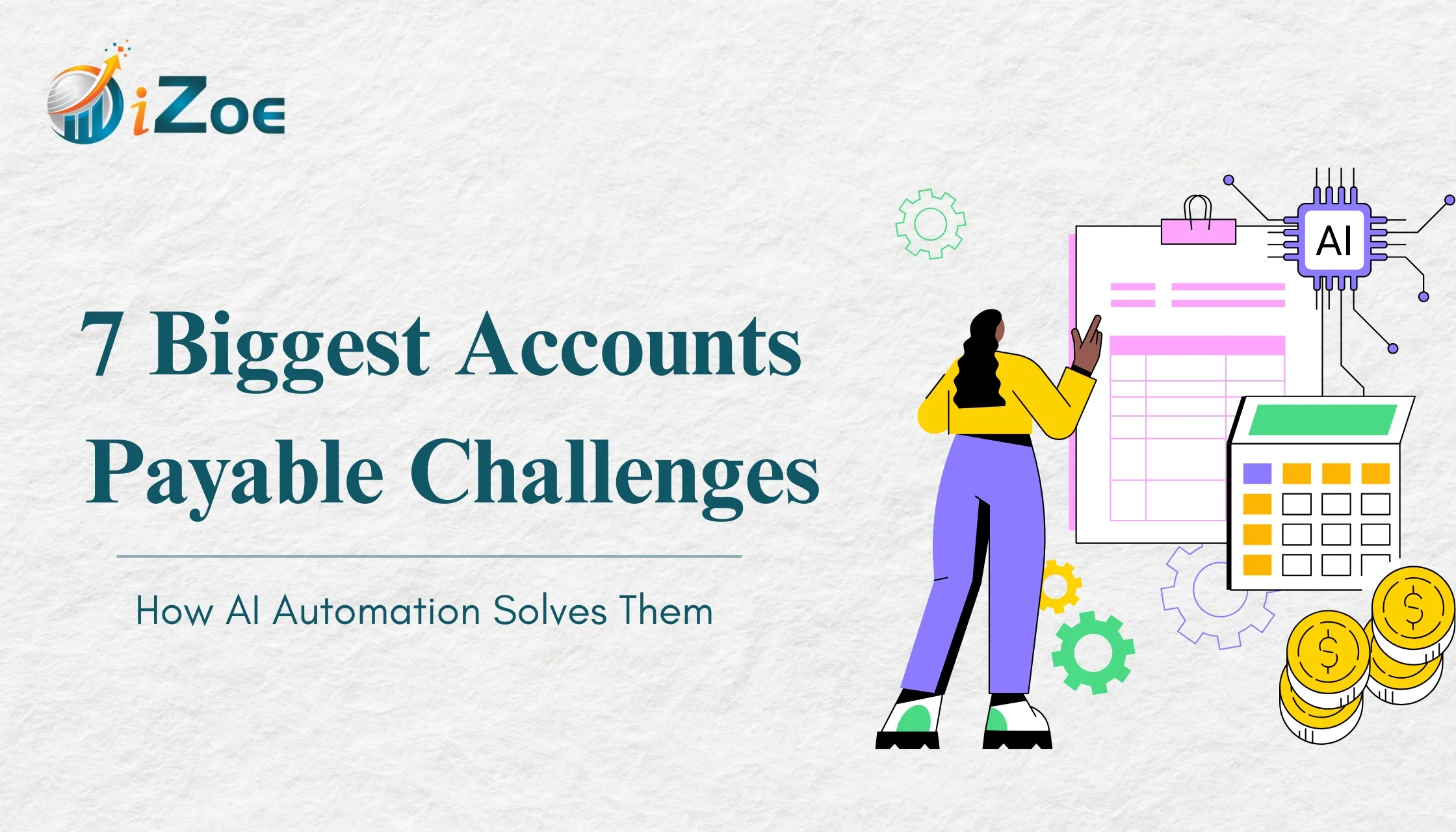
Accounts payable (AP) is one of the most critical -yet most time-consuming functions in finance. Every invoice processed correctly keeps vendor relationships strong, ensures compliance, and protects cash flow. But for many businesses, AP is still heavily manual and prone to errors.
From endless data entry to GST reconciliation stress, finance teams often spend more time fixing mistakes than creating insights.
This is where AI accounting tools and AP automation are transforming the way modern finance teams work.
Let’s explore the 7 biggest accounts payable challenges and how AI automation is solving them.
1. Manual Invoice Data Entry Slows Down Finance Teams
In traditional workflows, invoices arrive via email, WhatsApp, PDFs, or paper. Someone has to:
- Download them
- Read them
- Enter details into accounting software
- Double-check every number
Multiply this by hundreds of invoices each month, and AP quickly becomes a time drain.
How AI Solves It
AI-powered invoice OCR can read invoices instantly and convert them into structured accounting data.
Instead of typing, finance teams simply upload invoices — and AI extracts vendor details, invoice numbers, dates, taxes, and totals automatically.
Impact:
• Save hours of manual work every week
• Process invoices faster than ever before
2. Human Errors Cause Financial Discrepancies
Manual data entry inevitably leads to mistakes:
- Incorrect GST numbers
- Wrong invoice amounts
- Missed line items
- Typing errors
Even small mistakes can create compliance risks and reconciliation headaches.
How AI Solves It
AI accounting tools run automated validation checks to ensure data accuracy before entries are created.
These tools verify:
- Vendor information
- Tax calculations
- Invoice totals
- Data consistency across records
Impact:
• Cleaner books
• Fewer corrections and rework
3. Duplicate Invoices and Fraud Risks
Duplicate invoices are more common than businesses expect. They often occur when:
- Vendors resend invoices
- Multiple teams upload the same document
- Files arrive through different channels
This can lead to duplicate payments and revenue loss.
How AI Solves It
AI can analyze invoice patterns, vendor history, and transaction data to detect duplicates and suspicious activity instantly.
Impact:
• Prevent double payments
• Reduce fraud risk
• Protect company cash flow
4. GST Reconciliation is Complex and Stressful
For Indian businesses, GST compliance adds another layer of complexity to AP.
Manual reconciliation between invoices and GST returns is time-consuming and prone to errors. Missed mismatches can lead to penalties and last-minute panic during filing.
How AI Solves It
AI continuously monitors transactions and identifies GST mismatches early.
Instead of scrambling during filing season, finance teams get proactive alerts and can fix issues in advance.
Impact:
• Faster reconciliation
• Reduced compliance risk
• Less stress during GST filing
5. Slow Approval Workflows Delay Payments
Invoice approvals often involve multiple stakeholders:
- Finance teams
- Department heads
- Founders or CFOs
Manual approval processes lead to lost invoices and delayed payments, damaging vendor relationships.
How AI Solves It
AI automation streamlines approval workflows by organizing invoices and keeping everything centralized and trackable.
Impact:
• Faster approvals
• On-time vendor payments
• Stronger vendor trust
6. Lack of Real-Time Visibility into Payables
Without automation, finance teams struggle to answer key questions like:
- How much do we owe vendors today?
- What payments are due this week?
- How is our cash flow trending?
Delayed reports mean delayed decisions.
How AI Solves It
AI accounting tools provide real-time dashboards and insights.
Finance teams can instantly see outstanding payables, upcoming payments, and cash flow impact.
Impact:
• Better financial planning
• More confident decision-making
7. Scaling AP Requires Hiring More Staff
As businesses grow, invoice volume increases. Without automation, scaling AP means hiring more accountants — increasing operational costs.
How AI Solves It
AI scales effortlessly. Whether processing 100 or 10,000 invoices, automation handles the workload without additional headcount.
Impact:
• Lower operational costs
• Seamless business growth
Why AI Accounting Tools Are the Future of Accounts Payable
AI is not replacing accountants - it is transforming their role.
By removing repetitive work, AI allows finance teams to focus on:
- Financial strategy
- Analysis and forecasting
- Business advisory
This shift is helping finance teams become strategic partners in business growth.
How iZoe Supports the Shift to AI Accounting
At iZoe, we help finance teams and accountants move away from manual processes and embrace intelligent automation. Our goal is to simplify financial operations so teams can focus on analysis, strategy, and growth instead of repetitive data entry.
To enable this transition, we offer our AI-powered accounting tool- Akounter AI.
Akounter AI helps businesses:
- Convert invoices into accounting entries using OCR AI
- Run 50+ automated checks to keep books accurate and error-free
- Identify GST mismatches early
- Sync seamlessly with existing accounting software
- Access real-time reports and financial insights
If you’re ready to modernize your accounts payable workflow and explore the power of AI accounting, this is a great place to begin.
FAQs
1. What is accounts payable automation?
Accounts payable automation uses AI and software to automate invoice capture, validation, approvals, and reporting, reducing manual work and errors.
2. What is invoice OCR in accounting?
Invoice OCR uses AI to read invoices and extract key details like vendor name, invoice number, GST, and amounts automatically.
3. Is AI accounting suitable for small businesses?
Yes. AI accounting tools are especially helpful for small and growing businesses because they save time, reduce hiring needs, and improve accuracy.
4. Can AI help with GST compliance?
Yes. AI tools can detect GST mismatches early and simplify reconciliation, reducing compliance risks.
5. Will AI replace accountants?
No. AI handles repetitive tasks, allowing accountants to focus on higher-value work such as advisory and financial planning.