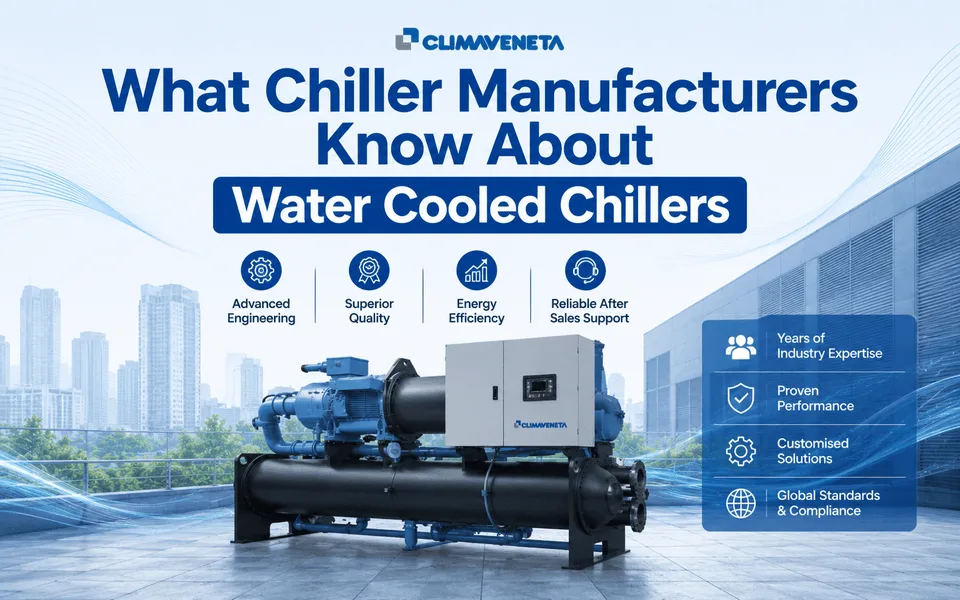
When discussing Air Source Heat Pumps and commercial cooling systems developed by leading Chillers Manufacturers, many people assume they are entirely different technologies. In reality, they share the same engineering principles and several core components.
Both systems are designed to transfer heat rather than generate it. While a chiller removes heat from a building to provide cooling, an Air Source Heat Pump extracts heat from the surrounding air to deliver heating. Although their applications differ, the underlying technology remains largely the same. The primary differences lie in system configuration, control strategy, and intended use.
Let's explore the five common technologies that form the foundation of both Air Source Heat Pumps and chillers.
5 Common Technologies That Power Both Air Source Heat Pumps and Chillers
1. Compressor Technologies – The Core of Every System
The compressor is one of the most important components in both Air Source Heat Pumps and chillers. It compresses the refrigerant, allowing heat to be transferred efficiently throughout the refrigeration cycle. Without a compressor, neither heating nor cooling is possible.
Scroll CompressorsScroll compressors are commonly used in residential and light commercial Air Source Heat Pumps. They are compact, operate quietly, and have fewer moving parts, making them reliable and energy efficient. Many Chillers Manufacturers also use scroll compressors in smaller-capacity systems where dependable performance is essential.
Screw CompressorsFor larger commercial and industrial applications, screw compressors are the preferred choice. They are built to handle higher capacities and continuous operation, making them ideal for heavy-duty chillers and high-capacity Air Source Heat Pumps.
Inverter and Variable Speed DrivesModern systems increasingly use inverter-driven compressors instead of traditional fixed-speed units. These compressors automatically adjust their operating speed based on the building's heating or cooling demand.
This technology offers several important benefits:
- Lower energy consumption
- Reduced mechanical wear and tear
- Improved efficiency during partial-load operation
Today, variable-speed compressor technology has become a standard feature in both Air Source Heat Pumps and commercial chillers.
2. Heat Exchanger Technology – The Centre of Heat Transfer
Heat exchangers are responsible for transferring heat between the refrigerant and the surrounding air or water. Their design directly affects system efficiency, refrigerant usage, maintenance requirements, and operating costs.
Microchannel Coils
Microchannel coils use multiple small aluminum channels to improve heat transfer while reducing refrigerant volume. Their lightweight construction and compact design make them increasingly popular in both outdoor Air Source Heat Pumps and systems produced by leading Chillers Manufacturers.
Finned Tube Coils
Copper tubes with aluminum fins continue to be widely used, particularly in Air Source Heat Pumps. Their durability and ease of maintenance make them highly effective, especially during defrost cycles where frost needs to be removed efficiently.
Plate Heat Exchangers
Plate heat exchangers are commonly installed on the water side of hydronic systems. Their compact construction and excellent thermal efficiency make them suitable for both chillers and water-based heat pump applications.
The primary objective remains the same—maximize heat transfer while minimizing pressure losses and refrigerant consumption.
3. Electronic Expansion Valves – Accurate Refrigerant Control
Older HVAC systems relied on mechanical expansion valves, but modern equipment uses Electronic Expansion Valves (EEVs) controlled by advanced microprocessors.
These valves precisely regulate refrigerant flow to maintain the correct level of superheat. Superheat is the temperature of refrigerant vapor above its boiling point. Maintaining the correct superheat prevents liquid refrigerant from entering the compressor, protecting it from damage.
Electronic Expansion Valves provide several advantages:
- Faster response to changing load conditions
- Stable operation in varying outdoor temperatures
- Higher seasonal energy efficiency
This level of precision is essential for both Air Source Heat Pumps operating across different climates and chillers serving buildings with constantly changing cooling demands.
4. Advanced Refrigerants – Improving Sustainability
Environmental regulations continue to influence the HVAC industry. Policies such as the Kigali Amendment have encouraged manufacturers to adopt refrigerants with lower Global Warming Potential (GWP).
Some of the most commonly used refrigerants today include:
- R32
- R454B
- R290
These refrigerants help reduce environmental impact while maintaining excellent cooling and heating performance. As a result, both Air Source Heat Pumps and products from leading Chillers Manufacturers are increasingly designed around low-GWP refrigerants.
This shift requires careful engineering to accommodate different operating pressures, material compatibility, and refrigerant charge requirements.
5. Smart Controls and Connectivity – Intelligent System Management
Modern HVAC systems have evolved beyond simple mechanical equipment. They now incorporate intelligent controls and connected technologies that improve efficiency and simplify maintenance.
Building Management System (BMS) Integration
Communication protocols such as BACnet and Modbus enable Air Source Heat Pumps and chillers to integrate seamlessly with Building Management Systems (BMS).
This allows facility managers to monitor performance, optimize energy consumption, and coordinate multiple HVAC systems from a single platform.
Predictive Maintenance
IoT-enabled sensors continuously monitor operating conditions such as temperature, pressure, and vibration. By identifying potential issues before they become major failures, predictive maintenance reduces downtime and lowers maintenance costs.
Today, intelligent controls have become an important competitive advantage for both Air Source Heat Pump manufacturers and leading Chillers Manufacturers.
Conclusion
From an engineering perspective, Air Source Heat Pumps and chillers are built upon the same refrigeration principles rather than being completely different technologies.
Both systems rely on advanced compressors, efficient heat exchangers, electronic expansion valves, environmentally friendly refrigerants, and intelligent control systems to deliver reliable performance.
Understanding these shared technologies helps businesses and facility managers choose the right solution based on application requirements, operating conditions, and long-term lifecycle costs rather than simply focusing on whether the equipment is labelled as a heat pump or a chiller.
Ultimately, the true difference lies not in the name of the system but in how effectively it has been engineered to deliver efficient, reliable, and sustainable thermal performance.