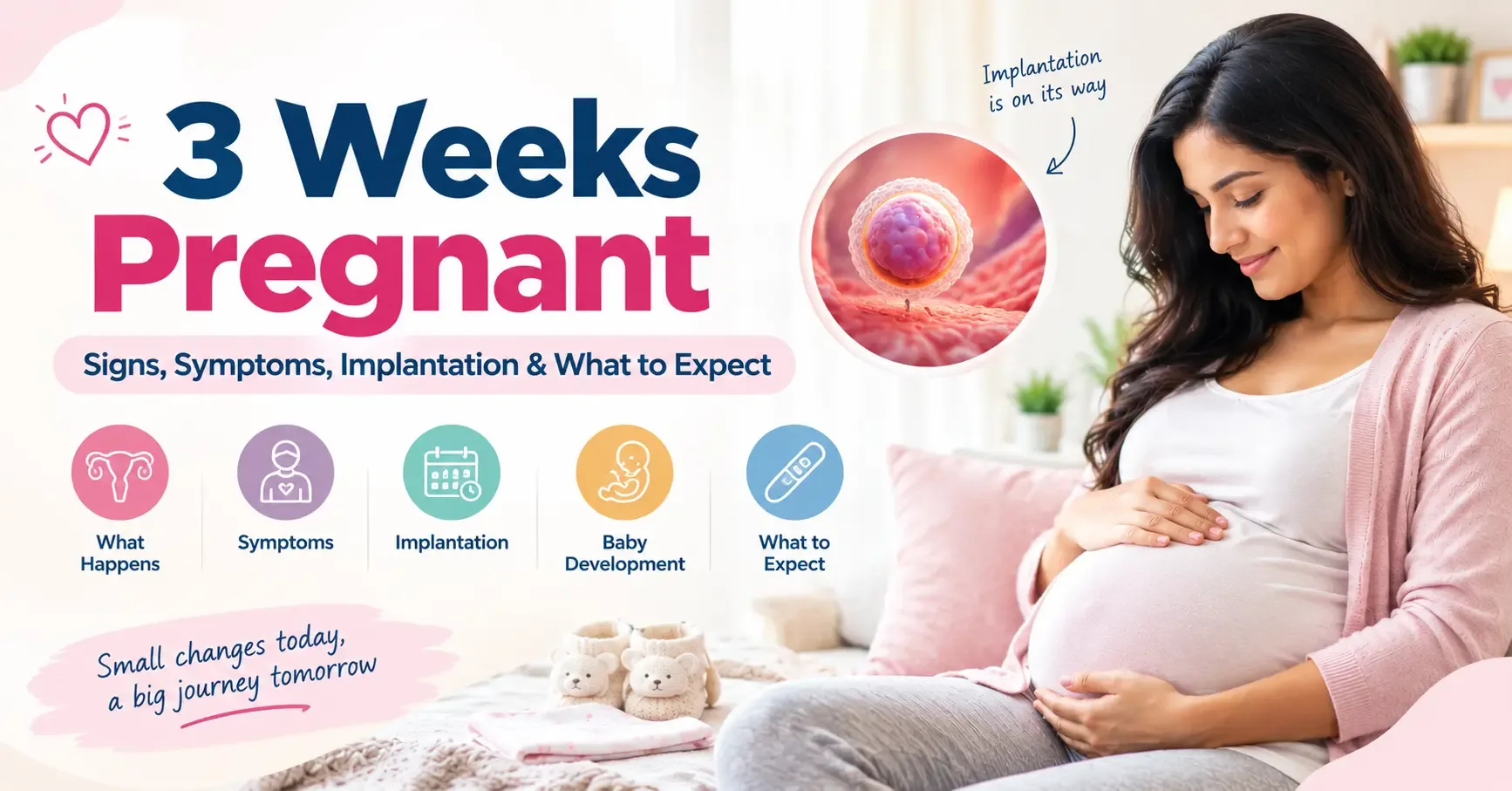
3 Weeks Pregnant: Signs, Symptoms, Implantation & What to Expect
Being 3 weeks pregnant can feel a little confusing. You may have just started wondering whether conception happened, or you may be watching closely for the first signs of pregnancy. At this stage, everything is happening on a very small scale, and you may not feel much different from usual.
One important thing to understand is that pregnancy is usually counted from the first day of your last menstrual period, not from the day of conception. This means that at 3 weeks, conception may have happened only recently, depending on when you ovulated.
Some women notice mild cramping, spotting, tiredness, or breast changes around this time, while others have no symptoms at all. Both can be completely normal.
This guide explains 3 weeks pregnant symptoms, implantation, early pregnancy signs, baby development, pregnancy testing, and 3 weeks pregnant what to expect in the days ahead.
3 Weeks Pregnant in Months: How Many Months Is It?
If you are wondering about 3 weeks pregnant in months, you are still very early in the first month of pregnancy.
Three weeks is roughly less than one month. However, pregnancy is normally tracked in weeks because weeks provide a more accurate way to follow pregnancy development than months.
There is also an important reason the timing can seem confusing. Doctors generally calculate pregnancy from the first day of your last menstrual period. The first two weeks are included even though conception usually has not happened yet.
So, being 3 weeks pregnant does not necessarily mean that conception happened exactly three weeks ago. In a typical cycle, ovulation and conception occur around the middle of the cycle, although the timing can vary from person to person.
If you are unsure about your dates, don't worry. Your healthcare provider can help estimate your pregnancy dates, and an early ultrasound may be used later to confirm gestational age when appropriate.
What Happens at 3 Weeks Pregnant?
At this stage, the most important event may be conception.
Around ovulation, an egg is released from an ovary. If sperm meets the egg and fertilization occurs, a fertilized egg begins dividing into more cells as it travels toward the uterus.
The developing group of cells will eventually reach the uterus and attach to the uterine lining. This process is called implantation.
Because these changes are happening at a microscopic level, you will not be able to see or feel the developing embryo directly.
You may also have no obvious physical changes yet. That is one reason the early days of pregnancy can be difficult to identify.
For many women, the first clear sign comes later, when the expected period does not arrive.
When Does Implantation Happen?
One of the most common questions at this stage is, when does implantation happen?
Implantation occurs after fertilization, when the developing embryo attaches to the lining of the uterus. The exact timing is different for every pregnancy.
For someone with a typical cycle, implantation may occur several days after ovulation. Depending on when ovulation occurred, this can fall toward the end of the third week of pregnancy or around the beginning of the fourth week.
This timing is one reason why 3 weeks pregnant signs can be difficult to identify.
Some people notice very light spotting around the time implantation occurs. This is sometimes called implantation bleeding. However, not every pregnant person experiences it, and spotting can happen for other reasons too.
Implantation should not be confused with a normal menstrual period. If you have bleeding during early pregnancy, particularly if it is heavy or accompanied by significant pain, it is important to speak with a healthcare professional.
3 Weeks Pregnant Symptoms: What Might You Notice?
When it comes to 3 weeks pregnant symptoms, the honest answer is that you may not notice anything yet.
Pregnancy symptoms commonly become more noticeable in the following weeks as pregnancy hormone levels rise. Some people may notice changes earlier, while others may feel completely normal.
Possible early changes include:
- Mild lower abdominal cramping
- Very light spotting
- Breast tenderness
- Feeling more tired than usual
- Bloating
- Mild mood changes
- Increased vaginal discharge
- Changes in taste or smell
- More frequent urination
These symptoms can also happen before a period, which makes them difficult to interpret.
For example, breast tenderness can occur because of normal hormonal changes during the menstrual cycle as well as early pregnancy. Mild cramps may also have several possible causes.
So, having one of these symptoms does not automatically mean you are pregnant.
Likewise, having no symptoms does not mean that pregnancy has not occurred.
3 Weeks Pregnant Signs: Can You Tell You Are Pregnant?
The 3 weeks pregnant signs you notice, if any, may be very mild.
At this stage, the most reliable way to know whether you are pregnant is a pregnancy test rather than symptoms alone.
Some early signs that may eventually become noticeable include:
Mild cramping
Some women describe early pregnancy cramps as similar to mild period cramps. The feeling may come and go and may be difficult to distinguish from normal menstrual changes.
Light spotting
A small amount of light spotting can occur around the time of implantation. However, bleeding during pregnancy should not automatically be assumed to be implantation bleeding.
Breast changes
Hormonal changes can make the breasts feel tender, fuller, or more sensitive.
Tiredness
Fatigue is a common pregnancy symptom, although at 3 weeks it may be too early for many women to notice a significant difference.
Bloating
Hormonal changes can affect digestion and may make you feel bloated or uncomfortable.
Remember that none of these signs can confirm pregnancy on their own.
Early Pregnancy Symptoms: Why They May Not Start Yet
Many people search for early pregnancy symptoms as soon as they believe conception may have occurred.
It is completely understandable to look for clues, but very early pregnancy does not always cause noticeable symptoms.
Pregnancy hormones increase after implantation, and symptoms often become more noticeable later. Some women may start experiencing symptoms around the time of a missed period, while others may not experience much until several weeks into pregnancy.
This means you should not worry if you are 3 weeks pregnant and feel completely normal.
Your body does not need to provide obvious signs immediately for a healthy pregnancy to be developing.
It is also easy to mistake normal premenstrual symptoms for pregnancy symptoms. The best approach is to look at the timing of your menstrual cycle and use a pregnancy test when it is appropriate.
3 Weeks Pregnant Baby Development: What Is Happening?
At 3 weeks, development is just beginning.
After fertilization, the fertilized egg starts dividing into more cells. As it moves toward the uterus, these cells continue developing and organizing.
Eventually, the developing embryo needs to implant into the uterine lining so that the pregnancy can continue developing.
It is far too early to think of the developing pregnancy as a recognizable baby at this point. There are no visible arms, legs, facial features, or a recognizable belly.
However, this early stage is extremely important because the foundations for later development are beginning to form.
The placenta will also eventually develop to support the pregnancy by helping provide oxygen and nutrients and removing waste products.
There is a lot happening even though none of it can be seen from the outside.
What Does a 3 Weeks Pregnant Belly Look Like?
If you are wondering about a 3 weeks pregnant belly, you probably will not have a visible pregnancy bump yet.
Your uterus has not grown enough at this point to create the typical pregnant belly. Any bloating you notice is more likely to be related to normal hormonal or digestive changes than the size of the developing pregnancy.
Every body is different, but a visible baby bump generally develops much later.
So, don't compare your stomach with pregnancy photos online. A flat stomach, bloated stomach, or completely unchanged appearance can all be normal at this stage.
Can You Take a Pregnancy Test at 3 Weeks?
This is another common question: can you get a positive pregnancy test this early?
It depends on when ovulation, fertilization, and implantation occurred.
Pregnancy tests detect human chorionic gonadotropin, commonly called hCG. This hormone rises after implantation.
If implantation has not happened yet, there may not be enough hCG for a home pregnancy test to detect.
Testing too early can therefore produce a negative result even if pregnancy eventually becomes confirmed.
If you test early and receive a negative result but your period does not arrive, consider testing again after a few days or following the instructions provided with your test.
For the most reliable result, follow the timing recommendations on the pregnancy test you are using.
3 Weeks Pregnant What to Expect in the Coming Days
Knowing 3 weeks pregnant what to expect can make this early stage feel less uncertain.
Over the next several days, implantation may occur depending on your ovulation and conception timing. Pregnancy hormone levels may then begin to rise.
You may notice some early changes, or you may continue feeling completely normal.
As you approach the time your period is expected, you may begin noticing more recognizable pregnancy signs.
This is also a good time to start treating your health seriously if pregnancy is possible.
Consider:
- Eating a balanced diet
- Taking a prenatal vitamin as recommended by your healthcare provider
- Getting enough rest
- Staying hydrated
- Avoiding smoking and recreational drugs
- Avoiding alcohol if pregnancy is possible
- Checking medications with your healthcare professional
- Managing existing health conditions with appropriate medical advice
If you take regular prescription medication, do not stop it suddenly without speaking with your doctor. Some medicines should be continued, while others may need to be changed during pregnancy.
What Should You Do If You Think You Are Pregnant?
If you think you may be pregnant, you do not need to have every answer immediately.
Start by confirming the pregnancy with an appropriate test.
Once pregnancy is confirmed, contact your doctor or maternity care provider to discuss prenatal care. Your provider can advise you about supplements, medications, medical conditions, lifestyle choices, and when your first appointment should take place.
Folic acid is particularly important in early pregnancy because it helps reduce the risk of certain neural tube defects. If you have not started a prenatal vitamin or folic acid supplement, speak with your healthcare provider about what is appropriate for you.
It is also useful to note the first day of your last menstrual period. This information is commonly used to estimate your due date.
When Should You Contact a Doctor?
Light spotting or mild cramping can have different causes, but bleeding during early pregnancy should not simply be ignored.
Contact a healthcare professional if you experience:
- Heavy vaginal bleeding
- Significant or worsening abdominal pain
- Severe one-sided pain
- Dizziness or fainting
- Shoulder pain along with abdominal pain or bleeding
- Severe weakness or feeling seriously unwell
These symptoms can sometimes indicate a problem that requires urgent assessment, including ectopic pregnancy or pregnancy loss.
If you are worried about any symptom, it is better to ask a healthcare professional rather than trying to diagnose the cause yourself.
Final Thoughts
Being 3 weeks pregnant is the beginning of a remarkable process, but it can also be a time filled with questions.
You may be checking for 3 weeks pregnant symptoms, wondering about 3 weeks pregnant signs, or searching for answers about when does implantation happen. The important thing to remember is that there is a wide range of normal experiences at this stage.
You may feel mild cramps or notice light spotting, or you may feel absolutely nothing. Neither experience alone can confirm whether you are pregnant.
Because pregnancy is dated from the first day of your last menstrual period, the timing of conception and implantation can also make week 3 seem confusing. A pregnancy test, followed by appropriate medical care, is a much better way to confirm pregnancy than relying on symptoms.
If you think you may be pregnant, take things one step at a time. Look after your health, take recommended prenatal supplements, review medications with your healthcare provider, and arrange prenatal care after a positive test.
The next few weeks will bring many changes, and your healthcare provider can help you understand what is happening at every stage.
Frequently Asked Questions About 3 Weeks Pregnant
Is 3 weeks pregnant considered one month?
Not exactly. 3 weeks pregnant in months means you are still in the first month of pregnancy. Pregnancy is usually tracked in weeks because this provides more precise information about development.
Can you feel pregnancy symptoms at 3 weeks?
Some people may notice mild changes, but many have no symptoms at all. More noticeable pregnancy symptoms often develop later.
What are the most common 3 weeks pregnant symptoms?
Possible symptoms include mild cramps, light spotting, tiredness, breast tenderness, bloating, and changes in vaginal discharge. However, these symptoms can also occur before a period.
When does implantation happen?
Implantation happens after fertilization when the developing embryo attaches to the lining of the uterus. The timing varies between pregnancies and depends partly on when ovulation occurred.
Can implantation cause spotting?
Some women experience very light spotting around implantation, but not everyone does. Bleeding can have many causes, so heavier bleeding or bleeding with pain should be medically assessed.
Can you test positive at 3 weeks pregnant?
It is possible in some cases, depending on when ovulation and implantation occurred and how sensitive the pregnancy test is. Testing very early can give a negative result even when pregnancy later becomes confirmed.
Does no symptoms at 3 weeks mean something is wrong?
No. Having no symptoms this early does not necessarily indicate a problem. Pregnancy symptoms vary widely from one person to another.
Can you feel the baby at 3 weeks?
No. The developing pregnancy is far too small to feel as movement. Noticeable fetal movement happens much later in pregnancy.
Does a 3 weeks pregnant belly show?
Usually, no. A visible pregnancy bump does not normally appear this early. Bloating may occur because of hormonal changes, but it is not the same as a baby bump.