When people talk about drone batteries, LiPo usually comes up first.
That makes sense. LiPo packs can deliver a lot of current, which is exactly what many multirotor drones need during takeoff, climbing and fast movement.
But not every UAV needs that kind of power all the time.
For mapping, inspection, surveying and other long-duration applications, the conversation is often different. The aircraft may spend a long period flying at a relatively steady power level, and carrying extra battery weight can become a problem.
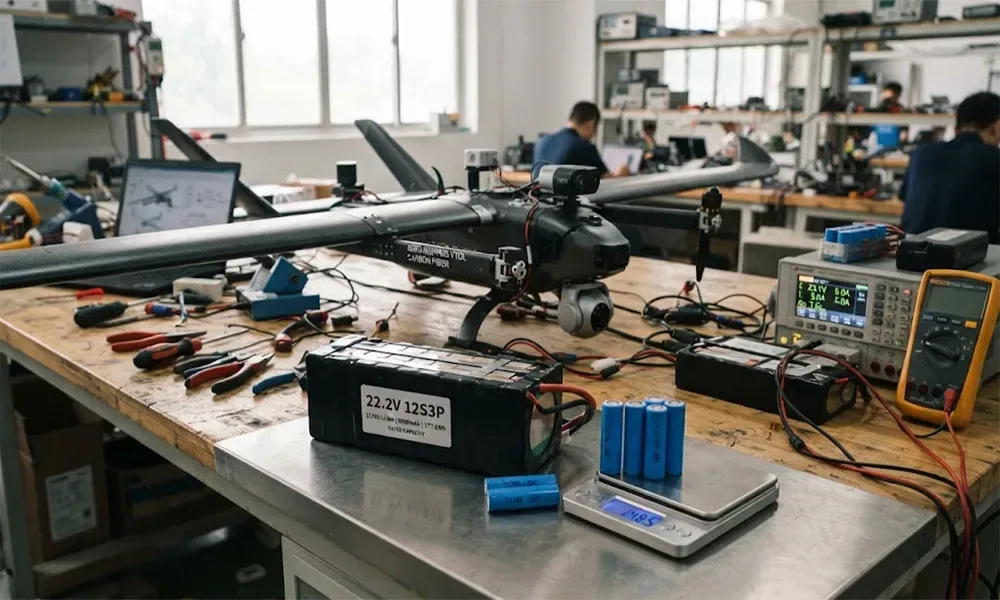
This is where a 21700 drone battery becomes interesting.
The 21700 cell is larger than the familiar 18650 format and can offer higher capacity at the individual-cell level. With the right cell and pack design, it can be a practical option for a long endurance UAV battery.
It is not a magic upgrade for every drone, though. The aircraft’s power requirements still come first.
21700 Li-ion cells are becoming an interesting option for UAVs where energy density and endurance matter. For a broader introduction to drone battery chemistry, capacity, voltage and pack selection, see our LiPo Battery for Drone: Complete Guide for UAV Manufacturers and Buyers.
Why Are 21700 Cells Interesting for UAVs?
The 21700 format was originally developed for applications where more energy could be packed into a similar physical space.
Compared with many traditional 18650 cells, a 21700 cell can offer higher capacity.
That can be useful when designing a battery pack for a long-endurance UAV.
Instead of simply adding more cells to increase capacity, the larger cell format may allow the battery designer to achieve a useful energy level with a different overall configuration.
There is another practical benefit.
Fewer cells can sometimes mean fewer electrical connections and a simpler pack structure, although this depends heavily on the required voltage and capacity.
For a production UAV, every little mechanical detail matters.

Long Flight Time Is Not Just About Capacity
This is where battery discussions often become too simple.
A buyer might say:
“I need a 20,000mAh battery.”
But that number alone does not tell us how long the drone will fly.
Flight time depends on:
- Battery voltage
- Capacity
- Battery weight
- Aircraft weight
- Motor efficiency
- Propeller selection
- Payload
- Flight speed
- Wind
- Operating temperature
- Actual current consumption
Suppose you increase battery capacity by adding more cells, but the aircraft becomes substantially heavier.
Some of the additional energy is now being used to lift the battery itself.
So for long-endurance UAVs, I would pay close attention to Wh/kg, not just mAh.
21700 vs 18650 for Drone Battery Packs
The 21700 format is larger than 18650, but that does not automatically mean it is better.
The comparison should look at the actual cell specifications.
Factor21700 Cell18650 CellPhysical sizeLargerSmallerTypical capacityHigherLowerEnergy per cellOften higherGenerally lowerPack flexibilityGoodVery goodHigh-current optionsAvailableWidely availableLong-endurance potentialStrongStrong depending on cellAvailabilityBroadVery broadFor a new UAV platform, 21700 can be attractive when the design favors higher energy per cell.
For an existing aircraft with a very tight battery compartment, however, 18650 may still be easier to package.
The cell format should follow the aircraft rather than the other way around.
Where Does 21700 Drone Battery Make Sense?
A 21700 Li-ion battery pack is particularly worth considering for UAVs where endurance matters more than extreme peak power.
Mapping UAVs
Mapping drones often follow relatively predictable flight paths.
They may carry cameras or surveying equipment and spend a long time in the air.
A high-energy-density Li-ion pack can make sense here, assuming the aircraft’s current demand is within the cell’s capabilities.
Power Inspection
Inspection drones may need to carry cameras, thermal sensors and communication equipment.
Again, battery weight matters.
If the drone can achieve the required power level with a lighter or more energy-dense pack, that can improve the useful flight time.
Surveying and Monitoring
For surveying, environmental monitoring and similar applications, long endurance can be more valuable than short bursts of extreme acceleration.
This is one reason Li-ion UAV batteries deserve more attention in commercial drone development.

But What About Current?
This is the part that should not be skipped.
Li-ion cells are not all the same.
A high-capacity 21700 cell may have excellent energy density but may not be suitable for a UAV that demands very high current.
Imagine a drone that needs a large current surge during takeoff.
The battery must be able to supply that current without excessive voltage drop or overheating.
So when selecting a 21700 drone battery, look beyond capacity.
Check:
- Continuous discharge current
- Peak discharge capability
- Internal resistance
- Operating temperature
- Cell voltage
- Cell capacity
- Weight
For some UAV platforms, a high-discharge LiPo pack will still be the better solution.
For others, 21700 Li-ion may provide a better balance.
Battery Weight Can Change the Result
I have seen battery projects where the first idea was simply to add more capacity.
On paper, it looked good.
Then the battery became heavier, the drone consumed more power, and the expected flight-time improvement became much smaller than originally estimated.
This is why battery development should include actual aircraft testing.
A useful calculation is:
Battery energy = Voltage × Capacity
For example, a 22.2V, 20Ah battery stores approximately 444Wh of nominal energy.
But the drone cannot necessarily use all of that energy in practical operation.
There are voltage limits, reserve requirements, discharge losses and changing aircraft power demand.
The real-world flight result matters more than the theoretical number.
21700 Li-ion Can Be Useful for Long-Endurance UAV Design
For a long-endurance UAV, the battery is part of a larger system.
You have:
Cell → Battery pack → Power system → Motors → Propellers → Aircraft → Payload
Changing one part affects the others.
A higher-energy battery may extend flight time, but if the battery becomes too heavy, the benefit starts to disappear.
A lower-current battery may be very efficient in cruise but struggle during takeoff.
This is why there is no universal “best 21700 battery” for every drone.
The best cell is the one that fits the actual load profile.
Designing 21700 UAV Battery Pack
For OEM customers, the pack can be designed around the drone’s available space.
Typical specifications might include:
- Cell configuration
- Nominal voltage
- Capacity
- Maximum current
- Battery dimensions
- Weight limit
- Connector type
- Cable length
- Charging method
- Battery monitoring requirements
For example, a UAV manufacturer may have a long and narrow battery compartment.
A conventional rectangular battery may waste space.
A custom 21700 pack can potentially be arranged to make better use of that compartment.
This is one area where custom battery development becomes more useful than simply buying an off-the-shelf pack.
21700 Battery Packs for Commercial UAVs
Commercial UAV customers usually care about more than flight time.
They may also ask:
How many cycles can the battery provide?
How consistent are the production batches?
Can the supplier maintain the same cell specification?
Can the pack be supplied in volume?
Can the connector and dimensions be customized?
These questions become important once the drone moves from prototype to production.
A battery that works well for one prototype is not necessarily ready for a fleet.
For a distributor, consistency between batches can be just as important as the initial battery capacity.
Is 21700 Better Than LiPo for a Drone?
Not necessarily.
A high-discharge LiPo battery can still be a better option for:
- FPV racing
- Heavy-lift UAVs
- Agriculture spraying drones
- High-current multirotors
- Applications with aggressive acceleration
A 21700 Li-ion battery may be more attractive for:
- Mapping
- Surveying
- Inspection
- Monitoring
- Long-endurance UAVs
- Relatively stable cruise applications
The dividing line is really the aircraft’s power profile.
If you want to compare the two chemistries in more detail, see our guide to LiPo vs Li-ion drone batteries.

What Should Buyer Send to a 21700 Battery Manufacturer?
If you are requesting a quotation, don’t only send:
“21700 battery, 20Ah, please quote.”
That leaves too many questions.
A much better inquiry includes:
- Required voltage
- Target capacity
- Continuous current
- Peak current
- Maximum battery weight
- Available dimensions
- Connector type
- Charger requirements
- Estimated order quantity
- UAV application
Even better, provide the drone’s motor, ESC and power-consumption data if available.
That allows the supplier to recommend a cell configuration rather than simply matching a number on paper.
Apsenx supplies customized UAV battery solutions, including Li-ion battery packs for applications where energy density and endurance are important. You can explore the UAV Battery product category for commercial UAV battery solutions and OEM/ODM projects.
A Practical Example
Imagine a mapping UAV that consumes around 500W during normal cruise.
A battery with approximately 500Wh of nominal energy might appear to provide around one hour of theoretical operation.
But real operation is not that clean.
The aircraft may consume more power during takeoff and climbing. Wind can increase demand. The operator may also keep an energy reserve rather than completely draining the pack.
So perhaps the practical mission time is closer to 40–50 minutes, depending on the aircraft.
This is why I would rather test a 21700 battery pack on the actual UAV than promise a specific flight time based only on cell capacity.
FAQ
What is a 21700 drone battery?
A 21700 drone battery is a UAV battery pack built using 21700-format lithium-ion cells. These cells are larger than 18650 cells and can provide relatively high energy per cell.
Are 21700 batteries good for drones?
They can be a good option for UAVs that prioritize energy density and endurance, particularly mapping, surveying and inspection platforms. The required discharge current still needs to be checked.
Can 21700 batteries provide longer drone flight time?
Potentially. Higher cell-level capacity and good energy density can help reduce the amount of battery structure required for a given energy target, but actual flight time depends on the complete aircraft system.
Are 21700 Li-ion batteries better than LiPo?
Not in every case. LiPo generally has an advantage in high-current applications, while 21700 Li-ion can be attractive for endurance-focused UAVs.
Can a 21700 UAV battery be customized?
Yes. Cell configuration, capacity, voltage, dimensions, connectors, cables and other pack specifications can be customized for an OEM UAV project.